This article provides a detailed guide on What is Unicorn Startup in India and how these billion-dollar companies are changing the Indian business ecosystem. Today, India is one of the fastest-growing startup hubs in the world, and many Indian startups are reaching massive valuations within a few years.
A unicorn startup is not just a trendy business term. It represents innovation, scalability, strong customer demand, smart funding strategies, and high business potential. Startups like Flipkart, BYJU’S, Ola, and Paytm have shown how Indian entrepreneurs can build globally recognized companies.
In simple words, a unicorn startup is a privately owned startup company valued at more than 1 billion US dollars. These startups usually grow very fast, attract investors, and solve real-world problems using technology and innovation.
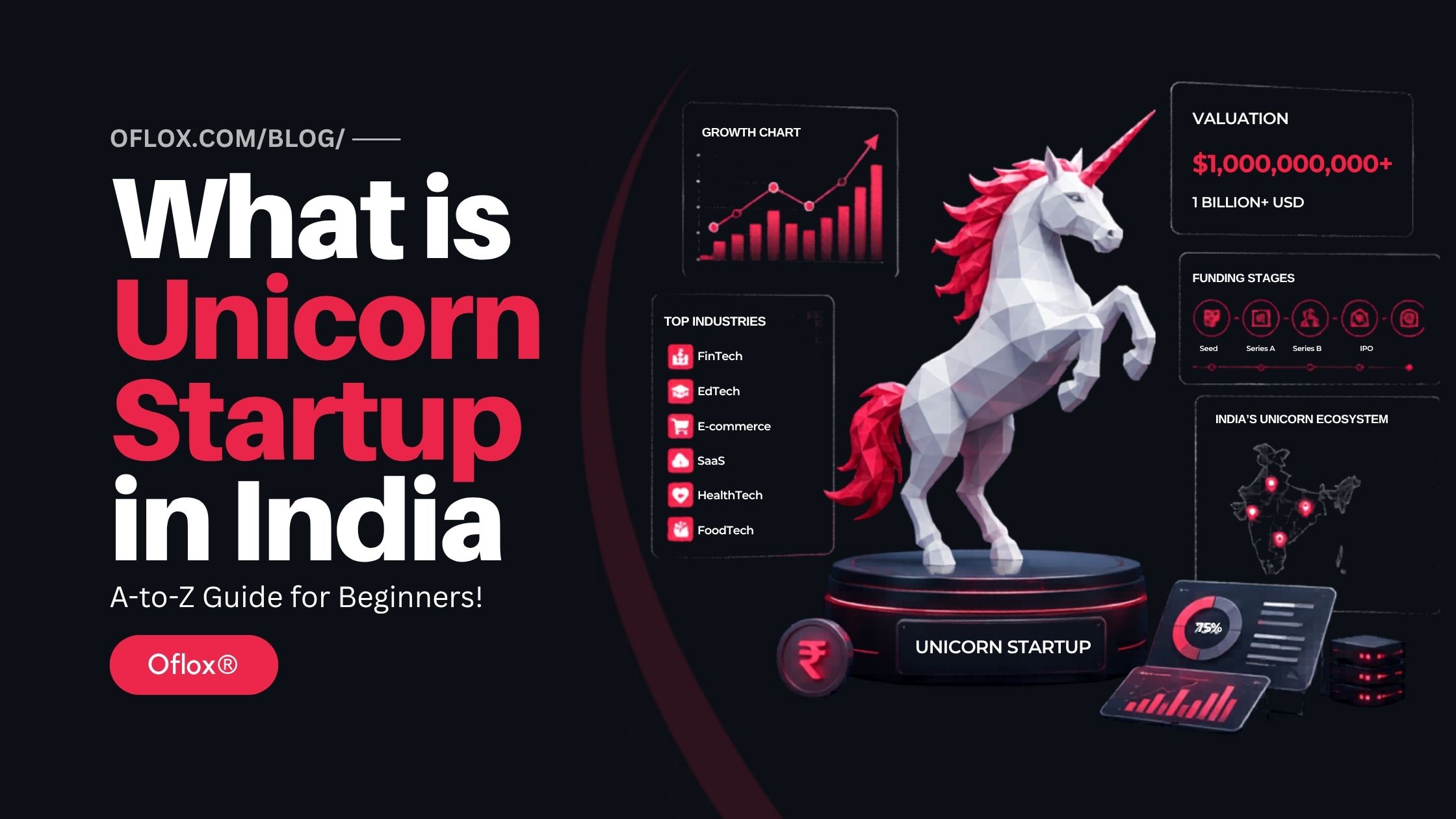
In this detailed guide, you will learn the meaning of unicorn startups, how startups become unicorns, startup valuation, funding, government support, benefits, challenges, future trends, and much more in very simpally.
Let’s explore it together!
Table of Contents
What is a Unicorn Startup?
A unicorn startup is a privately owned startup company whose valuation crosses $1 billion before becoming publicly listed on the stock market.
The term “Unicorn” was introduced because billion-dollar startups were once considered extremely rare — just like a mythical unicorn.
Today, unicorn startups are becoming more common due to:
- Digital transformation
- Internet growth
- AI and automation
- Mobile apps
- Online payments
- Cloud technology
- Investor interest
A unicorn startup is a startup company valued at over $1 billion while still privately owned.
History of Unicorn Startups
The history of unicorn startups explains how innovative startups evolved into billion-dollar companies through technology, funding, and rapid business growth.
1. Global History
The term “Unicorn Startup” was first used in 2013 by venture capitalist Aileen Lee.
At that time, billion-dollar startups were very rare.
Companies like:
- Uber
- Airbnb
became early examples of unicorn startups.
2. Unicorn Startup Growth in India
India’s startup ecosystem started growing rapidly after:
- Affordable internet
- Smartphone revolution
- Digital India initiative
- UPI payments
- Startup funding boom
After 2020, India saw massive growth in unicorn startups.
India is now among the top startup ecosystems globally.
3. Unicorn Startup Ecosystem in India
India has become one of the world’s largest startup ecosystems.
Major Startup Hubs in India:
| City | Popular For |
|---|---|
| Bengaluru | Tech & SaaS startups |
| Mumbai | Fintech & business |
| Delhi | E-commerce & services |
| Hyderabad | AI & software |
| Pune | IT & innovation |
Why India is Producing More Unicorns
India is producing more unicorn startups because of its growing digital economy, large internet user base, strong investor support, affordable technology access, and rapidly expanding startup ecosystem.
- Large Population: India has a huge customer base.
- Digital Adoption: People use smartphones, apps, and digital payments daily.
- Investor Interest: Foreign and Indian investors actively invest in startups.
- Government Support: Startup India and Digital India programs help entrepreneurs.
- Young Entrepreneurs: India has a strong youth-driven innovation culture.
Key Features of Unicorn Startups
Unicorn startups share several important features such as rapid growth, billion-dollar valuation, innovation, scalability, strong investor backing, and technology-driven business models.
- High Valuation: Their business value exceeds $1 billion.
- Rapid Growth: They grow much faster than traditional businesses.
- Technology Driven: Most unicorn startups use AI, Cloud computing, Mobile apps, Data analytics, and Automation.
- Strong Investor Support: They attract venture capital funding.
- Scalable Business Model: Their business can expand quickly.
- Innovation Focus: They solve real-world problems creatively.
Difference Between Startup and Unicorn Startup
Although both are business ventures, unicorn startups differ from normal startups in terms of valuation, market size, funding, growth speed, and overall business impact.
| Feature | Startup | Unicorn Startup |
|---|---|---|
| Valuation | Low or medium | Over $1 Billion |
| Growth | Early-stage | Rapid scaling |
| Funding | Limited | Massive funding |
| Brand Recognition | Small | Global recognition |
| Revenue Potential | Developing | Very high |
| Market Presence | Local/Regional | National/Global |
How Startups Become Unicorns (Step-by-Step)
Here is a detailed step-by-step explanation of how startups become unicorns:
1. Identify a Real Problem
The foundation of every successful unicorn startup is solving a real customer problem. Startups that focus on practical problems usually grow faster because people actively need their solutions.
Instead of creating random products, successful founders study customer pain points carefully. They observe what people struggle with in daily life and then create solutions that make life easier, faster, or cheaper.
Common Problems Solved by Unicorn Startups:
| Problem | Startup Solution |
|---|---|
| Difficulty sending money online | Digital payment apps |
| Slow food ordering process | Food delivery platforms |
| Lack of affordable transport | Cab booking apps |
| Limited access to education | Online learning platforms |
| Complex online business payments | FinTech payment gateways |
Real Examples from India:
- Paytm simplified digital payments.
- Zomato solved restaurant discovery and food delivery issues.
- Ola improved urban transportation.
- BYJU’S made online learning accessible.
Why This Step is this step important?
If a startup solves a genuine problem:
- Customers trust the product faster
- Word-of-mouth marketing increases
- Investors become interested
- Market demand grows naturally
2. Build a Unique Solution
After identifying a problem, startups must create a unique and effective solution. This is where innovation becomes important.
A unicorn startup usually offers:
- Better user experience
- Faster service
- Lower cost
- Advanced technology
- Greater convenience
The goal is not just to copy competitors but to improve the customer experience significantly.
What Makes a Startup Solution Unique?
- Simplicity: Easy-to-use products attract more users.
- Technology: Using AI, automation, or cloud systems improves efficiency.
- Speed: Faster services increase customer satisfaction.
- Convenience: Customers prefer platforms that save time and effort.
Important Tip:
A startup does not always need a completely new idea. Sometimes, improving an existing service can also create a billion-dollar business.
3. Validate the Idea
Before investing large amounts of money, startups test their ideas in the real market. This process is called idea validation.
Many startups fail because founders assume customers will automatically love their product without testing it.
Successful startups’ first launch:
- MVPs (Minimum Viable Products)
- Beta versions
- Trial services
- Limited market launches
What is MVP?
An MVP is the simplest version of a product with basic features.
It helps startups:
- Test customer interest
- Collect feedback
- Improve the product
- Reduce business risk
How Startups Validate Ideas?
| Validation Method | Purpose |
|---|---|
| Surveys | Understand customer needs |
| Beta testing | Test product performance |
| User interviews | Collect feedback |
| Trial launch | Measure demand |
| Analytics tracking | Monitor user behavior |
Why Validation Matters?
Validation helps startups:
- Avoid wasting money
- Improve products early
- Understand customer expectations
- Build better business strategies
4. Build a Strong Team
No startup becomes a unicorn with only one person. Behind every successful startup is a strong and skilled team.
A good startup team usually includes:
- Founders
- Developers
- Designers
- Marketing experts
- Financial advisors
- Operations managers
Why Team Building is Important?
A skilled team helps:
- Improve innovation
- Solve technical issues
- Scale operations faster
- Handle business challenges
- Maintain company growth
Key Qualities of Strong Startup Teams:
- Shared Vision: Everyone should believe in the startup mission.
- Problem-Solving Skills: Challenges appear daily in startup life.
- Adaptability: Startups change rapidly.
- Technical Knowledge: Technology-driven startups need strong technical expertise.
Real Example:
Flipkart grew successfully because of strong leadership, operational planning, and technological innovation.
5. Secure Funding
Once a startup gains customer traction and shows growth potential, the next step is raising funds.
Scaling a startup requires money for:
- Hiring employees
- Product development
- Marketing
- Technology infrastructure
- Expansion
Common Startup Funding Sources:
| Funding Type | Description |
|---|---|
| Bootstrapping | Self-funding by founders |
| Angel Investors | Early-stage private investors |
| Venture Capital | Large startup investment firms |
| Startup Incubators | Mentorship and funding support |
| Government Schemes | Startup grants and programs |
Angel Investors:
Angel investors invest in early-stage startups with high potential.
They often provide:
- Capital
- Mentorship
- Business connections
Venture Capitalists (VCs):
VC firms invest large amounts into startups that show rapid growth potential.
They help startups:
- Scale quickly
- Enter new markets
- Hire talent
- Improve infrastructure
Startup Incubators & Accelerators:
Programs like:
- Startup India
- NASSCOM
- T-Hub
support startups through:
- Mentorship
- Networking
- Funding access
- Office support
6. Scale Rapidly
Scaling means growing the business quickly without losing quality or efficiency.
This is one of the most critical stages for becoming a unicorn startup.
How Startups Scale:
- Expand to New Cities: Startups increase customer reach geographically.
- Improve Technology: Better infrastructure supports more users.
- Increase Marketing: Brand awareness drives growth.
- Hire More Employees: Larger operations require bigger teams.
- Enter Global Markets: Some Indian startups expand internationally.
Challenges During Scaling:
| Challenge | Impact |
|---|---|
| Operational costs | Increase rapidly |
| Competition | Becomes stronger |
| Customer service | Harder to maintain |
| Technology load | Servers and systems face pressure |
Important Tip:
Scaling too fast without planning can damage a startup. Sustainable growth is more important than aggressive expansion.
7. Increase Valuation
As startups grow in users, revenue, market share, and technology strength, their valuation increases.
When the startup valuation crosses $1 billion, it officially becomes a unicorn startup.
Factors That Increase Startup Valuation:
- Revenue Growth: Higher revenue increases investor confidence.
- User Base: Millions of active users improve valuation.
- Brand Recognition: Popular brands attract higher investments.
- Market Opportunity: Large industries create bigger growth potential.
- Technology & Innovation: Advanced technology improves long-term value.
Understanding Startup Valuation
Startup valuation means estimating the total worth of a startup.
Factors Affecting Startup Valuation:
| Factor | Impact |
|---|---|
| Revenue | Higher revenue increases valuation |
| User Growth | More users attract investors |
| Market Size | Bigger markets increase potential |
| Technology | Unique innovation raises value |
| Team Strength | Strong leadership matters |
| Profitability | Investors prefer sustainable growth |
Funding Stages of Unicorn Startups
Most unicorn startups grow through multiple funding stages, where investors provide capital to help the company build products, expand operations, and scale rapidly.
- Bootstrapping: Founders use personal money.
- Angel Funding: Early investors provide capital.
- Seed Funding: Used for product development.
- Series A Funding: Helps scale operations.
- Series B & C Funding: Supports rapid expansion.
- IPO or Acquisition: Some unicorns eventually go public.
Top Indian Unicorn Startups
| Startup | Industry | Founded | Estimated Valuation |
|---|---|---|---|
| Flipkart | E-commerce | 2007 | Multi-billion |
| Paytm | Fintech | 2010 | Billion-dollar |
| BYJU’S | EdTech | 2011 | Billion-dollar |
| Ola | Mobility | 2010 | Billion-dollar |
| Razorpay | Fintech | 2014 | Billion-dollar |
| Zomato | FoodTech | 2008 | Billion-dollar |
| Swiggy | FoodTech | 2014 | Billion-dollar |
| Meesho | E-commerce | 2015 | Billion-dollar |
| CRED | Fintech | 2018 | Billion-dollar |
| Nykaa | Beauty & E-commerce | 2012 | Billion-dollar |
Industries Producing Unicorn Startups in India
Several fast-growing industries in India are actively producing unicorn startups by combining technology, innovation, and strong market demand.
- FinTech: Examples, Paytm, Razorpay, and CRED.
- EdTech: Examples BYJU’S and Unacademy.
- E-commerce: Examples, Flipkart and Meesho.
- SaaS: Examples Freshworks and Zoho.
- HealthTech: Examples, PharmEasy.
- Food Delivery: Examples Zomato and Swiggy.
Government Support for Startups in India
The Indian government supports startups through funding programs, tax benefits, incubation initiatives, and digital business policies that encourage entrepreneurship and innovation.
- Startup India: Provides: Tax benefits, Funding support, and recognition certificates
- Digital India: Encourages digital transformation.
- SIDBI Support: Provides startup financing.
- Incubation Programs: Many universities and organizations support startups.
Important Startup Terms You Should Know
| Term | Meaning |
|---|---|
| Startup | New business company |
| Unicorn | Startup valued over $1B |
| Decacorn | Startup valued over $10B |
| IPO | Public stock market launch |
| Venture Capital | Investment in startups |
| Bootstrapping | Self-funding |
| Scalability | Ability to grow rapidly |
Future Trends of Unicorn Startups (2026 & Beyond)
The future of unicorn startups in India looks highly promising, with emerging technologies like AI, SaaS, fintech, automation, and green innovation expected to drive the next wave of billion-dollar companies.
- AI-Powered Startups: Artificial Intelligence startups will grow rapidly.
- Green Startups: Eco-friendly businesses will attract funding.
- DeepTech Growth: Advanced technologies like robotics and AI will dominate.
- Rural Digital Startups: Rural-focused digital platforms will expand.
- SaaS Expansion: Indian SaaS companies will become global leaders.
Tools Used by Unicorn Startups
Unicorn startups use advanced tools for communication, project management, marketing, analytics, automation, and product development to scale their businesses efficiently.
1. Productivity Tools:
| Tool | Use |
|---|---|
| Notion | Team management |
| Slack | Communication |
| Trello | Task management |
2. Marketing Tools
| Tool | Use |
|---|---|
| HubSpot | CRM & marketing |
| SEMrush | SEO research |
| Ahrefs | Backlink analysis |
3. Design & Development Tools
| Tool | Use |
|---|---|
| Figma | UI/UX design |
| GitHub | Code management |
| Jira | Development workflow |
Pros & Cons of Unicorn Startups
Unicorn startups offer massive growth opportunities and innovation potential, but they also face challenges such as high competition, funding pressure, and profitability risks.
Pros
- Economic Growth: They contribute to GDP growth.
- Job Creation: Thousands of jobs are generated.
- Innovation: They encourage new technologies.
- Global Recognition: India gains global startup recognition.
- Investor Confidence: More unicorns attract more investments.
Cons
- High Competition: The startup market is extremely competitive.
- Profitability Issues: Some unicorns struggle to generate profits.
- Funding Pressure: Investors expect fast growth.
- Regulatory Challenges: Government regulations can impact growth.
- Market Saturation: Too many similar startups reduce uniqueness.
Expert Tips Before Building a Unicorn Startup
Building a unicorn startup requires smart planning, market understanding, innovation, strong execution, and long-term business vision from the very beginning.
- Focus on Real Problems: Do not build products nobody needs.
- Validate Before Scaling: Test your idea before spending heavily.
- Build Strong Branding: Brand trust matters.
- Understand Customers Deeply: Customer satisfaction drives growth.
- Use Technology Smartly: Automation and AI improve scalability.
- Monitor Cash Flow Carefully: Poor financial management kills startups.
Common Mistakes Startups Should Avoid
Many startups fail because of common mistakes like poor planning, weak market research, overspending, ignoring customer feedback, and scaling too quickly without strategy.
- Ignoring Market Research: Never build blindly.
- Scaling Too Fast: Rapid expansion without stability is risky.
- Weak Team Building: A poor team slows growth.
- Ignoring Customer Feedback: Customer insights improve products.
- Poor Financial Planning: Cash flow management is essential.
Real-World Lessons from Indian Unicorns
Indian unicorn startups provide valuable real-world lessons about innovation, scalability, customer focus, funding strategies, and building successful businesses in competitive markets.
- Flipkart: Focused on solving e-commerce trust issues.
- Paytm: Benefited massively from India’s digital payment boom.
- Razorpay: Simplified online payment solutions for businesses.
- Zomato: Used customer convenience and technology effectively.
FAQs:)
A. A startup valued at over $1 billion.
A. Because billion-dollar startups were once considered very rare.
A. Flipkart is one of India’s most famous unicorn startups.
A. Yes, if they solve real problems and scale effectively.
A. FinTech and SaaS industries produce many unicorns.
A. Not always. Some unicorns focus on growth before profits.
A. A startup valued above $10 billion.
A. Through angel investors, venture capitalists, and institutional investors.
A. It is the estimated financial worth of a startup.
A. Yes, through Startup India and related schemes.
Conclusion:)
Unicorn startups have completely transformed India’s business ecosystem. They are not just billion-dollar companies — they are symbols of innovation, technology, entrepreneurship, and digital transformation. From fintech and SaaS to e-commerce and AI, Indian startups are creating global impact and inspiring the next generation of entrepreneurs.
If you want to build a successful startup, focus on solving real problems, understanding your customers, improving your product continuously, and scaling smartly. The journey to becoming a unicorn startup is difficult, but with the right vision, technology, strategy, and consistency, it is possible.
“Big unicorn startups are not built overnight — they are built through innovation, consistency, and solving real-world problems.” – Mr Rahman, CEO Oflox®
Read also:)
- What is Startup Valuation: A-to-Z Guide for Beginners!
- What is a Startup Incubator: A-to-Z Guide for Beginners!
- What is Exit Strategy in Startup: A-to-Z Guide for Beginners!
Have you tried building or planning a startup idea in India? Share your experience or ask your questions in the comments below — we’d love to hear from you!