This article provides a complete guide on When Was the First AI Robot Made, including the history of Shakey, its development timeline, creators, working process, key features, technologies, limitations, historical importance, and contribution to modern AI-powered robotics.
The first widely recognised AI robot was Shakey, developed at the Stanford Research Institute (SRI) between 1966 and 1972. It was the first mobile robot capable of perceiving its surroundings, reasoning about its actions, planning routes, and completing basic tasks without receiving step-by-step human instructions.
From navigating through specially designed rooms and identifying obstacles to planning its own actions, Shakey introduced several revolutionary ideas that later influenced computer vision, autonomous navigation, warehouse robots, planetary rovers, and self-driving vehicles.
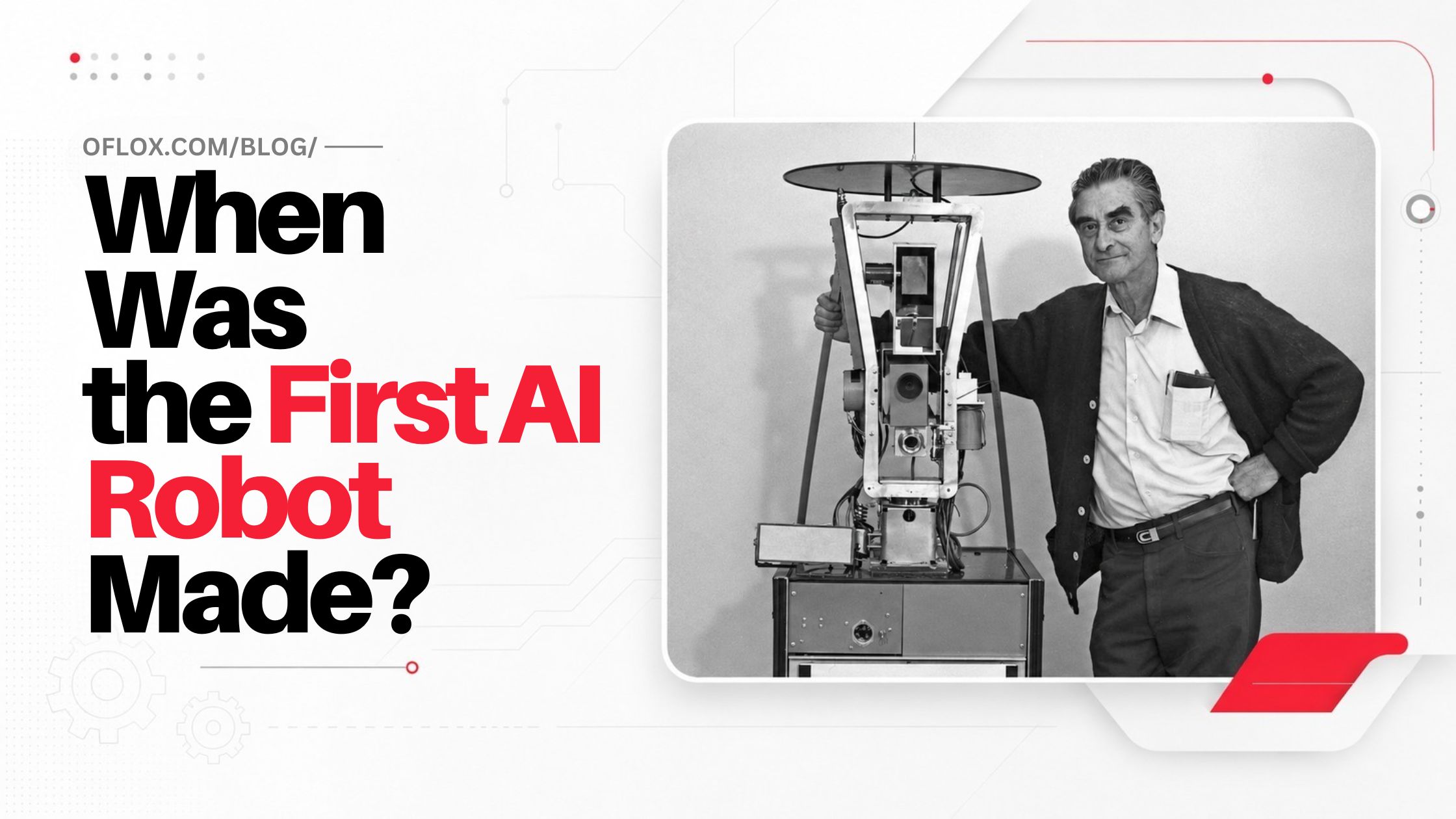
In this detailed article, we’ll explore when the first AI robot was made, who developed it, how Shakey worked, why it became an important milestone, and how it shaped the future of artificial intelligence and robotics.
Let’s explore it together.
Table of Contents
When Was the First AI Robot Made?
The first widely recognised AI-powered mobile robot, Shakey the Robot, was developed beginning in 1966 at the Stanford Research Institute in California. The project continued from 1966 to 1972, and the first fully integrated Shakey robot system was completed in 1969. Shakey was the first mobile robot capable of perceiving its surroundings, reasoning about its actions, planning routes, and completing tasks without receiving step-by-step instructions.
SRI International describes Shakey as the first mobile robot able to perceive and reason about its surroundings. The Computer History Museum similarly identifies it as the first mobile robot that could reason about its actions.
| Question | Short answer |
|---|---|
| What was the first AI robot? | Shakey the Robot |
| When did its development begin? | 1966 |
| When was the first integrated system completed? | 1969 |
| How long did the project continue? | 1966–1972 |
| Where was it developed? | Stanford Research Institute, California |
| Who led the project? | Charles Rosen and an SRI research team |
| Why was it important? | It combined perception, reasoning, planning and physical movement |
| Was Shakey humanoid? | No, it was a tall wheeled mobile robot |
What Is an AI Robot?
An AI robot is a physical machine that uses artificial intelligence to understand information, make decisions, plan actions, or adapt its behaviour.
A traditional automated machine normally performs a fixed sequence of instructions. If its surroundings or task changes, the machine may be unable to continue without being reprogrammed.
An AI robot can use information from cameras, microphones, distance sensors, touch sensors, or other devices to decide what action should be performed next.
In simple words:
A robot becomes an AI robot when it can use sensory information and intelligent software to make at least some decisions instead of depending entirely on direct human control.
An AI robot generally combines three major areas:
- Robotics: The physical structure, motors, wheels, arms and sensors.
- Artificial intelligence: Software for reasoning, planning, learning or decision-making.
- Control systems: Technology that converts software decisions into physical actions.
Modern AI robots may also use machine learning, deep learning, natural language processing, computer vision, generative AI and reinforcement learning.
However, these modern technologies were not available when Shakey was created. Shakey mainly depended on symbolic AI, logical rules and search-based planning.
Was Shakey Really the First Robot?
No. Shakey was not the first machine or robot ever created.
It is more accurate to call Shakey the first mobile, general-purpose robot that embodied artificial intelligence and could reason about its actions.
Several important robotic developments occurred before Shakey:
| Year | Machine or development | Historical importance |
|---|---|---|
| 1921 | The word “robot” appeared in R.U.R. | Popularised the term “robot” |
| 1939 | Elektro was displayed publicly | Early humanoid-style exhibition robot |
| 1954 | George Devol patented a programmable robotic arm | Foundation of industrial robotics |
| 1961 | Unimate entered factory service | First industrial robot used in production |
| 1966 | Work on Shakey began | First major AI-powered mobile robot project |
| 1969 | First integrated Shakey system completed | Connected perception, planning and movement |
| 1970 | Shakey received major public attention | Demonstrated intelligent robotics to the world |
The difference is important:
- Unimate was the first industrial robot.
- Elektro was an early exhibition robot.
- Shakey was the first widely recognised mobile AI robot capable of reasoning about its actions.
Therefore, the answer depends on what the word “first” means.
Historical Background of AI Robotics
The development of Shakey did not happen suddenly. It emerged from decades of progress in machines, computing, artificial intelligence and automation.
1. The Term “Robot” Appeared in 1921
The word “robot” became famous through the science-fiction play R.U.R. — Rossum’s Universal Robots, written by Czech playwright Karel Čapek.
The play premiered in 1921. Its artificial workers were closer to manufactured biological beings than today’s metal robots, but the word became part of popular culture.
The term originated from the Czech word robota, associated with forced labour or compulsory work.
This event introduced the idea of artificial workers, but it did not produce an AI-powered robot.
2. Early Mechanical and Exhibition Robots
During the 1920s and 1930s, inventors demonstrated machines that could move, speak recorded words or respond to simple commands.
One famous example was Elektro, a large humanoid-style robot displayed at the 1939 New York World’s Fair. It could walk, move its arms and produce speech using electrical and mechanical systems.
Elektro looked impressive, but it did not independently understand its environment or make intelligent plans. Its behaviour was pre-programmed and controlled.
3. The Birth of Artificial Intelligence
Artificial intelligence emerged as a formal academic field during the 1950s.
In 1950, British mathematician Alan Turing published an influential paper asking whether machines could think. He also proposed what later became known as the Turing Test.
The term artificial intelligence was coined by computer scientist John McCarthy in a 1955 proposal for the Dartmouth Summer Research Project. The workshop was held in 1956 and is widely considered the formal beginning of AI as a research field.
Early AI researchers developed computer programs that could:
- Solve mathematical problems
- Prove logical statements
- Play simple games
- Search through possible solutions
- Represent knowledge using symbols
- Make rule-based decisions
However, these programs were mainly software systems. They did not have physical bodies or move through the real world.
4. The First Industrial Robot
In 1954, American inventor George Devol filed a patent for a programmable mechanical arm. He later worked with entrepreneur Joseph Engelberger to commercialise industrial robotics.
Their machine, Unimate, was installed in a General Motors factory in 1961. It handled hot metal parts and performed repetitive work that could be dangerous for human workers.
Unimate was historically important, but it was not an AI robot in the modern sense. It followed programmed instructions within a controlled factory environment.
5. The Need for an Intelligent Mobile Robot
By the mid-1960s, researchers wanted to create a machine that could connect AI software with the physical world.
Such a robot would need to:
- See or sense its surroundings
- Represent objects and locations
- Understand instructions
- Plan a sequence of actions
- Move without continuous control
- Identify errors and adjust its plan
This ambitious goal became the foundation of the Shakey project.
Who Made the First AI Robot?
Shakey was developed by a research team at the Artificial Intelligence Center of the Stanford Research Institute, commonly called SRI.
SRI was connected historically with Stanford University but operated as an independent research organisation. It is now known as SRI International.
The project was led by Charles Rosen, a computer scientist and pioneer in machine intelligence. Important researchers associated with the project included:
- Nils J. Nilsson
- Bertram Raphael
- Peter Hart
- Richard Duda
- Richard Fikes
- Richard Waldinger
- Thomas Garvey
- Other engineers and computer scientists at SRI
It would therefore be inaccurate to credit Shakey to only one inventor. Charles Rosen led the programme, but the robot resulted from multidisciplinary teamwork.
The project received support from the United States Advanced Research Projects Agency, commonly known as ARPA and later DARPA.
Why Was the Robot Named Shakey?
The robot was named Shakey because its tall, top-heavy structure visibly shook or wobbled while moving.
Its appearance was very different from the smooth humanoid robots shown in modern technology demonstrations.
Shakey looked like a tall rectangular tower mounted on wheels. It contained cameras, sensors, electronic equipment and a radio communication system.
The simple name made the robot memorable and reflected a real feature of its physical movement.
When Exactly Was Shakey Completed?
Different sources sometimes mention 1966, 1969 or 1970. These dates describe different stages of the same project.
- 1966: Development Began: Work on the Shakey project began in 1966. This is the date commonly used when answering when the first AI robot was made.
- 1969: First Integrated System Was Completed: According to a historical SRI technical account preserved by Stanford, the first integrated robot system was completed in 1969. It included a mobile vehicle, television camera, sensors and radio-based computer control. This is a more precise answer if “made” means the completion of an operational integrated system.
- 1970: Public Recognition Increased: Shakey gained wider media and public attention around 1970. Life magazine famously described it as the “first electronic person,” although this was a media description rather than a technical definition.
- 1972: The Research Project Ended: Development and experimentation continued until 1972. During this period, the researchers improved Shakey’s software, planning abilities and computing system.
Therefore, the most accurate explanation is:
Shakey’s development began in 1966, its first fully integrated system was completed in 1969, it became publicly famous around 1970, and research continued until 1972.
How Did the First AI Robot Work?
Shakey worked through a repeating process of perception, representation, planning and action.
Although modern robots can perform similar processes in seconds or milliseconds, Shakey needed much more time because computers in the 1960s had extremely limited processing power.
1. Receive a Command
A researcher gave Shakey a high-level instruction.
For example, the robot might be instructed to move to another room or push a block from a platform.
Older machines would need detailed commands such as:
- Move forward
- Turn left
- Continue for a particular distance
- Stop
- Turn right
- Push the object
Shakey could receive a broader goal and determine many of the intermediate actions itself.
2. Observe the Environment
Shakey used a television camera and other sensors to collect information about the surrounding rooms.
Its sensors included:
- A TV camera
- Bump detectors
- Range-measuring equipment
- Wheel-control mechanisms
- Radio communication equipment
The environment was deliberately simplified. Rooms contained walls, doors, platforms, ramps and blocks with easily identifiable shapes.
3. Send Information to External Computers
Shakey did not carry the full computing system needed for its reasoning.
Sensor data was transmitted through a radio link to large external computers. Those computers processed the information and sent movement commands back to the robot.
This arrangement was necessary because computers were too large and heavy to fit conveniently inside a mobile robot.
4. Build a Representation
The software transformed sensory data into a simplified internal representation of the environment.
The system attempted to identify:
- Rooms
- Doorways
- Walls
- Obstacles
- Platforms
- Blocks
- Possible routes
This was an early form of robotic world modelling.
5. Plan the Actions
Shakey used AI planning software to determine how to reach the requested goal.
Instead of considering only the next movement, the system could create a sequence of actions.
For example:
- Leave the current room.
- Move through a doorway.
- Navigate around an obstacle.
- Find a ramp.
- Push the ramp towards a platform.
- Move up the ramp.
- Push a block.
This ability separated Shakey from fixed automated machines.
6. Execute the Plan
The external computer sent movement instructions to the robot.
Shakey then moved, turned or pushed an object as required. Its movement was slow, partly because sensing and computation required significant time.
7. Check the Result
The robot observed the environment again to determine whether the planned action had succeeded.
If the situation did not match the expected result, the software could update the plan or attempt a different action.
This perception–planning–action cycle remains fundamental in modern autonomous robotics.
Important Technologies Developed Through Shakey
Shakey was more than a single machine. The project produced or advanced several ideas that influenced artificial intelligence and computer science.
1. STRIPS Planning System
One of the best-known outcomes was STRIPS, or Stanford Research Institute Problem Solver.
STRIPS represented:
- The current condition of the world
- The goal the robot needed to achieve
- Actions available to the robot
- Conditions required before an action
- Changes created after an action
The software searched for a valid sequence that could transform the current situation into the desired situation.
Modern automated planning systems still use concepts influenced by this approach.
2. A* Search Algorithm
Researchers Peter Hart, Nils Nilsson and Bertram Raphael developed the A* search algorithm during the wider research environment associated with SRI.
A* helps find an efficient path between a starting point and a goal. It considers the known cost of the journey and an estimate of the remaining distance.
The algorithm later became extremely influential in:
- Robot navigation
- Video game pathfinding
- Route-planning systems
- Logistics software
- Mapping applications
- Autonomous vehicles
3. Computer Vision
Shakey needed to interpret images from its camera. This encouraged advances in extracting useful information from visual data.
Its vision was primitive compared with modern AI, but it showed that a mobile robot could use a camera to understand elements of its physical surroundings.
4. Natural Language Processing
Shakey could process limited instructions expressed in simple English.
It did not conduct open-ended conversations like modern AI assistants. However, its ability to translate a high-level instruction into planned physical actions was remarkable for the period.
5. Autonomous Navigation
Shakey could select routes and move between locations without a human manually controlling every step.
This capability contributed to ideas later used in:
- Self-driving cars
- Warehouse robots
- Planetary rovers
- Delivery robots
- Robotic vacuum cleaners
- Military and rescue robots
Main Features of Shakey the Robot
Shakey had several features that made it historically different from earlier machines.
| Feature | What it allowed Shakey to do |
|---|---|
| Mobile wheeled base | Travel between rooms |
| Television camera | Capture visual information |
| Range sensing | Estimate distance from objects |
| Bump sensors | Detect physical contact |
| Radio connection | Communicate with external computers |
| World modelling | Represent rooms, doors and objects |
| Logical reasoning | Decide what actions were required |
| AI planning | Break a goal into smaller steps |
| Route finding | Select a path towards a destination |
| Error recovery | Respond when execution differed from the plan |
| Simple language processing | Interpret limited high-level commands |
These features may appear basic today, but combining them into one system was revolutionary in the 1960s.
Why Was the First AI Robot Important?
Shakey proved that AI did not have to remain inside a computer.
It showed that software reasoning could be connected with sensors and motors to affect the physical world.
1. It Connected Thinking and Action
Earlier AI programs solved puzzles or logical problems in controlled digital environments. Shakey connected artificial reasoning with real movement.
This required the system to handle imperfect sensory information, obstacles, changing positions and physical errors.
2. It Introduced Goal-Based Robotic Behaviour
Shakey could receive a goal rather than a complete list of movements.
This concept is central to autonomous systems. A modern robot may be told what outcome is required and then calculate how to achieve it.
3. It Advanced Multiple Fields
The project influenced:
- Artificial intelligence
- Mobile robotics
- Computer vision
- Automated planning
- Natural language processing
- Pathfinding
- Knowledge representation
- Autonomous navigation
4. It Inspired Future Technologies
Shakey’s influence can be recognised in modern systems that sense, reason and act.
The Computer History Museum describes it as an important predecessor to intelligent navigation technologies. It is sometimes informally called a “grandfather” of autonomous vehicles.
5. It Demonstrated the Difficulty of Real-World AI
A task that appears easy for a human can be extremely difficult for a robot.
Moving from one room to another requires the robot to recognise walls, locate doors, calculate distance, avoid collisions, control its wheels and monitor the result.
Shakey made researchers more aware of these challenges.
Benefits of AI Robots
The practical benefits of AI robots have expanded considerably since the Shakey project.
1. Improved Workplace Safety
AI robots can perform work in dangerous locations, such as:
- Burning buildings
- Nuclear facilities
- Deep-sea environments
- Mines
- Disaster zones
- Space
- Areas containing harmful chemicals
This can reduce direct human exposure to serious hazards.
2. Better Accuracy and Consistency
Robots can repeat carefully defined tasks with consistent precision. AI can help them recognise variations and adjust their actions.
This is particularly useful in manufacturing, electronics, healthcare and quality inspection.
3. Continuous Operation
Robots can work for long periods with scheduled maintenance and charging. This makes them valuable in warehouses, factories and monitoring systems.
4. Support for Healthcare
AI-assisted robots can help with surgery, rehabilitation, hospital logistics, patient monitoring and medicine delivery.
Human medical judgement remains essential, but robotics can improve precision and operational efficiency.
5. Faster Logistics
Modern warehouse robots can locate products, transport shelves, optimise routes and support order fulfilment.
6. Greater Accessibility
Robotic technologies may help people with disabilities through:
- Intelligent wheelchairs
- Robotic prosthetics
- Mobility assistance
- Home-support robots
- Voice-controlled physical systems
7. Exploration of Difficult Environments
Planetary rovers and underwater robots can collect information in places where sending humans would be costly or dangerous.
Challenges and Limitations of the First AI Robot
Shakey was revolutionary, but it had serious limitations.
1. Very Slow Operation
Shakey took a long time to analyse images, prepare plans and move. Some operations that a human could perform immediately required several minutes or longer.
Its slow speed reflected the limited computing power of the period.
2. Controlled Environment
The robot worked in specially prepared indoor spaces containing simple objects.
It could not navigate a crowded Indian street, recognise thousands of everyday objects or operate reliably in unpredictable weather.
3. Limited Visual Understanding
Shakey’s computer vision was designed for basic shapes, boundaries and controlled lighting. It could not understand complex scenes as modern deep-learning systems can.
4. Dependence on External Computers
The robot depended on large external computers connected through radio communication.
It was physically mobile, but its “intelligence” was not fully contained inside its body.
5. No Human-Level Intelligence
Shakey could reason only within a narrow task environment. It did not possess common sense, emotions, consciousness or general human intelligence.
6. High Cost and Complexity
The system required expensive equipment and a team of highly trained researchers.
It was a research platform, not a commercial household product.
Major Challenges in Modern AI Robotics
Many early limitations have been reduced, but modern AI robots still face important challenges.
1. Safety
A robot moving around people must avoid causing injury or damaging property.
Safety becomes especially important for:
- Self-driving vehicles
- Surgical robots
- Industrial collaborative robots
- Childcare and eldercare systems
- Humanoid robots
2. Reliability
An impressive laboratory demonstration does not always mean that a robot can operate reliably every day.
Real environments include dust, rain, poor lighting, moving objects, unusual situations and unexpected human behaviour.
3. Data and Bias
Machine-learning robots depend on training data. Incomplete or biased data can cause inaccurate decisions.
4. Privacy
Robots equipped with cameras and microphones may capture sensitive personal information.
Organisations must use responsible policies for consent, storage, processing and access.
5. Cybersecurity
A connected robot can become a cybersecurity risk. Attackers may attempt to steal information, interrupt operations or control the machine.
6. Cost
Advanced sensors, processors, actuators, batteries and safety systems remain expensive.
7. Employment Concerns
AI robotics can automate certain tasks and change job requirements. Businesses and governments need to support reskilling and responsible adoption.
8. Ethical Responsibility
If an autonomous system causes harm, responsibility may involve developers, manufacturers, operators, owners or organisations deploying it.
Clear governance and human oversight are therefore essential.
Shakey vs Modern AI Robots
| Capability | Shakey | Modern AI robot |
|---|---|---|
| Development period | 1966–1972 | Mainly 2000s–2020s |
| Processing | External large computers | Onboard chips plus cloud or edge systems |
| Vision | Basic shapes and structured rooms | Deep-learning object and scene recognition |
| Navigation | Slow, controlled indoor movement | Real-time mapping and obstacle avoidance |
| Language | Limited commands | Advanced speech and language models |
| Learning | Very limited | Machine learning and reinforcement learning |
| Speed | Extremely slow | Often real-time |
| Environment | Specially arranged rooms | Homes, roads, warehouses and public spaces |
| Physical form | Tall wheeled platform | Arms, drones, vehicles, quadrupeds and humanoids |
| Autonomy | Early goal-based autonomy | Increasingly complex autonomous behaviour |
Despite these differences, modern intelligent robots still follow the broad cycle Shakey demonstrated: sense, understand, plan, act and check.
Real-World Examples Influenced by Early AI Robotics
The foundational technologies introduced by early AI robots continue to influence many intelligent machines and autonomous systems used in the real world today.
- Self-Driving Vehicles: Autonomous vehicles use cameras, radar, lidar, maps and AI to understand roads and plan movement. The technology is far more advanced than Shakey, but both systems attempt to observe surroundings, choose a route and execute actions safely.
- Warehouse Robots: Warehouse robots move goods, carry shelves and select efficient paths while avoiding people and other machines. Their planning and navigation reflect concepts explored during early mobile robotics research.
- Robotic Vacuum Cleaners: A robotic vacuum senses obstacles, maps rooms, chooses routes and adjusts its movement. This is a simple consumer example of autonomous mobile robotics.
- Mars Rovers: Planetary rovers must navigate difficult terrain with limited real-time human control. They combine sensing, planning, movement and error handling.
- Delivery Robots: Small mobile robots are being tested for food, medicine and parcel delivery. They must recognise paths, avoid obstacles and respond to changing surroundings.
- Agricultural Robots: AI robots can identify weeds, monitor crops, spray targeted areas, harvest selected produce and analyse field conditions.
- Healthcare Robots: Hospitals use robots for surgical support, rehabilitation, transport and disinfection. AI can improve perception and decision support, although professional supervision remains necessary.
- Humanoid Robots: Modern humanoid robots aim to work in spaces designed for people. They may use computer vision, language models and advanced motor control to understand instructions and handle objects.
Tools & Technologies Used to Build AI Robots Today
Modern AI robotics relies on a combination of hardware and software.
| Tool or technology | Main purpose |
|---|---|
| ROS or ROS 2 | Robot communication and software development |
| Python | AI, automation and rapid prototyping |
| C++ | High-performance robotic control |
| OpenCV | Image and video processing |
| PyTorch | Machine-learning model development |
| TensorFlow | AI training and deployment |
| Gazebo | Robot simulation |
| NVIDIA Isaac | AI robotics simulation and development |
| MATLAB and Simulink | Modelling and control-system design |
| Lidar | Distance measurement and mapping |
| Cameras | Object and scene perception |
| IMU sensors | Orientation and motion measurement |
| GPS or GNSS | Outdoor location tracking |
| Edge processors | Local AI computation |
| Digital twins | Virtual testing of physical systems |
These tools allow developers to test robotic behaviour in simulation before deploying it on expensive physical hardware.
How an AI Robot Is Developed Step by Step
Developing an AI robot involves combining hardware, sensors, intelligent software, and control systems through a carefully planned step-by-step process.
- Define the Problem: Developers must decide what the robot should achieve. A warehouse robot, agricultural robot and hospital robot require completely different designs.
- Study the Operating Environment: The team identifies lighting conditions, surfaces, obstacles, people, weather and safety risks.
- Choose the Physical Structure: The robot may use Wheels, Tracks, Legs, Propellers, Robotic arms, Grippers, and Soft actuators.
- Select Sensors: Sensors provide information about the environment. Common choices include cameras, lidar, radar, microphones, force sensors and proximity detectors.
- Build the Control System: The control system manages motors, balance, steering, speed and physical movement.
- Develop the Perception Layer: AI software converts raw sensor data into useful information, such as the location of a person, object, road or obstacle.
- Add Planning and Decision-Making: The robot determines what it should do and how it should reach the goal.
- Train AI Models: When machine learning is used, models are trained on suitable data and evaluated for accuracy, fairness and reliability.
- Test in Simulation: Simulation allows developers to examine failures without damaging equipment or endangering people.
- Conduct Controlled Physical Testing: The robot is introduced into a carefully managed real environment.
- Add Safety and Human Oversight: Emergency stops, operating boundaries, permissions, monitoring and manual controls should be included.
- Deploy and Monitor: After deployment, developers monitor performance, investigate failures and release improvements.
Expert Tips for Understanding AI Robotics
Understanding AI robotics becomes easier when you focus on how robots sense their surroundings, process information, make decisions, and perform physical actions.
- Do not judge intelligence only by a robot’s appearance. A human-shaped robot may have limited autonomy, while a simple wheeled robot may use advanced AI.
- Separate automation from intelligence. A machine performing a complex fixed sequence is not necessarily making decisions.
- Check whether the robot can perceive, plan and adapt. These abilities provide stronger evidence of AI-based operation.
- Learn basic programming before purchasing expensive hardware. Python, mathematics, computer vision and control-system fundamentals provide a strong starting point.
- Begin with simulation. It is safer and more affordable than immediately building a physical robot.
- Use reliable historical sources. Terms such as “first robot” and “first AI robot” describe different achievements.
- Consider safety from the beginning. Safety should be part of the design rather than an addition made after development.
- Evaluate real-world performance. Controlled demonstrations may not represent performance in crowded or unpredictable settings.
Common Mistakes People Make About the First AI Robot
Many people misunderstand the history of the first AI robot because they confuse early automated machines, industrial robots, and genuinely intelligent robotic systems.
- Saying the First Robot Was Made in 1966: Robotic and automated machines existed earlier. The year 1966 marks the beginning of Shakey’s development, not the beginning of all robotics.
- Calling Unimate the First AI Robot: Unimate was the first industrial robot used in manufacturing. It followed programmed operations and did not have Shakey’s general perception-and-planning capabilities.
- Saying Shakey Was Completed on One Exact Date: Shakey was a research project developed over several years. Work began in 1966, the first integrated system was completed in 1969, and research continued until 1972.
- Assuming Shakey Looked Human: Shakey was not humanoid. It was a tall wheeled machine equipped with cameras, sensors and communication equipment.
- Believing Shakey Used Modern Machine Learning: Shakey mainly relied on symbolic AI, logical planning and search techniques. It did not use modern deep neural networks or generative AI.
- Claiming One Person Invented It Alone: Charles Rosen led the project, but Shakey was created by a multidisciplinary SRI team.
- Comparing Shakey Directly With ChatGPT: Shakey was an embodied robotic research system designed to perceive and act in a limited physical environment. ChatGPT is a language-based AI system. Their purposes and technologies are different.
Future Trends in AI Robotics: 2026 and Beyond
AI robotics is moving from specialised machines towards systems that can understand broader instructions and operate in less structured environments.
- Generative AI-Controlled Robots: Language models may allow users to give robots instructions in everyday language. Instead of programming every action, a person may describe the desired result and allow the robot to prepare a plan.
- Vision-Language-Action Models: New robotic models are being designed to connect visual understanding, language and physical actions. A robot may interpret a spoken instruction, identify relevant objects and select suitable movements within one integrated system.
- More Capable Humanoid Robots: Humanoid robots are being tested for warehouses, factories, research facilities and service environments. Their human-like form may help them use doors, stairs, shelves and tools designed for people. However, cost, reliability and safety remain major barriers.
- Smarter Collaborative Robots: Collaborative robots, or cobots, will increasingly work near human employees. Better sensing and adaptive control may allow these robots to handle more varied tasks while maintaining safe distances and force limits.
- Edge AI: More intelligence will operate directly on the robot instead of depending entirely on cloud servers. Edge AI can reduce delays, strengthen privacy and allow robots to continue working when internet connectivity is poor.
- Swarm Robotics: Groups of smaller robots may cooperate to perform agriculture, inspection, mapping, disaster response and environmental monitoring.
- Healthcare and Elder Support: AI robots may support mobility, rehabilitation, hospital logistics and routine home assistance. Human supervision, dignity, privacy and informed consent will remain essential.
- Sustainable Robotics: Developers will focus more on energy efficiency, recyclable materials, repairability and longer equipment life.
- Stronger Regulation: As autonomous robots enter public and professional spaces, governments and industry bodies are likely to develop stronger rules for safety, cybersecurity, transparency and accountability.
- Robots as Physical AI Agents: The next major evolution may involve AI agents that can not only recommend an action but also perform it through a physical machine.
This creates enormous opportunities, but it also increases the need for permissions, monitoring and human control.
FAQs:)
A. Development of the first widely recognised AI-powered mobile robot, Shakey, began in 1966. Its first integrated system was completed in 1969, and development continued until 1972.
A. It was called Shakey the Robot because its tall structure shook while moving.
A. Shakey was developed by a team at the Stanford Research Institute. Computer scientist Charles Rosen led the project, with major contributions from Nils Nilsson, Bertram Raphael, Peter Hart and other researchers.
A. It was developed at the Stanford Research Institute’s Artificial Intelligence Center in Menlo Park, California, United States.
A. No. Earlier mechanical, exhibition and industrial robots already existed. Shakey was the first widely recognised mobile robot capable of perceiving its surroundings and reasoning about its actions using AI.
A. Shakey could observe simple rooms, identify basic objects, plan routes, move between locations, push objects and complete limited tasks from high-level commands.
A. Shakey had early autonomous capabilities because it could plan and execute actions without receiving every movement as a separate command. However, it depended on external computers and operated in a controlled environment.
A. Unimate is generally recognised as the first industrial robot. It entered service at a General Motors factory in 1961.
A. Shakey primarily used symbolic artificial intelligence, logical reasoning, search algorithms and automated planning. It did not use modern deep-learning technology.
A. Shakey demonstrated the complete process of sensing, modelling, planning and acting. These ideas influenced autonomous vehicles, mobile robots, computer vision, pathfinding and intelligent planning.
A. Shakey is preserved by the Computer History Museum in Mountain View, California.
A. A robot is a physical machine capable of performing actions. An AI robot uses intelligent software to interpret information, make decisions, plan tasks or adapt its behaviour.
A. No. Shakey was a tall rectangular mobile platform mounted on wheels. It did not have a human-like face, hands or legs.
A. Normally, no. A chatbot is software. A robot usually has a physical body that can sense or act in the real world. A chatbot can become part of a robot when connected to physical hardware.
A. Modern robots can perform advanced perception, planning and learning within defined tasks. However, most do not possess human-level general intelligence or consciousness.
Conclusion:)
So, when was the first AI robot made?
The most accurate answer is that work on Shakey the Robot began in 1966 at the Stanford Research Institute. The first integrated version was completed in 1969, the robot gained major public recognition around 1970, and research continued until 1972.
Shakey was not the world’s first robot or the first industrial robot. Its real achievement was becoming the first widely recognised mobile robot that could perceive its environment, reason about its actions, prepare a plan and physically carry out that plan.
Its appearance was simple and its movement was extremely slow, but the ideas behind it were revolutionary. Modern autonomous vehicles, warehouse robots, planetary rovers, delivery systems and intelligent mobile machines continue to use the same fundamental cycle of perception, planning and action.
Shakey proved that artificial intelligence could leave the computer screen and interact with the physical world. That achievement made it one of the most important machines in the history of AI and robotics.
“The journey of intelligent robots began in 1966, when Shakey connected artificial intelligence with the physical world.” — Mr Rahman, Founder of Oflox®
Read also:)
- Who Invented the First Robot in 1921? Complete History of Robots!
- The 5 Best AI Visibility Tools in 2026 (Compare Top Platforms)
- When Was Artificial Intelligence Invented? Complete History of AI!
If you have any questions about the history of AI robots or modern robotics, feel free to share them in the comments below.