This article serves as a professional guide on What is Churn Rate in SaaS, including its meaning, formula, importance, strategies, tools, examples, and future trends.
In the modern SaaS industry, customer retention has become more important than customer acquisition. Many businesses spend huge amounts on ads and marketing to gain users, but if users leave quickly, the company may struggle to survive.
Churn rate is one of the most important metrics for SaaS companies because it directly affects revenue, growth, profitability, and long-term sustainability. Whether you run a startup, SaaS platform, AI tool, subscription business, or online service, understanding churn rate is extremely important.
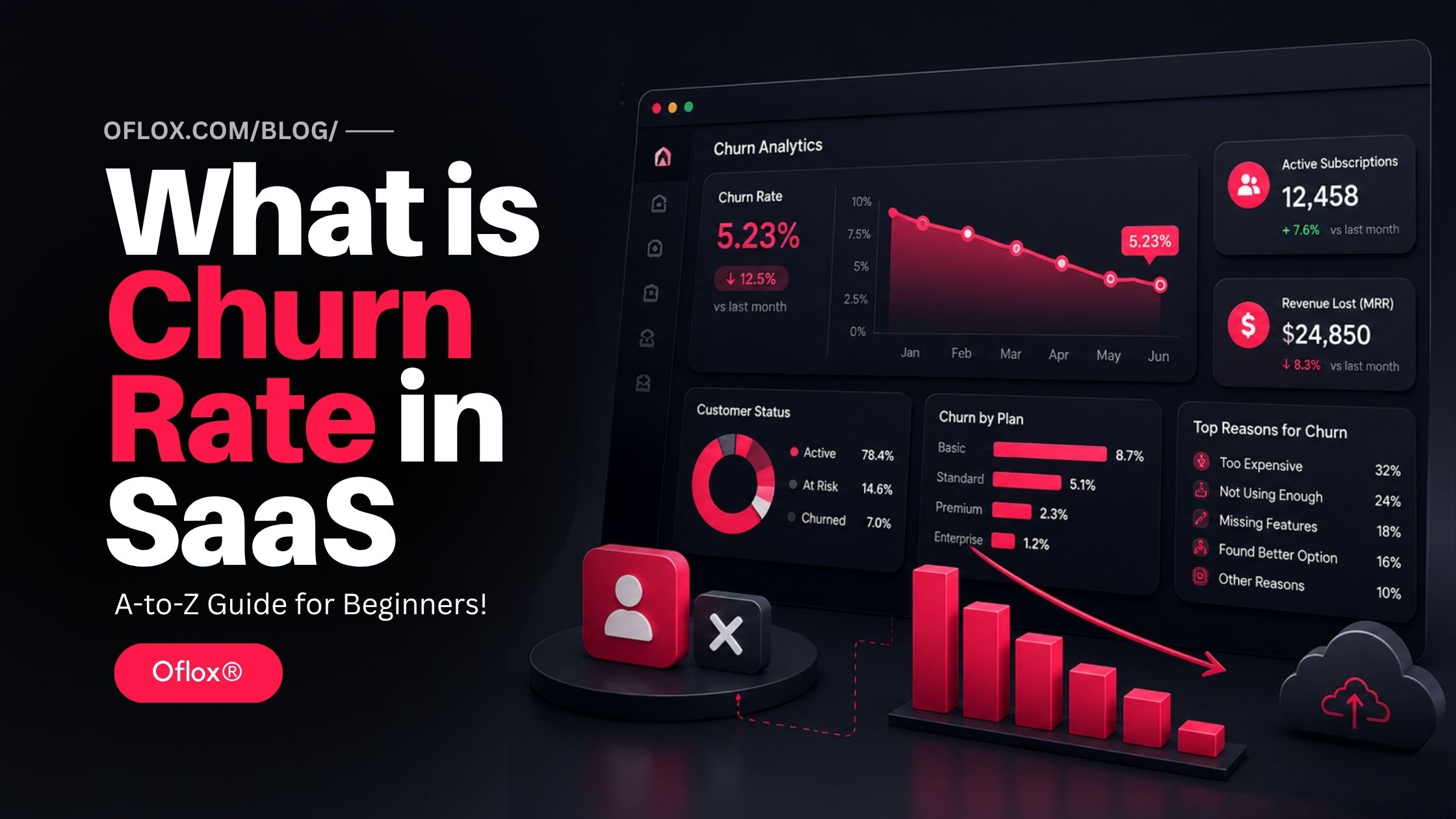
In this detailed guide, we will explore everything about SaaS churn rate in simplicity with practical examples, expert insights, and actionable strategies.
Let’s explore it together!
Table of Contents
What is Churn Rate in SaaS?
Churn rate in SaaS refers to the percentage of customers who stop using a software service during a specific period.
In simple words:
If users cancel their subscription, stop paying, or leave your platform, they become “churned customers.”
The churn rate helps businesses measure customer loss.
Simple Definition of SaaS Churn Rate
Churn Rate = Percentage of customers lost during a time period.
For example:
If a SaaS company starts the month with 1000 customers and loses 50 customers, the churn rate becomes:
\text{Churn Rate} = \frac{50}{1000} \times 100 = 5%
That means the company lost 5% of its customers.
History and Background of Churn Rate
The concept of churn originally came from telecom and banking industries where companies tracked customers leaving their services.
Later, SaaS businesses adopted churn analysis because subscription-based revenue models depend heavily on customer retention.
Today, churn rate has become one of the most important SaaS KPIs (Key Performance Indicators).
Modern SaaS companies like Salesforce, HubSpot, and Netflix constantly monitor churn to improve growth.
Why Churn Rate is Important in SaaS
Here are some major reasons why churn rate matters:
1. Measures Customer Satisfaction
A high churn rate may indicate:
- Poor customer experience
- Weak product quality
- Bad support
- Pricing issues
2. Impacts Revenue
SaaS businesses rely on recurring income.
If customers leave regularly, revenue decreases.
3. Affects Business Growth
Even if a company gets new users daily, high churn can slow overall growth.
4. Important for Investors
Investors check churn rate before funding SaaS startups.
Low churn indicates:
- Product-market fit
- Customer satisfaction
- Stable growth
5. Helps Improve Retention Strategy
Businesses use churn data to:
- Improve onboarding
- Add better features
- Increase support quality
- Personalize customer experience
Types of Churn Rate in SaaS
Here are the main types of churn:
| Type | Meaning |
|---|---|
| Customer Churn | Percentage of customers lost |
| Revenue Churn | Revenue lost from cancellations |
| Gross Churn | Total revenue lost |
| Net Churn | Revenue loss after upgrades |
| Voluntary Churn | Users intentionally cancel |
| Involuntary Churn | Failed payments or technical issues |
Customer Churn vs Revenue Churn
Customer Churn and Revenue Churn may sound similar, but both measure different aspects of SaaS business loss and growth.
1. Customer Churn
Tracks the number of customers leaving.
Example:
100 users lost out of 2000 users.
2. Revenue Churn
Tracks actual money lost.
Sometimes a company loses few users but loses huge revenue because enterprise customers leave.
How to Calculate Churn Rate
Here is the simple step-by-step process used by SaaS businesses to calculate churn rate and measure how many customers leave their platform during a specific period.
Basic Churn Formula:
\text{Churn Rate} = \frac{\text{Customers Lost During Period}}{\text{Total Customers at Start}} \times 100
Example of Churn Calculation
Suppose:
- Starting customers = 5000
- Lost customers = 250
Then:
\text{Churn Rate} = \frac{250}{5000} \times 100 = 5%
The churn rate is 5%.
What is a Good Churn Rate in SaaS?
There is no universal number, but generally:
| Churn Rate | Performance |
|---|---|
| Below 3% | Excellent |
| 3%–5% | Good |
| 5%–7% | Average |
| Above 7% | Risky |
Enterprise SaaS products usually have lower churn compared to consumer SaaS tools.
Common Reasons for High SaaS Churn
Here are some of the most common reasons why SaaS businesses experience high churn rates and lose customers over time.
- Poor Onboarding: If users do not understand the software quickly, they may leave.
- Bad User Experience: Complex UI can increase churn.
- Weak Customer Support: Slow support frustrates users.
- High Pricing: Expensive plans may cause cancellations.
- Strong Competition: Competitors may offer better features.
- Lack of Product Updates: Users expect innovation regularly.
- Technical Issues: Frequent bugs or downtime can increase churn.
How to Process to Reduce SaaS Churn
Here are the proven strategies and processes that help SaaS companies minimize customer cancellations and improve long-term retention.
1. Improve Customer Onboarding
Guide users properly.
Use:
- Tutorials
- Walkthroughs
- Product tours
- Knowledge bases
2. Analyze User Behavior
Track:
- Login frequency
- Feature usage
- Session duration
- Drop-off points
3. Provide Excellent Support
Offer:
- Live chat
- Email support
- Help center
- AI chatbot assistance
4. Collect Feedback
Use surveys to understand problems.
5. Offer Flexible Pricing
Provide:
- Free trial
- Discounts
- Monthly plans
- Custom enterprise plans
6. Improve Product Features
Continuously update your SaaS platform.
7. Build Customer Relationships
Engaged users stay longer.
Features of Good SaaS Retention Systems
Here are important retention features:
| Feature | Benefit |
|---|---|
| Email automation | Improves engagement |
| Personalized onboarding | Better activation |
| Usage analytics | Tracks behavior |
| Customer support | Solves issues quickly |
| AI recommendations | Improves user experience |
| Community support | Builds loyalty |
Benefits of Lower Churn Rate
A lower churn rate brings long-term growth, stable revenue, and stronger customer relationships for SaaS businesses.
- Higher Revenue Stability: Recurring revenue becomes predictable.
- Better Business Growth: Customer retention boosts long-term scaling.
- Increased Customer Lifetime Value (LTV): Retained users spend more over time.
- Lower Marketing Costs: Keeping users is cheaper than acquiring new ones.
- Stronger Brand Reputation: Satisfied customers promote your brand.
Real-World SaaS Churn Examples
Real-world SaaS churn examples help beginners understand the practical challenges and customer retention strategies used in the industry.
1. Streaming Platforms
Streaming platforms reduce churn by:
- Personalized recommendations
- Exclusive content
- Mobile accessibility
2. CRM Platforms
CRM companies reduce churn through:
- Dedicated support
- Training programs
- Automation tools
3. AI SaaS Platforms
AI platforms reduce churn using:
- Continuous model improvements
- Better speed
- More integrations
SaaS Churn Metrics Businesses Should Track
Let’s explore the essential SaaS churn metrics that help businesses make better retention and growth decisions.
- Customer Lifetime Value (CLV): Measures total revenue from one customer.
- Monthly Recurring Revenue (MRR): Tracks predictable revenue.
- Net Revenue Retention (NRR): Measures retained and expanded revenue.
- Customer Acquisition Cost (CAC): Measures marketing and acquisition expenses.
- Product Adoption Rate: Tracks feature usage.
5+ Best Tools for Churn Analysis in SaaS
Here are some of the best tools SaaS businesses use to analyze churn rate, track customer behavior, and improve retention strategies.
1. Mixpanel
Mixpanel is one of the most popular SaaS analytics tools used for tracking customer behavior and product engagement.
Useful for:
- User analytics
- Retention tracking
- Funnel analysis
- Feature usage monitoring
- Cohort analysis
- Customer journey tracking
Key Features:
- Real-time event tracking
- User segmentation
- Behavioral analytics dashboards
- AI-powered insights
- Retention reports
2. HubSpot
HubSpot is a powerful CRM and marketing automation platform widely used for improving customer engagement and reducing churn.
Helps with:
- Customer relationship management
- Email automation
- Lead nurturing
- User engagement
- Customer support workflows
Key Features:
- Automated email campaigns
- Customer lifecycle tracking
- Sales pipeline management
- Contact segmentation
- Customer support integration
3. Google Analytics
Google Analytics is one of the most widely used analytics tools for tracking website and SaaS platform user behavior.
Tracks:
- User behavior
- Traffic patterns
- Conversion rates
- Session duration
- Bounce rate
- User acquisition channels
Key Features:
- Real-time analytics
- Audience insights
- Event tracking
- Goal tracking
- Conversion analytics
4. Hotjar
Hotjar is a user behavior analytics tool that visually shows how users interact with a SaaS platform.
Useful for:
- Heatmaps
- Session recordings
- User feedback
- User behavior tracking
- UX analysis
Key Features:
- Click heatmaps
- Scroll tracking
- Visitor recordings
- Feedback widgets
- User surveys
5. Zendesk
Zendesk is a customer support and ticket management platform designed to improve customer satisfaction and retention.
Improves:
- Customer support workflows
- Ticket management
- Customer communication
- Help desk operations
Key Features:
- Live chat support
- AI chatbots
- Multi-channel support
- Knowledge base creation
- Automated ticket routing
6. Amplitude
Amplitude is an advanced product analytics platform designed specifically for digital products and SaaS applications.
Useful for:
- Product analytics
- User retention analysis
- Behavioral insights
- Customer segmentation
- Feature adoption tracking
Key Features:
- Predictive analytics
- Retention cohorts
- Journey analysis
- AI-powered recommendations
- Conversion tracking
Why SaaS Businesses Use It?
Amplitude helps SaaS companies predict churn risks early and optimize product engagement.
SaaS Churn Rate Formula Variations
Let’s explore the various churn rate formulas used in SaaS to track customer churn, revenue churn, and subscription retention accurately.
Monthly Churn Rate:
\text{Monthly Churn} = \frac{\text{Customers Lost in Month}}{\text{Customers at Start of Month}} \times 100
Revenue Churn Formula:
\text{Revenue Churn} = \frac{\text{MRR Lost}}{\text{Starting MRR}} \times 100
How AI Helps Reduce SaaS Churn
Artificial Intelligence is transforming retention strategies.
| AI Can Predict: | AI Helps Through: |
| Which users may leave | Personalized recommendations |
| Which features users like | Smart chatbots |
| Which customers need support | Predictive analytics |
| Automated engagement |
SaaS Churn Reduction Strategies Used by Top Companies
The following SaaS churn reduction strategies are commonly used by leading companies to keep customers engaged and loyal.
- Personalized Email Campaigns: Businesses send: Feature tips, Renewal reminders, & Product updates.
- Loyalty Programs: Rewards encourage long-term usage.
- Better Customer Success Teams: Dedicated teams help enterprise clients.
- Product-Led Growth: Easy onboarding improves retention.
Common Challenges in Reducing Churn
Let’s explore the major obstacles that make churn reduction difficult for many SaaS businesses and subscription platforms.
- High Competition: Users easily switch products.
- Changing User Expectations: Customers expect constant innovation.
- Pricing Pressure: Cheap competitors affect retention.
- Technical Scaling Problems: Downtime can increase cancellations.
- User Fatigue: Too many SaaS subscriptions may overwhelm users.
Common Mistakes Beginners Make
Many SaaS startups fail to reduce churn because they ignore onboarding, customer feedback, analytics, and user engagement strategies.
- Ignoring Customer Feedback: Businesses often ignore complaints.
- Focusing Only on New Users: Retention is equally important.
- Complex Pricing: Confusing pricing increases churn.
- Poor Mobile Experience: Modern users expect mobile optimization.
- Lack of Analytics: Without data, churn becomes difficult to understand.
Expert Tips for Better SaaS Retention
The following expert tips can help SaaS companies build stronger customer relationships and improve recurring revenue performance.
- Keep User Experience Simple: Simple UI improves engagement.
- Use Data Analytics: Track behavior continuously.
- Build a Strong Community: Communities increase loyalty.
- Offer Fast Support: Quick responses reduce frustration.
- Continuously Improve the Product: Innovation reduces churn risk.
SaaS Churn Rate Benchmarks by Industry
| Industry | Average Churn |
|---|---|
| CRM SaaS | 3%–5% |
| Streaming SaaS | 5%–7% |
| EdTech SaaS | 4%–8% |
| AI SaaS | 3%–6% |
| FinTech SaaS | 2%–5% |
SaaS Churn vs Retention Rate
Retention rate measures customers who stay.
Formula:
\text{Retention Rate} = 100 – \text{Churn Rate}
If churn is 5%, retention becomes 95%.
Future Trends of SaaS Churn (2026 & Beyond)
The future of SaaS churn management will be driven by AI, automation, personalization, and predictive customer retention technologies.
- AI-Powered Predictive Retention: AI will predict churn before customers leave.
- Hyper-Personalization: SaaS platforms will offer personalized experiences.
- Subscription Flexibility: Flexible plans will reduce cancellations.
- Community-Based SaaS Growth: Communities will improve engagement.
- Voice & Conversational SaaS: AI voice assistants may improve retention.
- Automated Customer Success: Automation tools will handle proactive engagement.
Best Practices for SaaS Businesses
Below are some proven best practices that modern SaaS companies use to maintain customer loyalty and sustainable business growth.
- Monitor Metrics Weekly: Track churn regularly.
- Improve First-Time User Experience: First impressions matter.
- Invest in Customer Success: Support teams are critical.
- Focus on Product Quality: Good products naturally reduce churn.
- Educate Users Continuously: Tutorials improve adoption.
FAQs:)
A. It is the percentage of customers who stop using a SaaS product.
A. It affects revenue, growth, and customer retention.
A. Usually, below 5% is considered good.
A. Through better onboarding, support, pricing, and product improvements.
A. Poor user experience, pricing issues, and competition.
A. Yes, it is one of the most critical SaaS metrics.
A. AI predicts user behavior and improves personalization.
A. Revenue lost due to customer cancellations.
Conclusion:)
Churn rate is one of the most important metrics in the SaaS industry because it directly impacts revenue, growth, customer satisfaction, and business sustainability. A company with low churn and high retention usually achieves stronger long-term success compared to businesses that constantly lose customers.
Modern SaaS companies are now using AI analytics, automation, personalization, and customer success strategies to reduce churn and improve retention. Businesses that focus on customer experience, onboarding, support, and product quality are more likely to grow successfully in the competitive SaaS market.
“Customer retention is not just a support strategy — it is the foundation of sustainable SaaS growth.” – Mr Rahman, CEO Oflox®
Read also:)
- What is Micro-SaaS Business: A-to-Z Guide for Beginners!
- How to Build a SaaS Product from Scratch (Step-by-Step Guide)
- What Is Software Licensing: A-to-Z Guide for SaaS Users!
Have you tried improving customer retention for your SaaS business? Share your experience or ask your questions in the comments below — we’d love to hear from you!