This article provides a detailed guide to What Is One Hot Encoding, how it works, and how it helps convert categorical data into a format that machine learning models can use.
Imagine you are building a machine learning model to predict whether a website visitor will submit an enquiry. Your dataset includes traffic sources such as Google, Instagram, YouTube, and Email.
You understand these names easily. However, many machine learning algorithms need numerical inputs to perform calculations.
You could assign Google = 1, Instagram = 2, and YouTube = 3. But this creates a problem: those numbers may suggest an order or distance that does not actually exist.
YouTube is not “three times” Google, and Instagram does not sit mathematically between the two. One-hot encoding solves this representation problem by creating separate indicator columns for different categories.
For students, developers, data analysts, digital marketers, and business owners, understanding this technique is a useful step towards preparing better datasets.

In this Oflox® guide, we will explore its meaning, examples, Python implementation, benefits, limitations, and practical alternatives.
Let’s understand this in detail.
Table of Contents
What Is One Hot Encoding?
One-hot encoding is a data preprocessing technique that converts a categorical variable into separate binary columns. Each column represents one category. For a known category, its corresponding column contains 1, while the remaining category columns contain 0. This represents category membership without assigning an artificial numerical ranking.
For example, consider a dataset containing three payment methods:
- UPI
- Card
- Cash
The encoded representation looks like this:
| Payment method | Payment_UPI | Payment_Card | Payment_Cash |
|---|---|---|---|
| UPI | 1 | 0 | 0 |
| Card | 0 | 1 | 0 |
| Cash | 0 | 0 | 1 |
| UPI | 1 | 0 | 0 |
The number 1 means the category is present, and 0 means it is absent.
The term “one-hot” refers to one active position in the representation of a single categorical feature. Google’s machine learning documentation describes the same principle: a category is represented by a vector with one active element and the remaining elements set to zero.
An important detail: a complete dataset row can contain several ones when it includes multiple encoded features. A customer can have one active city column, one active payment column, and one active device column.
Understanding Categorical Data Before Encoding
Before choosing an encoding method, identify what your values actually mean.
1. Nominal Data
Nominal categories have no inherent ranking.
Examples include:
- Browser: Chrome, Firefox, Safari
- Traffic source: Organic Search, Social, Email
- City: Dehradun, Jaipur, Pune
- Product category: Furniture, Clothing, Electronics
One-hot encoding is often a sensible starting point for these variables.
2. Ordinal Data
Ordinal categories have a meaningful order.
Examples include:
- Satisfaction: Poor, Average, Good, Excellent
- Priority: Low, Medium, High
- Size: Small, Medium, Large
Ordinal encoding can preserve this order. However, assigning 1, 2, and 3 may also introduce assumptions about spacing, depending on the model.
A satisfaction score moving from Poor to Average may not represent the same practical improvement as moving from Good to Excellent.
3. Numerical Data
Values such as age, revenue, temperature, and purchase quantity represent measurable amounts.
They generally should remain numerical unless there is a specific reason to group them into categories.
A column’s meaning matters more than its appearance. A branch code such as 101 or 205 may be categorical even though it contains digits.
Why Is One-Hot Encoding Important?
Many predictive systems work by calculating relationships between numerical features.
If category names are converted into arbitrary numbers, the algorithm may learn relationships created by the encoding rather than relationships supported by the data.
Consider this mapping:
| Traffic source | Assigned number |
|---|---|
| Organic Search | 1 |
| 2 | |
| Social Media | 3 |
A linear model using this single numerical feature must treat the step from 1 to 2 like the step from 2 to 3.
Yet these acquisition channels do not have that mathematical relationship. Separate indicator columns allow the model to associate different contributions with different channels.
This is useful when you want to investigate questions such as:
- Does traffic source help predict lead conversion?
- Does device type relate to checkout completion?
- Does subscription plan help explain customer churn?
- Does product category influence return probability?
Encoding makes these categories usable. It does not establish that the observed relationships are causal, nor does it guarantee accurate predictions.
A Brief Background of One-Hot Encoding
One-hot encoding is closely related to indicator variables and dummy variables used in statistical modelling.
The underlying idea is straightforward: represent membership in a group using a numerical flag.
Statistical modelling also uses reference-category coding, where one category becomes the baseline and the remaining categories receive indicator columns. Modern machine learning workflows apply similar ideas through reusable preprocessing tools.
You will therefore see overlapping terms:
- One-hot encoding
- Dummy encoding
- Indicator encoding
- Categorical expansion
Terminology can vary between tutorials and software packages. Always inspect the output to determine whether every category has a column or whether one has been omitted.
How Does One-Hot Encoding Work?
Here is a practical workflow using a website visitor dataset.
1. Identify the Categorical Feature
Suppose your dataset contains:
| Visitor | Device |
|---|---|
| V001 | Mobile |
| V002 | Desktop |
| V003 | Tablet |
| V004 | Mobile |
The Device column contains three categories without a natural ranking.
2. Clean the Values
Check for accidental variations such as:
- Mobile
- Mobile
- Mobile
These may represent the same category but be treated as different strings.
Standardise spacing and capitalisation where appropriate. Avoid combining genuinely different categories simply because their names look similar.
3. Establish the Category Vocabulary
For this example, choose:
- Desktop
- Mobile
- Tablet
This vocabulary defines the meaning and order of the output columns.
In a machine learning project, learn data-dependent preprocessing from the training set. An externally defined business vocabulary can also be supplied when appropriate.
4. Create the Indicator Columns
The output becomes:
| Visitor | Device_Desktop | Device_Mobile | Device_Tablet |
|---|---|---|---|
| V001 | 0 | 1 | 0 |
| V002 | 1 | 0 | 0 |
| V003 | 0 | 0 | 1 |
| V004 | 0 | 1 | 0 |
5. Combine With Other Features
You can now combine these columns with numerical inputs such as:
- Session duration
- Number of pages viewed
- Previous purchases
The original text column is normally replaced in the model input.
6. Reuse the Same Mapping
Future data must use the same vocabulary and column order.
If Device_Mobile is the second column during training, it must remain the second column during prediction.
A model cannot reliably interpret a matrix whose column meanings change between requests.
A Simple Mathematical Explanation
For a feature with \(k\) categories, full one-hot encoding creates a vector containing \(k\) positions.
Using Desktop, Mobile, and Tablet:\[ \text{Desktop} = [1,0,0] \]\[ \text{Mobile} = [0,1,0] \]\[ \text{Tablet} = [0,0,1] \]Each known category has exactly one active position.
If you encode several categorical features separately, the total number of indicator columns is the sum of their category counts.
For example:
| Feature | Number of categories |
|---|---|
| Device | 3 |
| Traffic source | 5 |
| Payment method | 4 |
| Total encoded columns | 12 |
It is not \(3 \times 5 \times 4\). Multiplication becomes relevant only if you deliberately construct combinations or interactions.
How to Implement One-Hot Encoding in Python
Two commonly used options are pandas and scikit-learn.
1. Using pandas get_dummies()
For a small, inspectable dataset:
import pandas as pd

visitors = pd.DataFrame({
    "Device": ["Mobile", "Desktop", "Tablet", "Mobile"],
    "PagesViewed": [4, 7, 2, 5]
})

encoded = pd.get_dummies(
    visitors,
    columns=["Device"],
    dtype=int
)

print(encoded)
Expected output:
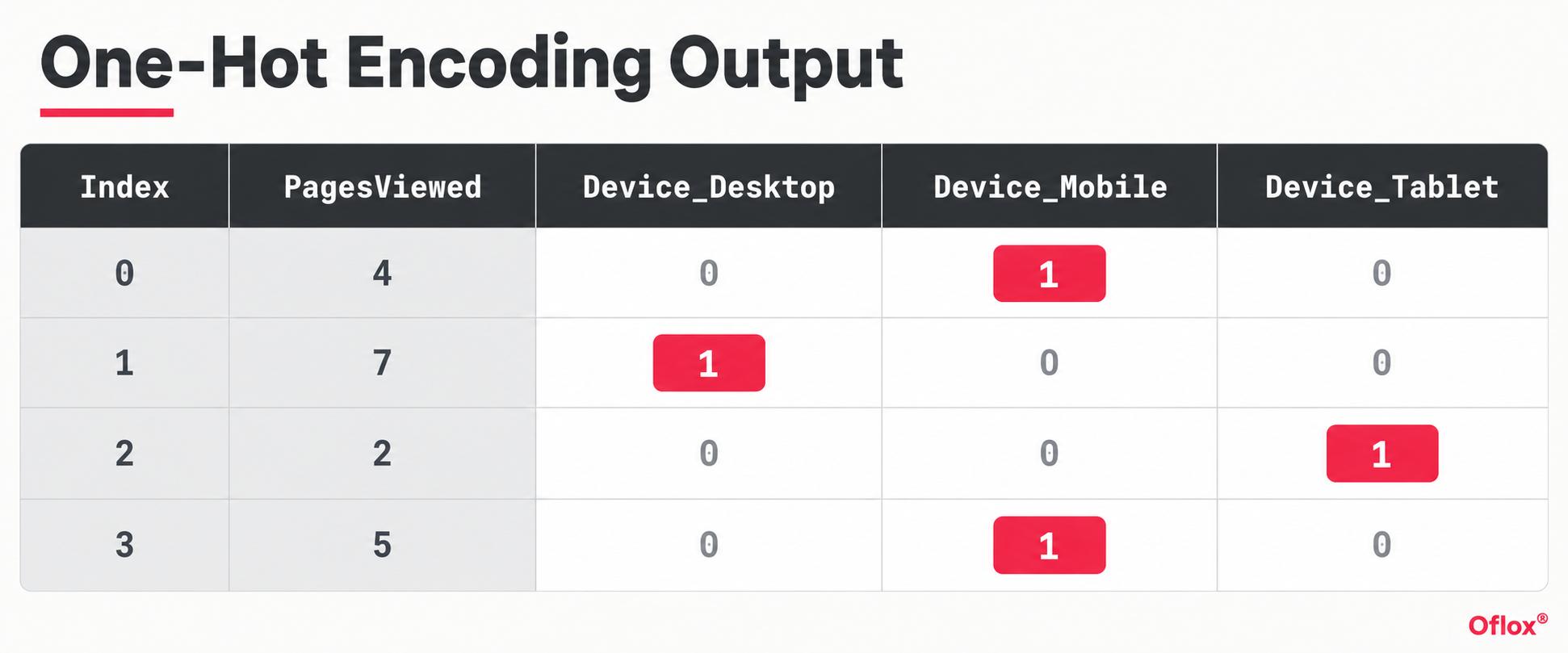
Here:
- columns selects the field to encode.
- dtype=int produces integer indicators.
- PagesViewed remains numerical.
Pandas also provides dummy_na=True to add an indicator for missing values and drop_first=True to omit the first category. Choose these options deliberately rather than copying them automatically.
For machine learning, avoid independently generating training and test dummy columns without controlling their schema. Different category sets can produce incompatible outputs.
2. Using scikit-learn OneHotEncoder
A fitted encoder learns a mapping that can be reused.
import pandas as pd
from sklearn.preprocessing import OneHotEncoder

train = pd.DataFrame({
    "Device": ["Mobile", "Desktop", "Tablet", "Mobile"]
})

new_visitors = pd.DataFrame({
    "Device": ["Mobile", "Smart TV"]
})

encoder = OneHotEncoder(
    handle_unknown="ignore",
    sparse_output=False,
    dtype=int
)

encoder.fit(train)

encoded_new = encoder.transform(new_visitors)

result = pd.DataFrame(
    encoded_new,
    columns=encoder.get_feature_names_out(),
    index=new_visitors.index
)

print(result)
Expected output:
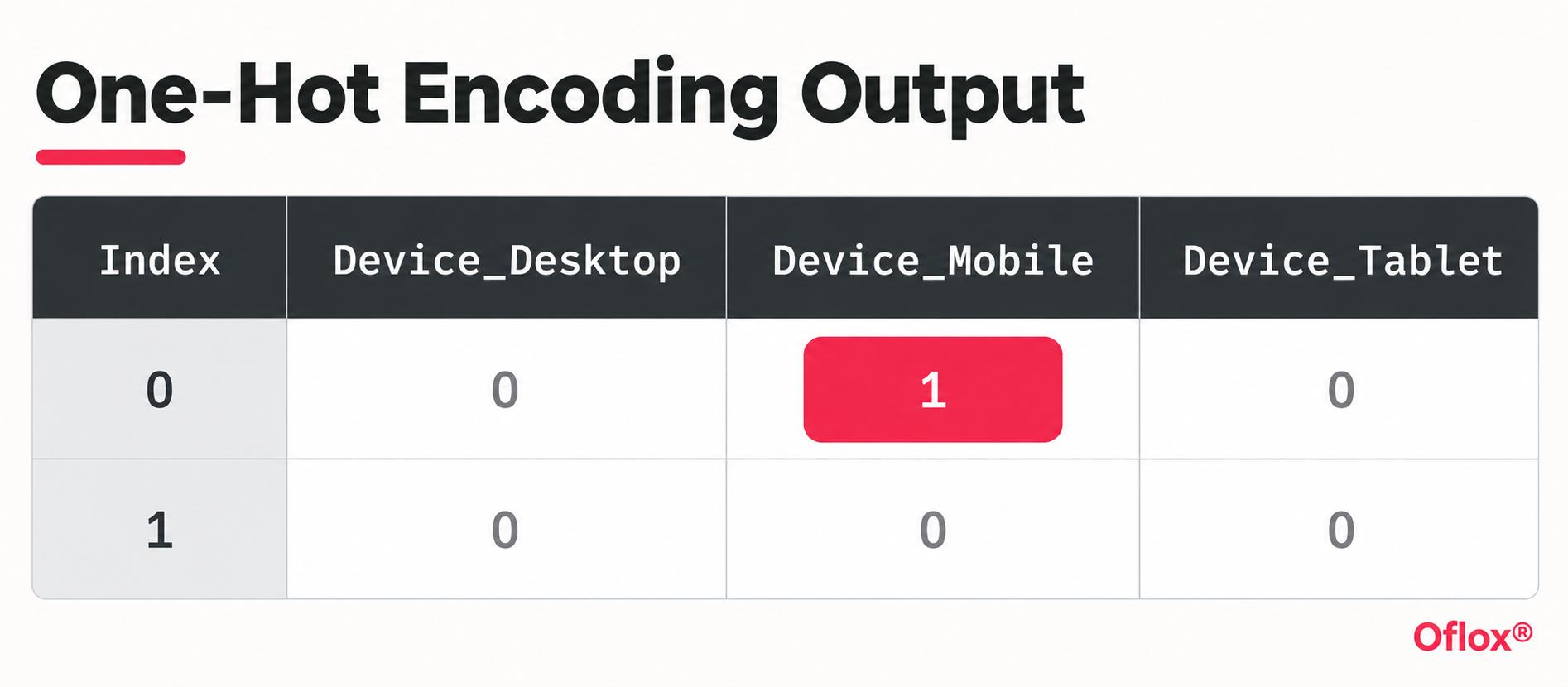
Smart TV was absent during fitting. With handle_unknown=”ignore”, it receives zeros across this feature’s columns. This prevents an unknown-category error, but it does not teach the model what Smart TV visitors are like.
The example uses dense output for readability. OneHotEncoder supports sparse output, unknown-category handling, and grouping infrequent categories. Its sparse_output parameter replaced the older sparse name in version 1.2.
3. Include Encoding in a Pipeline
For a predictive project, combine preprocessing and modelling:
from sklearn.compose import ColumnTransformer
from sklearn.linear_model import LogisticRegression
from sklearn.pipeline import Pipeline
from sklearn.preprocessing import OneHotEncoder, StandardScaler

preprocessor = ColumnTransformer(
    transformers=[
        (
            "categorical",
            OneHotEncoder(handle_unknown="ignore"),
            ["Device", "TrafficSource"]
        ),
        (
            "numerical",
            StandardScaler(),
            ["PagesViewed", "SessionSeconds"]
        )
    ]
)

model = Pipeline(
    steps=[
        ("preprocessor", preprocessor),
        ("classifier", LogisticRegression(max_iter=1000))
    ]
)

# X_train and X_test must contain the four columns listed above.
# y_train contains the corresponding conversion outcomes.
# This example assumes the input values are not missing.

model.fit(X_train, y_train)
predictions = model.predict(X_test)
This is a template for use after creating suitable training and test sets.
During cross-validation, evaluate the entire pipeline, so preprocessing is fitted within each training fold. Scikit-learn recommends pipelines to reduce inconsistent preprocessing and data leakage.
One-Hot Encoding vs Other Encoding Methods
Different methods preserve different information.
| Method | Representation | Useful starting point | Main consideration |
|---|---|---|---|
| One-hot encoding | Separate binary indicators | Unordered categories with manageable counts | Can create many columns |
| Ordinal encoding | One ordered numerical code | Categories with meaningful order | Model may interpret numerical spacing |
| Reference dummy coding | Usually \(k-1\) indicators | Regression with a chosen baseline | Baseline must be understood |
| Frequency encoding | Category count or proportion | Compact frequency-based features | Different categories can share values |
| Target encoding | Target-related category statistics | Some high-cardinality problems | Requires leakage controls |
| Learned embeddings | Trainable dense vectors | Large categorical vocabularies | More modelling complexity |
1. Is Label Encoding the Same as Ordinal Encoding?
People often use “label encoding” to describe assigning integers to categories.
However, scikit-learn’s LabelEncoder is intended for the target variable, y, rather than input features, X. For feature columns, choose a feature encoder appropriate to the model and category meaning.
2. Is Target Encoding Always Better?
No. Its suitability depends on the dataset and estimator.
Target encoding uses outcome information, so careless implementation can leak answers into training features. Cross-fitting helps by computing a row’s encoding using other training observations.
Scikit-learn’s target encoder documentation specifically distinguishes its cross-fitted fit_transform() behaviour from calling fit() and then transform() on the same training data. scikit-learn 1.9.1 documentation
Compare alternatives using an evaluation setup that reflects your actual prediction task.
Key Features and Benefits of One-Hot Encoding
Here are the main reasons one-hot encoding remains useful in practical projects.
1. Avoids Artificial Category Rankings
Payment methods, browser names, and campaign types can be represented without claiming that one is numerically larger than another.
This helps separate genuine numerical relationships from arbitrary coding choices.
2. Makes Feature Meaning Visible
A column named TrafficSource_Email is easy to inspect.
A marketer reviewing a dataset can understand what the indicator represents without decoding an unexplained number such as 7.
This transparency is helpful during debugging and collaboration.
3. Preserves Category Identity
With a complete vocabulary and no grouping, different categories receive different representations.
You can distinguish Mobile from Desktop even if both categories appear equally often. Frequency-based representations do not necessarily preserve that distinction.
4. Does Not Need the Target to Define Categories
Basic one-hot encoding can be fitted using the feature values alone. You do not need conversion outcomes, sales totals, or churn labels to establish its vocabulary.
This avoids the particular leakage risk associated with using target statistics, although proper train-test separation still matters.
5. Provides an Understandable Baseline
Before testing a complicated representation, build a simple baseline.
For example, a lead-scoring model using a few categorical indicators and numerical engagement features can help establish whether a more complex model delivers a worthwhile improvement.
6. Can Use Sparse Storage
When most indicator values are zero, compatible software can store the matrix efficiently.
However, sparse storage and predictive quality are separate issues. Efficient storage does not make an uninformative feature useful.
Practical One-Hot Encoding Examples
These illustrative scenarios show how the technique fits into everyday business datasets.
1. Digital Marketing Lead Scoring
A marketing team records:
- Traffic source
- Device category
- Landing page type
- Number of previous visits
It wants to predict whether a new enquiry will become a qualified lead.
One-hot encoding can represent unordered inputs such as Email, Organic Search, and Paid Social.
The team should use only information available at the intended prediction time. A field added after lead qualification would reveal future information.
2. E-commerce Return Prediction
An online store wants to estimate return probability using:
- Product category
- Delivery method
- Payment method
- Order value
Categories such as Clothing, Furniture, and Electronics can receive separate indicators.
However, individual product IDs may create an extremely large feature space. The team should assess whether broader product attributes or another representation would generalise better.
3. SaaS Customer Churn
A SaaS business may consider:
- Billing cycle
- Signup channel
- Account type
- Usage frequency
Monthly and annual billing can be represented with binary indicators.
Even when subscription plans have an order, one-hot encoding may be useful if the team does not want to impose a simple numerical relationship between them.
4. Customer Support Classification
A support system could encode ticket channels such as Email, Chat, and Phone.
Ticket descriptions require separate text processing. Encoding the channel does not capture the content of the customer’s problem.
This illustrates a common pattern: different columns in the same dataset need different preprocessing methods.
Challenges and Limitations of One-Hot Encoding
Here are the main limitations to understand before using one-hot encoding in a real project.
1. High Cardinality Creates Many Columns
Cardinality means the number of distinct categories in a feature.
A device field with three categories is easy to manage. A merchant field with 80,000 unique values requires much more consideration.
Possible consequences include:
- Higher memory usage
- Longer training time
- Larger models
- More difficult inspection
- Weak estimates for categories with little data
There is no universal category limit. Dataset size, storage format, estimator, and deployment constraints all matter.
2. Dense Matrices Can Become Expensive
Suppose a feature has 10,000 categories across 100,000 rows.
A dense representation contains:\[ 100{,}000 \times 10{,}000 = 1{,}000{,}000{,}000 \]That is one billion entries.
At eight bytes per entry, the values alone require approximately 8 GB in decimal units, before additional overhead.
Sparse storage can substantially reduce this requirement when very few entries are nonzero. However, downstream operations must preserve sparse compatibility.
3. Rare Categories Provide Limited Evidence
A campaign appearing in only two training rows receives its own indicator under full encoding.
That column identifies the campaign, but two observations may not support a reliable estimate of its relationship with conversion.
Grouping suitable rare categories can help. Choose the grouping rule using training data and validate whether it improves performance.
4. New Categories Need a Defined Policy
Production data changes. New browsers, products, regions, and campaign names appear.
Decide whether unfamiliar categories should:
- Trigger a validation error
- Receive an all-zero feature block
- Map to an explicit unknown category
- Join an established infrequent-category group
Scikit-learn’s infrequent_if_exist option uses an infrequent group when one exists; otherwise, unknown values receive the same treatment as ignore.
Monitor unknown-category rates. A sharp increase may signal data drift or a broken upstream field.
5. Missing and Unknown Values Are Different
A missing device value means the device was not recorded. An unknown device means a value was recorded but does not belong to the fitted vocabulary.
These conditions may deserve separate treatment.
For example, a missing value caused by tracking failure should not automatically be interpreted as a newly introduced device category.
6. Categories Have No Built-In Similarity
One-hot vectors distinguish categories but do not describe how similar they are.
For cities, the encoding does not reveal geographical distance. For products, it does not reveal shared materials or functions.
If such relationships matter, additional features or learned representations may be needed.
7. Full Indicators Can Be Redundant With an Intercept
For three complete category indicators:\[ x_1 + x_2 + x_3 = 1 \]An intercept column also contains ones. This creates linear dependence, commonly discussed as the dummy variable trap.
For ordinary unregularised regression with an intercept, using a reference category is a standard approach. Keeping full indicators is not automatically wrong for every model; regularisation, constraints, and model design affect the decision.
8. Some Models Prefer Their Own Categorical Handling
Do not automatically one-hot encode inputs for every algorithm.
CatBoost explicitly advises against external one-hot preprocessing and provides its own categorical processing. Some scikit-learn histogram-based gradient boosting estimators also support categorical features directly.
Should You Drop the First Category?
The correct answer depends on the model and interpretation you need.
Consider three payment methods:
| Payment method | Card | UPI |
|---|---|---|
| Cash | 0 | 0 |
| Card | 1 | 0 |
| UPI | 0 | 1 |
Cash is the reference category.
In a suitable regression model, the remaining coefficients describe differences relative to Cash, holding other included features constant.
Before dropping a column, ask:
- Does my model require a reference category?
- Do I need coefficients that compare against a baseline?
- How will regularisation interact with this choice?
- Can unknown values become indistinguishable from the baseline?
That final question matters. If unknown categories also receive zeros, the model may represent an unfamiliar payment method exactly like Cash.
Do not treat drop_first=True as a universal best practice.One-Hot Encoding vs Multi-Hot Encoding
One-hot encoding represents one category per feature.
Multi-hot encoding represents several active categories within a feature.
For example, a visitor might select several interests:
| Visitor interests | SEO | Google Ads | Web Design |
|---|---|---|---|
| SEO only | 1 | 0 | 0 |
| SEO and Google Ads | 1 | 1 | 0 |
| All three | 1 | 1 | 1 |
This is multi-hot encoding because several positions can be active.
It is useful for tags, selected preferences, and collections of labels. Google’s categorical-data guide makes this distinction explicitly.
Do not confuse it with several separate one-hot feature blocks appearing in the same row.
Tools for Working With Categorical Data
| Tool | Practical role |
|---|---|
| pandas | Inspect data and create dummy columns |
| scikit-learn | Fit encoders and integrate preprocessing with models |
| TensorFlow/Keras | Build categorical preprocessing into neural network workflows |
| statsmodels/Patsy | Apply statistical coding schemes and interpret regression models |
| CatBoost | Train models with built-in categorical processing |
TensorFlow provides lookup and category-encoding layers supporting representations such as one-hot and multi-hot outputs. Its embedding layers offer a different approach by mapping category indices to trainable dense vectors.
Choose the tool around your modelling workflow, deployment needs, and team’s experience.
Expert Tips for Developers and Business Owners
Here are practical ways to make your encoding decisions more reliable.
1. Audit Categories Before Modelling
Check unique values, missingness, spelling variations, and frequency distributions.
A field containing Instagram, instagram.com, and IG may need a documented mapping before encoding.
2. Match the Split to the Business Problem
For future sales prediction, a time-based split may be more realistic than a random split.
For repeated customer records, ensure your evaluation does not accidentally measure memorisation of customers when the goal is performance on new customers.
3. Track the Encoded Feature Count
Record how many columns each original field creates.
A sudden jump from 20 campaign categories to 20,000 may indicate that a campaign identifier or full URL has entered the wrong field.
4. Save Preprocessing With the Model
Keep the category mapping, column order, cleaning rules, and model together.
Reconstructing the encoder separately at deployment can change the meaning of the inputs.
5. Evaluate More Than Accuracy
Compare memory usage, prediction latency, calibration, and performance across important customer groups.
A small improvement in a headline metric may not justify a large increase in operating cost.
6. Separate Prediction From Explanation
An indicator associated with higher conversions does not prove that switching customers into that category will increase conversions.
Use suitable experiments or causal methods for claims about business interventions.
Common Mistakes to Avoid
| Mistake | Better approach |
|---|---|
| Encoding every numerical-looking column automatically | Check the business meaning first |
| Fitting preprocessing before splitting data | Fit data-dependent steps on training data |
| Encoding training and test sets independently | Reuse one fitted mapping |
| Ignoring new categories | Define and monitor an explicit policy |
| One-hot encoding unique identifiers without justification | Assess whether they generalise |
| Always dropping the first column | Match the choice to the estimator |
| Converting large sparse matrices to dense arrays | Check memory requirements first |
| Assuming encoding guarantees better predictions | Compare validated alternatives |
Another mistake is reporting feature importance without considering that one original field may now span many columns. Category-level and original-feature-level interpretations answer different questions.
FAQs:)
A. One-hot encoding gives each category its own column. The matching category receives 1, while the other category columns receive 0.
A. For one known category in a fully represented feature, exactly one position is active. That active position is called “hot.”
A. It can help a model use categorical information appropriately. However, the result depends on data quality, feature usefulness, the estimator, and the evaluation setup.
A. A feature with \(k\) categories normally creates \(k\) columns. Dropping a reference category produces \(k-1\). Grouping categories can reduce the number further.
A. Yes, if you define how missing values should be represented. They may receive a dedicated category, an indicator, or an imputed value, depending on the workflow.
A. Sometimes, particularly with sparse-compatible models. However, evaluate memory, training cost, category frequency, and alternatives before choosing it.
A. Usually not when the values represent quantities. Integer category codes are different: their numerical appearance does not mean they should be treated as measurements.
A. No. Tokenisation divides text into units such as words or subwords. One-hot encoding represents categories numerically. A text system may use both concepts at different stages.
A. No. They can use numerical inputs, embeddings, and other representations. Category indices can feed an embedding lookup without creating an explicit dense one-hot vector.
A. Use a small, clean, unordered feature. Inspect the output, understand the column mapping, then practise reusing the encoder on new data.
Conclusion:)
One-hot encoding helps machine learning models use categorical data by converting labels into binary columns without introducing an artificial numerical ranking. It offers a simple way to represent information such as payment methods, device types, and traffic sources.
However, effective encoding requires more than replacing categories with zeros and ones. Clean data, consistent category mappings, proper handling of missing and unknown values, and careful management of large category counts are essential for reliable results.
Whether you are learning data science or developing a business application, understanding one-hot encoding will help you make better decisions about data preparation and feature engineering.
Start with simple examples, understand what each column represents, and choose the encoding method that fits your data and model.
“Better predictions begin with better data preparation, where every category is represented clearly and consistently.” — Mr Rahman, Founder & CEO, Oflox®
Read also:)
- What Is OAuth 2.0 Authentication: A Complete Guide for Beginners!
- What Is Linktree Used For: A Complete Guide for Beginners!
- How to Become an AI Engineer After 12th: A Complete Guide!
Start with a small dataset, practise encoding its categories, and examine how the resulting columns affect your model. A clear understanding of your data today can help you build more dependable machine learning solutions tomorrow.