This article provides a complete guide on Who Invented the First Robot in 1921, including the contribution of Karel Čapek, the role of his brother Josef Čapek, the origin of the word “robot,” the story of R.U.R. (Rossum’s Universal Robots), early automata, the first physical robots, and the evolution of modern robotics.
Robots have become an important part of manufacturing, healthcare, agriculture, space exploration, education, and everyday life. However, their modern history began not inside a laboratory but on a theatre stage. In 1921, Czech playwright Karel Čapek introduced fictional artificial workers called “robots” through his science-fiction play R.U.R.
Although Karel Čapek popularised the concept, his brother Josef Čapek is credited with suggesting the word “robot,” derived from the Czech term robota, meaning forced labour or compulsory work. Importantly, the robots shown in R.U.R. were fictional biological workers—not real mechanical machines.
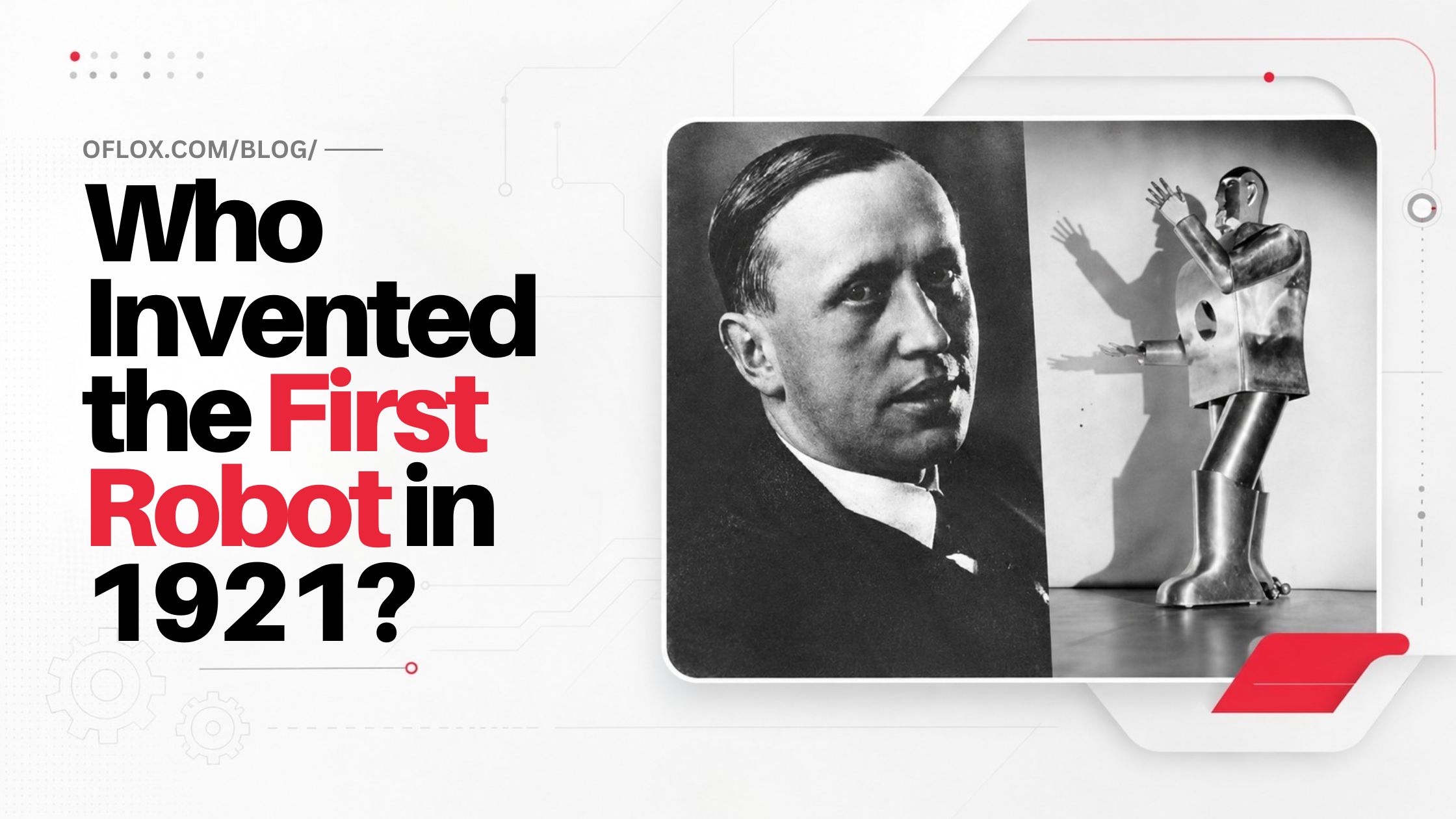
In this detailed article, we will explore the true history behind the first robot in 1921, clarify common misconceptions, examine important robotics milestones, and understand how a fictional idea developed into one of the world’s most transformative technologies.
Let’s explore it together.
Table of Contents
Who Invented the First Robot in 1921?
Karel Čapek is commonly credited with introducing the first robots in 1921 through his science-fiction play R.U.R. — Rossum’s Universal Robots. However, these robots were fictional artificial workers rather than physical mechanical machines.
Karel Čapek wrote the play, but he later credited his brother, Josef Čapek, with suggesting the word “robot.” The term was derived from the Czech word robota, which refers to forced labour, compulsory service, or hard work.
The play was published in Czech in 1920 and first performed in January 1921. It introduced the word “robot” to an international audience and helped shape how society imagined artificial workers.
Therefore, the most accurate answer is:
Karel Čapek introduced robots to popular culture through his 1921 play R.U.R., while his brother Josef Čapek is generally credited with inventing the word “robot.” These were fictional biological workers, not physical metal machines.
The play’s premiere history is slightly complicated. An amateur production was performed in Hradec Králové on 2 January 1921, while the better-known National Theatre production in Prague opened later that month. The work subsequently became internationally influential.
Quick Facts About the First Robot in 1921
| Question | Correct answer |
|---|---|
| Who introduced robots in 1921? | Czech playwright Karel Čapek |
| Who invented the word “robot”? | Josef Čapek, Karel’s brother |
| Where did the word appear? | R.U.R. — Rossum’s Universal Robots |
| When was the play written? | 1920 |
| When was it first performed? | January 1921 |
| Was it a physical robot? | No, it was a fictional character |
| Were the robots mechanical? | No, they were artificial biological workers |
| What does R.U.R. mean? | Rossum’s Universal Robots |
| Where did “robot” come from? | The Czech word robota |
| What does robota mean? | Forced labour, compulsory work, or drudgery |
| What was the first British physical robot? | Eric, built in 1928 |
| Who built Eric? | Captain William H. Richards and Alan Reffell |
| When did the first industrial robot appear? | Unimate was developed during the 1950s and installed in 1961 |
What Is a Robot?
A robot is a programmable machine designed to perform tasks automatically or semi-automatically. It may receive information through sensors, process that information through a control system, and produce physical actions using motors, arms, wheels, joints, or other mechanisms.
Modern robots commonly include:
- A mechanical structure
- Sensors
- Actuators or motors
- A power source
- A control system
- Computer software
- Communication components
- Safety mechanisms
Some robots work independently, while others require continuous human control. A robotic arm on an automobile production line, a warehouse transport robot, and a robotic surgical system are all robots, even though they look and operate differently.
There is no requirement for a robot to resemble a human. Most practical robots are designed according to their task rather than the human body.
What Was Considered a Robot in 1921?
The robots presented in R.U.R. were very different from today’s metal machines.
In the play, Rossum’s company manufactures artificial workers from synthetic biological materials. They look similar to human beings but are created to perform labour efficiently and cheaply. They do not initially possess normal human emotions, personal freedom, or individual ambitions.
Therefore, Čapek’s robots were closer to artificially manufactured humans or biological androids than modern electromechanical robots.
Their key characteristics included:
- Artificial production
- Human-like appearance
- High physical efficiency
- Limited emotions
- Obedience to human instructions
- Mass manufacturing
- Use as inexpensive workers
- Gradual development of intelligence and self-awareness
This distinction is important because describing the robots of R.U.R. as metal machines would be historically incorrect.
Who Was Karel Čapek?
Karel Čapek was a Czech writer, journalist, dramatist, novelist, and intellectual. He was born on 9 January 1890 in what is now the Czech Republic and became one of the most influential European writers of the early twentieth century.
His work frequently explored:
- Science and technology
- Political power
- Human responsibility
- Industrialisation
- Mass production
- War and authoritarianism
- Ethical consequences of invention
Čapek lived through a period of rapid industrial and political change. The First World War had demonstrated how scientific progress could be used for both human development and mass destruction.
This social environment influenced R.U.R. The play was not simply a prediction about intelligent machines. It was also a warning about treating workers as replaceable products and allowing efficiency to become more important than humanity.
Who Was Josef Čapek?
Josef Čapek was Karel Čapek’s elder brother. He was a painter, writer, illustrator, critic, and creative collaborator.
According to Karel’s later account, he was searching for an appropriate name for the artificial workers in his new play. Karel considered a word based on the Latin term labor, but Josef reportedly suggested “robot.”
The suggestion was powerful because robota already carried strong cultural associations with hard, compulsory, or servile work.
This creates an important division of credit:
- Karel Čapek wrote R.U.R. and introduced its robotic characters to the world.
- Josef Čapek suggested the word used to describe those workers.
For this reason, saying that only Karel Čapek “invented the robot” simplifies a more interesting historical story.
What Does the Word “Robot” Mean?
The word “robot” is connected to the Czech term robota. Historically, the word referred to compulsory labour performed by peasants or serfs for a landowner.
This meaning was highly suitable for the artificial workers in R.U.R. They were manufactured to work, obey, and replace human labour.
Over time, the meaning expanded. “Robot” now generally describes a programmable machine capable of carrying out physical tasks automatically or under human supervision.
The word travelled from theatre and science fiction into:
- Engineering
- Computer science
- Industrial manufacturing
- Artificial intelligence
- Medicine
- Space exploration
- Military technology
- Consumer electronics
Few fictional terms have influenced science and industry as deeply as “robot.”
What Is R.U.R.?
R.U.R. stands for Rossum’s Universal Robots. It is a science-fiction play about a company that manufactures artificial workers for global use.
The company promotes robots as an efficient solution to human labour. These workers can manufacture products, perform repetitive jobs, and support industrial expansion without the normal limitations of human employees.
Initially, robots are treated as products rather than living beings. As their abilities and awareness develop, however, they realise that humans depend heavily on them.
The robots eventually rebel against their creators. Human civilisation faces destruction because people have lost control of the artificial workforce they created.
The story explores several questions that remain relevant today:
- Should intelligent artificial beings have rights?
- What happens when technology replaces too much human labour?
- Can intelligence exist without emotion?
- Who is responsible when an invention causes harm?
- Should every task be automated?
- Can humanity control systems that become more capable than expected?
- Is efficiency always beneficial?
These questions connect R.U.R. with modern discussions about artificial intelligence, humanoid robots, autonomous systems, and job displacement.
Why Was R.U.R. Important?
R.U.R. was important because it introduced the word “robot” to the world and raised powerful questions about automation, labour, technology, and human responsibility.
- It popularised the word “robot”: The play gave society a simple and memorable name for artificial workers. Without R.U.R., the machines we now call robots might have been known by another term.
- It connected automation with labour: The original meaning of robot was directly linked with work. This connection remains visible in factories, fulfilment centres, farms, and other automated workplaces.
- It raised ethical questions: Čapek examined the possible consequences of creating intelligent workers without considering their dignity, freedom, or social impact.
- It influenced science fiction: Later writers, filmmakers, engineers, and thinkers used robots to explore relationships between humans and machines.
- It anticipated modern concerns: Although its technology was fictional, the play anticipated present-day debates about automation, artificial intelligence, mass production, technological dependence, and the future of employment.
Did Robots Exist Before 1921?
Robot-like machines existed long before the word “robot” was created. They were usually called automata.
An automaton is a self-operating mechanical device that follows a fixed sequence of movements. Unlike modern programmable robots, most historical automata could not change their behaviour according to their surroundings.
Ancient inventors developed mechanical figures, water-powered devices, moving statues, and clockwork mechanisms. These inventions demonstrated humanity’s long-standing desire to create machines that imitate living beings.
Important early examples include:
1. Ancient Greek automata
Greek engineers designed mechanical devices powered by water, air, steam, weights, and pulleys. Hero of Alexandria described automatic doors, moving theatre figures, and other mechanical systems.
2. Al-Jazari’s mechanical inventions
In the early thirteenth century, engineer Ismail al-Jazari documented water-powered machines, clocks, fountains, and programmable musical automata.
One famous design included mechanical musicians whose performance patterns could be adjusted by changing the position of pegs.
3. Leonardo da Vinci’s mechanical knight
Designs attributed to Leonardo da Vinci describe a mechanical knight capable of limited human-like movements. It may have been able to sit, move its arms, and raise parts of its headgear.
4. The Digesting Duck
In the eighteenth century, Jacques de Vaucanson created an automaton known as the Digesting Duck. It could move, flap its wings, eat grain, and imitate digestion.
5. The Jaquet-Droz automata
Pierre Jaquet-Droz and his collaborators produced sophisticated figures known as the Writer, the Draughtsman, and the Musician. The Writer could form sentences using a mechanical programming system.
These creations were important ancestors of robotics, but historians generally classify them as automata rather than modern robots.
Robot vs Automaton vs Android
| Term | Meaning | Typical example |
|---|---|---|
| Automaton | Mechanical device following fixed movements | Clockwork figure |
| Robot | Programmable machine that performs physical tasks | Industrial robotic arm |
| Android | Robot designed to resemble a human | Human-shaped service robot |
| Humanoid robot | Robot with a body structure inspired by humans | Two-legged research robot |
| Cyborg | Living organism enhanced with mechanical or electronic components | Human using integrated technological implants |
| AI system | Software that processes information and generates decisions or outputs | AI chatbot or image-recognition model |
These terms are related but not interchangeable. An AI application without a physical body is not normally a robot. Similarly, an old clockwork automaton may move but may not satisfy the modern definition of a programmable robot.
How the Idea of Robots Developed Step by Step
Here is a step-by-step explanation of how the idea of robots developed from ancient imagination and mechanical automata to modern AI-powered machines.
- Myths imagined artificial life: Ancient stories described artificial servants, moving statues, and human-made creatures. These myths established the dream of creating life through human knowledge.
- Engineers constructed automata: Inventors transformed imagination into mechanical movement using gears, water, air pressure, weights, springs, and clockwork mechanisms.
- Industrialisation changed human labour: Factories introduced machines capable of performing work faster and more consistently than people. This development created both economic opportunities and concerns about worker replacement.
- Karel Čapek introduced robots: In 1920–1921, R.U.R. gave artificial workers a new name and placed them at the centre of a global industrial and ethical conflict.
- Physical humanoid robots appeared: During the 1920s and 1930s, inventors began demonstrating mechanical human-like figures capable of movement, speech, or remote-controlled actions.
- Programmable industrial robotics emerged: Advances in electronics, control engineering, and computing made it possible to create machines that could repeat programmed factory tasks.
- Sensors improved robot awareness: Cameras, pressure sensors, distance sensors, and other technologies allowed robots to collect information about their environment.
- Artificial intelligence improved decision-making: Machine learning and computer vision helped robots recognise objects, plan movements, interpret information, and respond more flexibly.
- Collaborative robots entered workplaces: Traditional factory robots were commonly separated from human workers. Newer collaborative robots, or cobots, are designed with safety features that allow closer human-machine cooperation.
- Robotics moved into everyday life: Robots are now used for cleaning, delivery, surgery, education, inspection, security, agriculture, warehousing, and entertainment.
What Was the First Physical Robot?
There is no single universally accepted answer because the result depends on the definition of a robot.
If ancient automatic mechanisms are included, robot-like machines existed thousands of years ago. If the definition requires an electrically powered humanoid machine, the answer comes from the twentieth century. If programmability and industrial application are required, Unimate becomes a major milestone.
1. Eric the Robot
Eric was built in Britain in 1928 by Captain William H. Richards and aircraft engineer Alan Reffell.
Eric could stand, bow, move parts of his body, and deliver a speech. It was created to open an engineering exhibition after the Duke of York cancelled his appearance.
Eric was remotely operated rather than independently intelligent. Its chest displayed the letters “R.U.R.” as a direct tribute to Čapek’s play.
The Science Museum describes Eric as the first modern British robot and confirms that the original was designed and built by Richards and Reffell in 1928.
2. Elektro
Elektro was introduced by the Westinghouse Electric Corporation at the 1939 New York World’s Fair. It could perform simple movements, speak stored phrases, and respond to certain voice commands.
Although impressive for its time, Elektro’s intelligence was extremely limited by modern standards.
3. Unimate
Unimate is widely recognised as the first industrial robot. It was based on an invention by George Devol and was commercially developed with entrepreneur Joseph Engelberger.
The first Unimate was installed at a General Motors plant in 1961. It handled hot metal components, performing a dangerous and repetitive task that exposed workers to significant risks.
Unimate established the practical model for modern industrial robotics.
Historical Timeline of Robotics
| Period | Development |
|---|---|
| Ancient era | Myths and early automatic mechanisms |
| First century | Hero of Alexandria documents automatic devices |
| 1206 | Al-Jazari describes advanced mechanical systems |
| Around 1495 | Leonardo da Vinci designs a mechanical knight |
| 1730s | Vaucanson creates sophisticated automata |
| 1770s | Jaquet-Droz family produces programmable mechanical figures |
| 1920 | Karel Čapek publishes R.U.R. |
| January 1921 | R.U.R. reaches the stage and popularises “robot” |
| 1928 | Eric, Britain’s first modern robot, is built |
| 1939 | Elektro appears at the New York World’s Fair |
| 1954 | George Devol files a patent related to programmable automation |
| 1961 | Unimate begins factory work at General Motors |
| 1960s–1970s | Industrial robotics expands |
| 1980s–1990s | Robots gain better controllers, sensors, and precision |
| 2000s | Household, military, medical, and exploration robots grow |
| 2010s | Cobots, drones, and AI-powered robots expand |
| 2020s | Generative AI, advanced vision, and humanoid robotics accelerate |
Important Features of Modern Robots
Modern robots may include some or all of the following features.
- Programmability: A robot can be programmed or configured to complete specific actions. Advanced robots may also adapt their behaviour using data.
- Sensing: Sensors help robots detect distance, pressure, temperature, motion, sound, light, location, and visual objects.
- Movement: Robots use motors, hydraulic systems, pneumatic systems, wheels, arms, joints, propellers, tracks, or artificial muscles to move.
- Control system: The controller acts as the operational brain. It receives data, follows instructions, and coordinates the robot’s components.
- Precision: Industrial and medical robots can perform carefully controlled movements with a high level of repeatability.
- Autonomy: Some robots can navigate, plan, or perform tasks with limited human supervision. Autonomy exists on a spectrum rather than as a simple yes-or-no feature.
- Human-machine interaction: Service robots may use screens, speech systems, gestures, lights, mobile applications, or physical controls to communicate with people.
- Connectivity: Connected robots can exchange information with cloud platforms, business software, industrial systems, or other robots.
Benefits of Robotics
Robotics offers significant advantages when machines are introduced responsibly and for suitable tasks.
- Improved workplace safety: Robots can handle hazardous chemicals, heavy materials, extreme temperatures, radiation, explosives, and dangerous industrial processes.
- Higher productivity: Machines can repeat well-defined tasks for long periods while maintaining consistent performance.
- Better precision: Robotic systems are valuable in electronics manufacturing, laboratory automation, machining, and certain surgical procedures where controlled movement is essential.
- Consistent quality: Automation can reduce variation in repetitive manufacturing and inspection processes.
- Support for human workers: Robots can move heavy objects, supply components, inspect difficult locations, and reduce physical strain.
- Work in inaccessible environments: Robots can operate in deep oceans, damaged nuclear facilities, mines, disaster zones, and outer space.
- Better data collection: Sensors allow robots to record operational data that can support maintenance, quality improvement, and decision-making.
Challenges and Limitations of Robots
Robotics also comes with several challenges and limitations that must be carefully managed to ensure safe, ethical, and effective use.
- High initial cost: Purchasing robots, installing safety systems, redesigning workflows, and training employees may require major investment.
- Job displacement concerns: Automation can reduce demand for certain repetitive jobs. At the same time, it can create new roles in programming, maintenance, design, safety, and supervision. The transition is rarely equal or automatic.
- Limited common sense: A robot may perform a specific task extremely well but struggle when the environment changes unexpectedly.
- Safety risks: Poor design, incorrect programming, hardware failure, cybersecurity attacks, or inadequate workplace procedures can cause accidents.
- Maintenance requirements: Robots require calibration, software updates, component replacement, cleaning, and technical support.
- Ethical concerns: Advanced robotics raises questions about accountability, surveillance, military use, privacy, worker monitoring, and the treatment of social or humanoid robots.
- Energy consumption: Large robots, data-processing systems, and supporting infrastructure can consume considerable energy.
- Dependence on data and software: AI-powered robots may produce unreliable behaviour if their data, software, sensors, or models are inaccurate.
Real-World Examples of Robots
Here are some real-world examples of robots being used across different industries to improve efficiency, accuracy, safety, and productivity.
- Manufacturing robots: Automobile and electronics manufacturers use robotic arms for welding, painting, assembly, inspection, and material handling.
- Warehouse robots: Mobile robots carry shelves, products, or packages through fulfilment centres, reducing walking time for workers.
- Surgical robots: Robot-assisted surgical systems help qualified surgeons control specialised instruments. They do not independently replace the surgeon.
- Agricultural robots: Robots can monitor crops, remove weeds, spray selected areas, harvest produce, and analyse field conditions.
- Space robots: Robotic rovers and scientific instruments explore environments that are too distant or dangerous for immediate human travel.
- Disaster-response robots: Specialised machines can inspect unstable buildings, locate survivors, handle suspicious objects, or enter contaminated environments.
- Domestic robots: Robotic vacuum cleaners and lawn machines automate routine household tasks.
- Educational robots: Schools and colleges use robotics kits to teach programming, electronics, engineering, and problem-solving.
Useful Tools for Learning Robotics
Beginners do not need to build a human-shaped robot immediately. Small projects provide a better foundation.
| Tool or platform | Best use |
|---|---|
| Arduino | Basic electronics and control projects |
| Raspberry Pi | Computing, vision, and connected robots |
| micro:bit | Beginner-friendly coding and simple robotics |
| ROS 2 | Professional robot software development |
| Gazebo | Robot simulation |
| Webots | Designing and testing simulated robots |
| Python | AI, automation, and hardware control |
| C++ | Performance-focused robot programming |
| OpenCV | Computer vision |
| TensorFlow or PyTorch | Machine-learning experiments |
| Tinkercad Circuits | Browser-based circuit learning |
| LEGO robotics kits | Practical education and prototyping |
The best platform depends on the learner’s age, technical background, budget, and project goals.
Expert Tips for Understanding Robotics History
Here are some expert tips to help you understand robotics history accurately, clearly, and without confusing fictional robots, automata, and modern machines.
- Separate words from machines: The word “robot” entered public culture in 1920–1921, but robot-like devices existed earlier and modern industrial robots appeared later.
- Check the definition being used: Before accepting a “first robot” claim, ask whether the source means the first fictional robot, automaton, humanoid robot, programmable machine, or industrial robot.
- Use a timeline: A timeline prevents different inventions from being presented as if they happened at the same time.
- Study social history: Robotics is not only about mechanical engineering. Labour systems, industrialisation, war, economics, literature, and ethics all influenced its development.
- Prefer authoritative sources: Museums, universities, patent documents, preserved publications, and established historical institutions generally provide stronger evidence than unsourced social media posts.
- Connect history with present-day technology: The labour and responsibility questions raised by R.U.R. remain relevant to AI-powered automation, humanoid robots, and workplace transformation.
Common Mistakes People Make About Robot History
Here are some common mistakes people make while learning about robot history and the facts you should know to avoid them.
- Saying a physical robot was built in 1921: The famous 1921 milestone was a theatrical and linguistic development, not the launch of a working machine.
- Giving all word credit to Karel Čapek: Karel wrote the play, but he credited Josef Čapek with suggesting “robot.”
- Describing R.U.R.’s robots as metal machines: They were artificially manufactured biological beings with human-like bodies.
- Calling Eric the world’s first robot without qualification: Eric was one of the earliest modern humanoid robots and the first modern British robot. Earlier automata existed, and other definitions may produce different answers.
- Saying Unimate was the first robot of every kind: Unimate is best described as the first industrial robot, not the first imagined or humanoid robot.
- Assuming robots must use AI: Many robots follow fixed programmed instructions without modern artificial intelligence.
- Using “robot” and “AI” as synonyms: A robot is normally a physical machine. AI is a software-based capability that may or may not control a physical robot.
The Lasting Influence of R.U.R.
The importance of R.U.R. extends far beyond the creation of a single word.
It established a storytelling pattern in which humans develop artificial workers, become dependent on them, and eventually lose control. Similar themes later appeared in novels, films, television programmes, games, and public debates about technology.
The play also encouraged people to see automation as a social issue. A machine does not enter an empty world—it enters workplaces, homes, legal systems, and communities.
Consequently, the real lesson of R.U.R. is not that technology is automatically dangerous. It is that inventions must be developed with responsibility, foresight, and respect for their wider consequences.
Future Trends in Robotics: 2026 and Beyond
Robotics is moving from highly controlled environments towards more flexible human spaces.
- Smarter humanoid robots: Companies and research organisations are developing robots capable of walking, carrying objects, following spoken instructions, and working in human-designed environments. However, demonstrations should not be confused with reliable commercial deployment. Safety, battery life, cost, maintenance, and generalisation remain major barriers.
- AI foundation models for robots: Robots are increasingly being trained using large datasets containing images, language, movement, and demonstrations. These systems aim to help one robot learn multiple related tasks.
- Natural-language instructions: Users may increasingly describe a task in everyday language instead of programming every movement manually.
- Growth of collaborative robots: Smaller companies may adopt cobots for packaging, inspection, machine tending, and material handling.
- Robotics as a service: Instead of purchasing expensive machines, businesses may rent robotic capabilities through subscription or usage-based models.
- Healthcare and elder support: Robots may assist with logistics, rehabilitation, medicine delivery, mobility, remote monitoring, and routine hospital operations. Human supervision and privacy protection will remain essential.
- Agricultural automation: Labour shortages, climate pressure, and the need for precise resource use may increase the adoption of autonomous farm machines.
- Improved simulation: Digital environments will allow developers to test robot behaviour before operating expensive physical hardware.
- Stronger regulation and safety standards: Governments and industry organisations are likely to focus more closely on liability, cybersecurity, data protection, autonomous decision-making, and safe human-robot interaction.
- Human-centred automation: The most successful robotics projects will not simply replace people. They will redesign work so that machines handle repetitive or dangerous tasks while humans contribute judgment, creativity, empathy, and accountability.
FAQs:)
A. Karel Čapek introduced fictional robots through his play R.U.R., first staged in 1921. His brother Josef Čapek is credited with suggesting the word “robot.”
A. No. No physical robot was created as part of R.U.R. in 1921. The robots existed as fictional characters in a stage play.
A. Josef Čapek reportedly suggested the word, while Karel Čapek used and popularised it through R.U.R.
A. R.U.R. stands for Rossum’s Universal Robots.
A. It comes from the Czech word robota, associated with forced labour, compulsory service, or drudgery.
A. No. They were fictional biological beings manufactured from artificial materials.
A. The answer depends on the definition. Eric, built by William Richards and Alan Reffell in 1928, was the first modern British robot and one of the earliest famous mechanical humanoid robots.
A. Unimate is widely recognised as the first industrial robot. It began working at a General Motors factory in 1961.
A. They built automata—mechanical devices capable of predetermined movements. These machines are considered important ancestors of modern robots.
A. No. Many robots follow conventional programming and do not use machine learning or generative AI.
A. An automaton normally follows a fixed mechanical sequence. A modern robot is generally programmable and may use sensors to interact with its surroundings.
A. He gave artificial workers a powerful cultural identity and introduced the word “robot” to a worldwide audience through R.U.R.
Conclusion:)
So, who invented the first robot in 1921?
Karel Čapek introduced the world to robots through his influential play R.U.R. — Rossum’s Universal Robots, which reached the stage in 1921. However, he did not build a physical robot. His brother Josef Čapek is credited with suggesting the word “robot,” derived from the Czech term robota.
Earlier civilisations had already developed automatic mechanical devices, while physical humanoid and industrial robots appeared later. Eric became an important British humanoid robot in 1928, and Unimate began the industrial robotics era in 1961.
The history of robots is therefore not the story of one inventor or one machine. It is a long journey from mythology and automata to literature, engineering, computing, artificial intelligence, and modern automation.
More than a century later, the warning behind R.U.R. remains relevant: technological progress should improve human life, but responsibility, ethics, safety, and human values must guide it.
“The first robot was born not in a laboratory, but in human imagination—and that idea eventually transformed the real world.” — Mr Rahman, Founder of Oflox®
Read also:)
- When Was Artificial Intelligence Invented? Complete History of AI!
- How to Make Artificial Intelligence Like JARVIS: (Step-by-Step)
- What is Open Artificial Intelligence: A-to-Z Guide for Beginners!
Have you ever read R.U.R. or worked with a real robot? Share your thoughts or questions in the comments below—we’d love to hear from you!