This article provides a complete guide on What Is Prompt Chaining, including its meaning, importance, history, working process, key features, types, benefits, challenges, popular tools, real-world applications, expert tips, common mistakes, and future trends.
Artificial intelligence tools such as ChatGPT, Claude, and Gemini can perform many tasks using a single prompt. However, when a task includes multiple activities—such as research, planning, writing, fact-checking, editing, and formatting—one lengthy prompt may not always produce an accurate, consistent, or well-structured result.
This is where prompt chaining becomes useful.
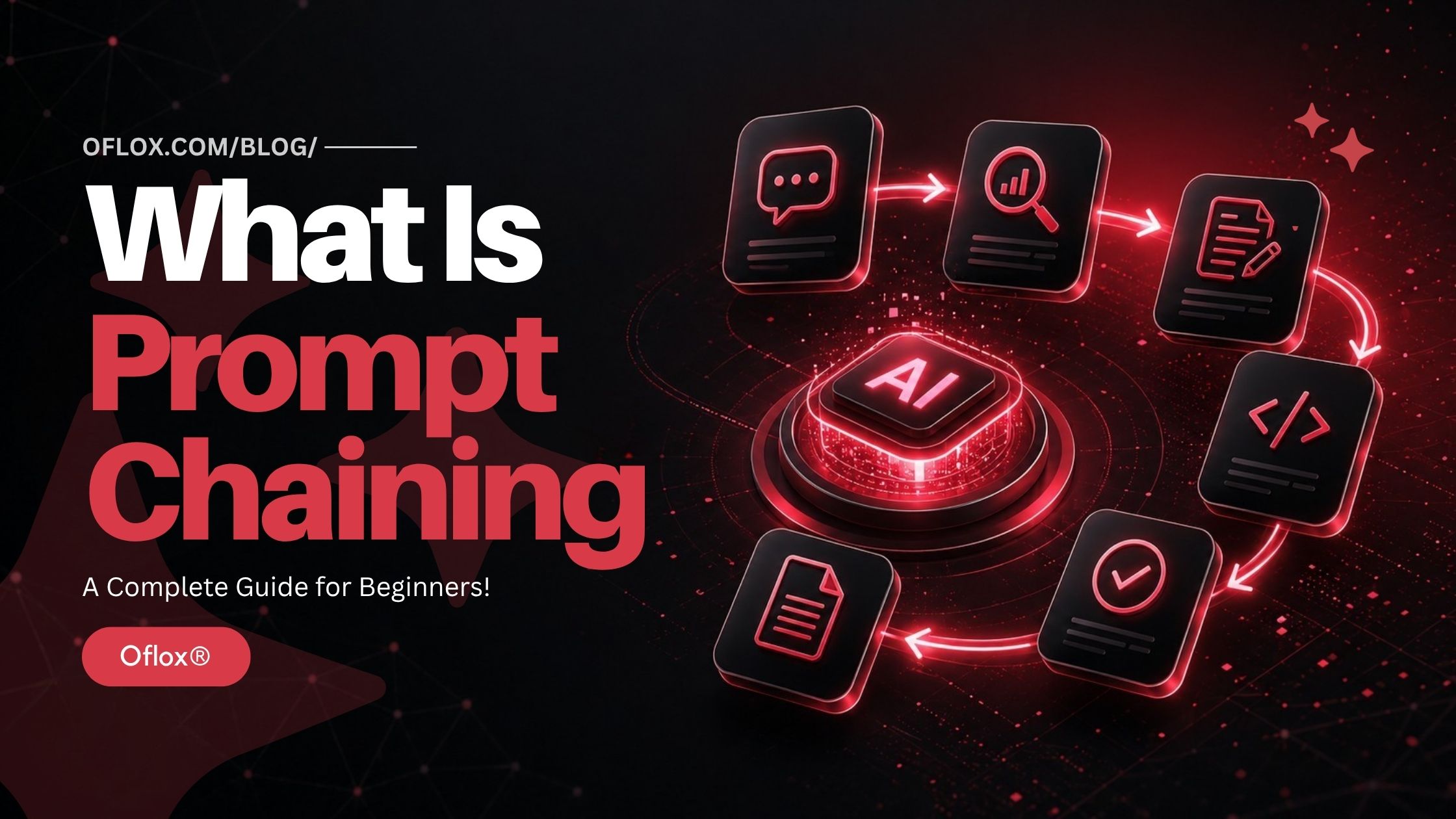
Prompt chaining is a prompt engineering technique in which a complex task is divided into a sequence of smaller and more focused prompts. The output of one prompt becomes the input or context for the next prompt, allowing the AI to complete the task step by step.
For example, instead of asking an AI tool to research a topic, create an outline, write an article, verify facts, and generate SEO metadata through one instruction, you can create a separate prompt for each stage. This makes the entire workflow easier to control, review, test, and improve.
Prompt chaining is widely used in content creation, SEO, software development, customer support, data analysis, document processing, marketing automation, and AI-powered business applications. It can improve transparency and consistency while also making it easier to identify errors before they affect the final output.
Whether you are a beginner exploring generative AI or a professional building advanced AI workflows, this guide will help you understand how prompt chaining works and how to use it effectively.
Let’s explore it together.
Table of Contents
What Is Prompt Chaining?
Prompt chaining is a prompt engineering technique in which a complex task is broken into a sequence of smaller prompts, where the output of one prompt is used as the input or context for the next prompt.
Every prompt in the chain performs a specific function. The combined output of all the stages produces the final result.
A basic prompt chain looks like this:
User input → Prompt 1 → Intermediate output → Prompt 2 → Refined output → Prompt 3 → Final result
For example:
- Prompt 1 identifies the user’s requirements.
- Prompt 2 creates a plan based on those requirements.
- Prompt 3 executes the plan.
- Prompt 4 checks the result.
- Prompt 5 formats the approved output.
This structured method helps users manage tasks that may be too complicated, sensitive, or unpredictable for a single prompt.
1. Prompt Chaining in Simple Words
Imagine you are preparing a meal.
Instead of putting every ingredient into one container and expecting a complete dish instantly, you follow a sequence:
- Select the ingredients.
- Wash and prepare them.
- Cook them in the correct order.
- Check the taste.
- Serve the finished dish.
Prompt chaining applies the same principle to artificial intelligence. Each stage completes one manageable part of the larger task.
2. Simple Example of Prompt Chaining
Suppose a business wants to create an email campaign.
The prompt chain may contain the following stages:
Prompt 1: Audience analysis
Analyse the following customer profile and identify the customer’s needs, objections, motivations, and purchase triggers.
Prompt 2: Campaign planning
Using the audience analysis below, create a five-email campaign journey. Define the purpose and call to action for each email.
Prompt 3: Email generation
Write Email 1 using the approved campaign plan. Keep it under 200 words and use a friendly professional tone.
Prompt 4: Quality review
Review the email for clarity, relevance, misleading claims, grammar, and compliance with the brand guidelines.
Prompt 5: Final revision
Rewrite the email by applying the review suggestions. Return only the final email.
The prompts are connected, but each has a clear and limited responsibility.
Why Is Prompt Chaining Important?
A simple prompt may be enough for a definition, caption, summary, or basic idea. However, professional work often contains multiple decisions and dependencies.
Consider an AI-based loan document processor. It may need to:
- Extract applicant information.
- Classify the document.
- Identify missing fields.
- Compare information across documents.
- Flag possible inconsistencies.
- Prepare a structured report.
- Send uncertain cases for human review.
Combining all these activities into one unstructured prompt may make the system difficult to test and maintain. A prompt chain creates clear stages and decision points.
1. It Reduces Task Complexity
Large tasks can confuse both users and AI systems. Dividing the assignment into focused stages allows the model to concentrate on one objective at a time.
Google’s Gemini guidance recommends considering prompt chaining instead of excessively long, multi-page prompts, particularly when a workflow involves distinct tasks or function calls.
2. It Makes Intermediate Results Visible
A single prompt usually gives you only the final answer. If the answer is incorrect, it can be difficult to locate the source of the problem.
A chain exposes intermediate outputs such as:
- Extracted data
- Search intent
- Content outline
- Classification result
- Selected evidence
- Calculation result
- Review comments
You can inspect these outputs before allowing the workflow to continue.
3. It Improves Process Control
Developers can define exactly what should happen at every stage. They can also add conditions such as:
- Continue only if confidence is above 90%.
- Ask for human approval before publication.
- Repeat the extraction if required fields are missing.
- Reject the answer if the output does not match the schema.
- Send high-risk cases to a specialist.
4. It Supports Better Quality Assurance
A dedicated verification prompt can examine the work produced by a generation prompt. This separation makes it easier to introduce fact-checking, policy checks, style reviews, and other safeguards.
5. It Makes AI Workflows Reusable
Once a chain works reliably, it can become a reusable template for similar tasks. A marketing agency could use the same content workflow for different clients by changing only the variables, brand guidelines, and source material.
A Brief History and Background of Prompt Chaining
Prompt chaining did not emerge from one invention or one person. It developed naturally from several earlier areas of computing and artificial intelligence.
1. Early Rule-Based Systems
Traditional software already divided complicated processes into smaller operations. Business applications utilized workflows, decision trees, conditional rules, and data pipelines long before the advent of generative AI.
A document might move through:
Collection → Validation → Approval → Processing → Reporting
Prompt chaining applies a similar workflow structure to language model calls.
2. Natural Language Processing Pipelines
Older natural language processing systems often used multiple specialised stages. For example, a text-processing pipeline could include:
- Tokenisation
- Part-of-speech tagging
- Entity recognition
- Sentiment analysis
- Classification
Each component passed its result to the next component.
3. Rise of Large Language Models
As large language models became widely accessible, users initially relied heavily on single prompts. It soon became clear that large, complicated instructions could produce inconsistent results, especially when the request contained several competing objectives.
Developers began separating tasks into multiple model calls. One call might classify input, another might retrieve relevant information, and another might generate an answer.
4. Prompt Chaining and Modern AI Applications
Modern AI systems combine prompt chains with:
- Retrieval-augmented generation
- Structured outputs
- Function calling
- External APIs
- Databases
- Human approvals
- Evaluation models
- AI agents
Prompt chaining remains relevant even when advanced models can reason across many steps internally. Its principal advantage is not merely making the model “think step by step.” Its practical value comes from creating an observable and controllable software workflow.
How Does Prompt Chaining Work?
A prompt chain works by passing information through several connected stages. The precise implementation depends on the application, but the fundamental process remains similar.
1. Define the Final Objective
Start by identifying the exact outcome you need.
A vague objective:
Create marketing content.
A clearer objective:
Produce a factually accurate, SEO-optimised, 1,500-word beginner’s guide that follows our brand tone and is ready for editorial review.
A clear final objective helps determine which stages the chain needs.
2. Break the Task into Smaller Subtasks
Separate the complete assignment into logically independent activities.
For the blog example, the subtasks might be:
- Understand the topic.
- Identify the audience and search intent.
- Research relevant concepts.
- Build an outline.
- Draft the content.
- Review the draft.
- Revise the content.
- Produce metadata.
Each subtask should have a distinct purpose.
3. Define the Input and Output of Every Stage
Every prompt should clearly state what information it receives and what it must return.
| Chain stage | Input | Expected output |
|---|---|---|
| Intent analysis | Topic and audience | Search intent report |
| Keyword mapping | Intent report | Keyword and entity list |
| Outline creation | Keywords and requirements | Structured H2/H3 outline |
| Drafting | Approved outline | Article draft |
| Verification | Draft and trusted sources | Claim review |
| Editing | Draft and review | Corrected article |
| SEO packaging | Final article | Title, meta and schema ideas |
This input-output mapping prevents unnecessary information from moving through the chain.
4. Write a Focused Prompt for Each Stage
A strong chain prompt normally contains:
- Role or responsibility
- Specific objective
- Necessary context
- Constraints
- Output format
- Completion criteria
Example:
Act as an SEO content strategist. Using the topic, audience profile, and search-intent report provided below, create a detailed article outline. Use one H1, 8–12 H2 headings, and relevant H3 headings. Remove overlapping sections. Return the outline as valid JSON.
This is easier to test than a broad instruction asking the model to research, plan, write, edit, and optimise simultaneously.
5. Pass the Output Forward
The application stores the result of Prompt 1 and inserts the relevant portion into Prompt 2.
Conceptually:
intent_report = run_prompt(prompt_1, user_topic)

outline = run_prompt(
    prompt_2,
    topic=user_topic,
    intent=intent_report
)

draft = run_prompt(
    prompt_3,
    outline=outline,
    brand_rules=brand_guidelines
)
The implementation may use direct API calls, a visual automation platform, or an AI orchestration framework.
6. Validate Intermediate Outputs
Do not assume that every stage will always return usable information.
Validation may check:
- Required fields
- Valid JSON
- Minimum or maximum length
- Allowed categories
- Source availability
- Confidence score
- Presence of prohibited content
- Numeric ranges
- Duplicate information
If validation fails, the system can retry, repair the response, request human input, or stop the chain.
7. Add Conditional Branches
Not every input should follow the same path.
For example:
If document is an invoice:
    Extract seller, buyer, tax and payment data.

If document is a receipt:
    Extract merchant, date, amount and payment method.

If document type is uncertain:
    Send it for human review.
This creates a branching prompt chain rather than a purely linear chain.
8. Generate and Verify the Final Output
The last stage should assemble the approved information into the required format. Depending on the risk, a separate evaluator may check the final answer before it reaches the user.
The final check could cover:
- Factual consistency
- Completeness
- Formatting
- Brand tone
- Safety
- Compliance
- Unsupported claims
9. Monitor Real-World Performance
After deployment, track whether the chain actually works across different inputs.
Useful metrics include:
- Task completion rate
- Validation failure rate
- Human correction rate
- Average processing time
- Token usage
- Cost per completed task
- User satisfaction
- Hallucination or unsupported-claim rate
Prompt chaining is not a one-time prompt-writing activity. It is an ongoing workflow-design and evaluation process.
Key Features of Prompt Chaining
Prompt chaining becomes especially powerful when it includes the following features.
- Modular Design: Every prompt performs a separate function. A weak stage can be replaced without rebuilding the complete system.
- Sequential Data Flow: Information moves from one step to another in a defined order. Later prompts can use, refine, or evaluate earlier outputs.
- Context Management: Only relevant information needs to be supplied to each stage. This can keep prompts focused and reduce unnecessary context.
- Structured Outputs: Prompts may return JSON, XML, tables, labels, or predefined fields. Structured output makes results easier for software to validate and process.
- Conditional Logic: The chain can choose different routes based on the input, confidence level, or intermediate result.
- Error Handling: A well-designed chain can retry failed steps, use a fallback model, request clarification, or send the case to a human.
- Human-in-the-Loop Review: A person can approve, reject, or edit an intermediate output before the workflow continues.
- Tool and API Integration: Prompt chains can connect language models with search systems, calculators, databases, CRMs, email platforms, or internal business software. Tool-enabled systems must also treat external content carefully because web pages, emails, and documents may contain malicious or misleading instructions.
Types of Prompt Chaining
Prompt chains can be organised in several ways.
1. Linear Prompt Chaining
Every stage runs in a fixed sequence.
Research → Outline → Draft → Review → Final copy
It is suitable for predictable processes such as article creation, report generation, and document summarisation.
2. Conditional Prompt Chaining
The next prompt depends on an earlier result.
Classify query
├── Sales query → Sales workflow
├── Support query → Support workflow
└── Complaint → Escalation workflow
This type is useful for customer service, lead routing, and document processing.
3. Parallel Prompt Chaining
Several prompts process the same input independently, and their results are later combined.
For example, a product proposal may be analysed simultaneously for:
- Technical feasibility
- Market demand
- Legal risk
- Financial viability
A final prompt combines the four analyses.
4. Iterative Prompt Chaining
The output is repeatedly reviewed and improved until it meets predefined standards.
Generate → Evaluate → Revise → Re-evaluate
This pattern is helpful for editing, coding, design feedback, and quality optimisation. However, the loop must have a stopping condition to prevent unnecessary cost.
5. Retrieval-Based Chaining
One stage converts the user’s question into a search request. Another retrieves relevant documents. A later stage evaluates and uses the evidence to create an answer.
This approach commonly appears in retrieval-augmented generation systems.
6. Human-Approval Chaining
A human approves an intermediate result before the chain proceeds.
For example:
AI creates advertisement → Compliance officer reviews it → AI makes corrections → Marketing manager approves publication
This pattern is important when financial, medical, legal, reputational, or operational risks are involved.
7. Model-Routing Chains
A routing stage selects a model according to task complexity.
- Simple classification goes to a fast, economical model.
- Detailed reasoning goes to a stronger model.
- Sensitive tasks go through additional verification.
- Specialised media tasks go to an image, audio, or video model.
Prompt Chaining vs Single Prompting
| Factor | Single prompt | Prompt chaining |
|---|---|---|
| Structure | One instruction | Multiple connected instructions |
| Best suited for | Simple or contained tasks | Multi-stage workflows |
| Intermediate visibility | Limited | High |
| Error localisation | More difficult | Easier |
| Cost and latency | Usually lower | Usually higher |
| Human approvals | Difficult to place | Easy to add between stages |
| Reusability | Moderate | High when modular |
| Maintenance | Simple at small scale | Better for complex production systems |
| Risk | One failure can affect everything | Errors can still propagate between stages |
Prompt chaining is not automatically superior. If a good model can complete a low-risk task accurately with one clear prompt, introducing six model calls may only increase time, cost, and maintenance.
Use a chain when the task genuinely contains separable stages or requires control over intermediate results.
Prompt Chaining vs Chain-of-Thought Prompting
These terms are sometimes confused, but they describe different ideas.
Prompt chaining is an application-level workflow. It uses multiple prompts or model calls connected by visible outputs.
Chain-of-thought prompting traditionally refers to encouraging a model to reason through intermediate steps within one response.
| Prompt chaining | Chain-of-thought prompting |
|---|---|
| Multiple connected prompts | Usually one prompt-response interaction |
| Managed by the user or application | Reasoning occurs inside the model response |
| Intermediate outputs can be stored and validated | Internal reasoning may not be available or appropriate to expose |
| Supports tools, APIs and human approvals | Primarily a prompting or reasoning approach |
| Designed for workflow orchestration | Designed to improve reasoning on a task |
For professional applications, ask models for concise conclusions, calculations, supporting evidence, and verifiable intermediate artifacts rather than relying on hidden reasoning.
Prompt Chaining vs AI Agents
Prompt chains usually follow a predefined path. AI agents have more autonomy to decide what action or tool to use next.
| Prompt chain | AI agent |
|---|---|
| Mostly predetermined workflow | More dynamic decision-making |
| Developer controls stages | Agent may plan its own stages |
| Easier to predict and test | More flexible but harder to predict |
| Suitable for stable processes | Suitable for open-ended goals |
| Usually has limited autonomy | May use memory, planning and tools |
In practice, the two approaches frequently overlap. An AI agent may internally use a chain, while a prompt-chain stage may call an agent to handle one specialised task.
Benefits of Prompt Chaining
Prompt chaining offers several advantages when it is applied to the right problem.
- Improved Output Quality: Focused prompts reduce the number of simultaneous objectives given to the model. Research, drafting, review, and formatting can receive separate attention.
- Better Transparency: Teams can inspect what happened at every stage. This is useful for troubleshooting, auditing, and explaining the workflow.
- Easier Debugging: If the final content has the wrong tone, developers can examine the drafting or editing stage. If the facts are incorrect, they can inspect retrieval and verification.
- Greater Consistency: Structured stages, reusable templates, and output schemas can produce more predictable results across repeated tasks.
- Flexible Human Oversight: People can review high-impact decisions without manually performing the complete process.
- Better Reusability: The same classification, summarisation, or validation component can be used in several different workflows.
- Efficient Model Selection: Not every stage requires the most capable and expensive model. A small or fast model may handle classification, while a stronger model handles complex synthesis.
- Safer Automation: Input checks, evidence retrieval, policy evaluation, and final approval can be placed at separate points. However, prompt chaining reduces risk only when these controls are properly designed. A longer chain without validation may simply create more places where errors can occur.
Challenges and Limitations of Prompt Chaining
Prompt chaining provides useful control, but it also introduces technical and operational challenges.
1. Error Propagation
An incorrect result from an early stage may influence every later stage.
If the first prompt misclassifies a customer request, the chain may send the request to the wrong workflow.
Solution: Validate high-impact outputs and provide fallback routes.
2. Higher Latency
Five sequential model calls usually take longer than one model call.
Solution: Run independent stages in parallel, remove unnecessary calls, cache repeated information, and use deterministic software for simple operations.
3. Increased Cost
Every prompt consumes input and output tokens. Passing large outputs through several stages can become expensive.
Solution: Pass concise structured data instead of complete transcripts and use smaller models for simpler tasks.
4. Context Loss
Useful information may disappear as outputs are summarised and passed forward.
Solution: Define a shared state object containing essential requirements, facts, sources, and decisions.
5. Difficult Testing
A chain may behave well on a few examples but fail on unusual, multilingual, incomplete, or adversarial inputs.
Solution: Build a representative evaluation dataset and test individual stages as well as the complete workflow.
6. Output-Format Failure
A model may return explanations around JSON, omit fields, or use invalid values.
Solution: Use structured-output features where supported and apply schema validation before continuing.
7. Security Risks
If a chain processes untrusted websites, uploaded files, support tickets, or emails, those sources may contain prompt-injection instructions.
Solution: Treat external text as data, isolate instructions from content, restrict tool permissions, validate tool calls, and require approval for consequential actions.
8. Maintenance Complexity
When prompts, model versions, schemas, and tools change, several stages may need retesting.
Solution: Version prompts, log model settings, maintain tests, and change one component at a time.
9. False Confidence from Multiple Stages
A reviewer model may agree with a generator even when both are wrong.
Solution: Verification should use independent evidence, clear rubrics, deterministic checks, or human review—not merely ask another model whether the answer “looks correct.”
Popular Tools for Building Prompt Chains
The appropriate tool depends on the scale and complexity of the application.
| Tool or approach | Best suited for |
|---|---|
| ChatGPT, Claude or Gemini interfaces | Manual experimentation and small workflows |
| Direct model APIs | Custom applications and maximum control |
| LangChain | Connecting model calls, prompts, retrievers and tools |
| LangGraph | Stateful, branching and cyclic AI workflows |
| LlamaIndex | Data-connected and retrieval-based applications |
| Microsoft Semantic Kernel | Enterprise AI orchestration and application integration |
| Google Agent Development Kit | Agent and multi-agent application development |
| n8n | Visual workflow automation and API integration |
| Make | No-code business automation |
| Zapier | Connecting AI steps with common business applications |
| Pipedream | Developer-focused event and API workflows |
| Custom Python or JavaScript | Lightweight and fully customised prompt chains |
Frameworks are optional. A simple chain can be implemented with a few API calls and ordinary application code. Use a framework only when it solves real needs such as state management, branching, tracing, retries, or tool orchestration.
Real-World Examples of Prompt Chaining
From content creation to customer support, prompt chaining helps businesses complete multi-stage AI tasks with better accuracy and control.
1. SEO Content Production
A professional content chain might perform:
- Topic classification
- Search-intent analysis
- Entity and keyword mapping
- Competitor-gap analysis
- Outline generation
- Section drafting
- Claim verification
- Readability editing
- Metadata generation
- Final editorial review
This does not replace genuine expertise. It provides a controlled system through which research and editorial judgement can be applied.
2. Customer Support Automation
A customer-support chain may:
- Detect the language.
- Classify the issue.
- Identify the customer and product.
- Retrieve relevant help documents.
- Draft a response.
- Check policy compliance.
- Escalate uncertain cases.
- Store the support summary.
3. Lead Qualification
The system can extract company information, determine the lead’s intent, calculate a qualification score, recommend the next action, and prepare a personalised sales message.
4. Software Development
A coding chain may:
- Clarify requirements.
- Design an implementation plan.
- Generate code.
- Run tests.
- Analyse failures.
- Revise the code.
- Review security and performance.
- Prepare documentation.
5. Document Processing
An insurance company could classify a claim document, extract policy and incident details, compare them with internal records, detect missing information, and route the case to the right department.
6. E-Commerce Product Listings
A chain can extract product specifications, identify the customer segment, draft the listing, check unsupported claims, generate marketplace-specific versions, and create SEO metadata.
7. Social Media Campaigns
A marketing team may use separate prompts for audience insights, hook generation, scriptwriting, platform adaptation, brand review, caption generation, and performance-based iteration.
8. Data Analysis
A prompt chain can clarify the business question, select the relevant dataset, generate a query, validate the query, summarise the results, and prepare a management-friendly explanation.
Numerical calculations should still be performed by code, spreadsheets, databases, or calculators whenever possible. The model can interpret results, but it should not replace reliable computation.
Practical Prompt Chaining Template
The following structure can be adapted to many workflows.
1. Analyse
Analyse the user request below. Identify the objective, target audience, constraints, missing information, risks, and expected output. Do not complete the task yet. Return a structured analysis.
2. Plan
Using the approved analysis, create a step-by-step execution plan. Every step must have a purpose, required input, and expected output.
3. Execute
Complete Step 1 of the approved plan using the supplied information. Follow the output schema exactly. Do not perform later steps.
4. Validate
Evaluate the output against the following requirements. Identify missing, incorrect, unclear, or unsupported elements. Return a pass/fail result and actionable corrections.
5. Revise
Apply the validation feedback. Preserve correct information and change only the failed elements. Return the corrected output.
6. Finalise
Convert the approved output into the required final format. Do not add facts that are absent from the approved material.
This pattern creates separation between planning, generation, evaluation, and presentation.
Expert Tips for Building an Effective Prompt Chain
A successful prompt chain depends on thoughtful workflow design, clear data contracts, and continuous testing—not simply adding more prompts.
1. Give Every Prompt One Primary Responsibility
A stage may perform related operations, but its main objective should remain clear. Avoid asking one prompt to research, draft, verify, translate, and publish simultaneously.
2. Define Output Schemas Early
Specify the exact fields, labels, data types, or headings expected from each stage.
For example:
{
  "intent": "informational",
  "audience": "beginners",
  "main_questions": [],
  "missing_information": [],
  "confidence": 0
}
3. Separate Facts from Instructions
Store trusted facts, user inputs, retrieved content, and system instructions in clearly labelled sections. Do not allow text inside an uploaded document to silently become an instruction.
4. Use Code for Deterministic Operations
Ordinary software is better for:
- Arithmetic
- Sorting
- Date calculations
- Schema validation
- Duplicate removal
- Permission checks
- Database updates
- Mandatory business rules
Use the language model where interpretation, classification, summarisation, or generation is genuinely needed.
5. Pass Only Relevant Context
Do not insert the complete output history into every stage. Extract the information the next prompt actually requires.
6. Add Confidence Thresholds Carefully
A confidence score generated by a model is not automatically calibrated. Test whether it correlates with real accuracy before using it to make important decisions.
7. Version Every Prompt
Maintain a prompt name, version, model identifier, date, and change description. This makes regression testing and rollback possible.
8. Build an Evaluation Dataset
Include:
- Normal inputs
- Incomplete inputs
- Conflicting instructions
- Multilingual inputs
- Extremely long inputs
- Unusual formatting
- Malicious or injected instructions
- Known failure examples
9. Limit Loops and Retries
Define a maximum number of attempts. If the result still fails validation, escalate it instead of repeating the same process indefinitely.
10. Monitor Cost and Latency
A chain should deliver enough quality or control to justify its operational cost.
11. Keep Humans Involved for High-Stakes Decisions
AI can assist with analysis and drafting, but consequential medical, legal, financial, employment, or safety decisions require qualified oversight and appropriate controls.
Common Prompt Chaining Mistakes
Prompt chaining can become ineffective when it is treated as a collection of prompts instead of a properly designed workflow.
- Creating Too Many Steps: More stages do not automatically mean better results. Every additional step increases cost, latency, and the possibility of failure.
- Passing Unverified Output Forward: If an important intermediate result is wrong, later prompts may confidently build upon it.
- Using Vague Completion Criteria: Instructions such as “make it better” or “check quality” are difficult to evaluate. Use measurable requirements. Keep the summary below 150 words, include all five required fields, cite a source for every factual statistic, and reject records with a missing invoice number.
- Asking the Model to Verify Itself Without Evidence: A second prompt cannot reliably confirm a factual claim unless it has access to trusted evidence or a deterministic validation method.
- Allowing Context to Grow Without Control: Repeatedly copying every previous output can increase token usage and introduce irrelevant or contradictory information.
- Ignoring Failure Paths: Developers often design the successful route but forget to decide what happens when The model returns invalid output, The API times out, Retrieval finds no relevant evidence, The user’s request is ambiguous, A tool call fails, Human approval is delayed.
- Mixing Trusted and Untrusted Instructions: Content taken from a website or document should not have the same authority as system or developer instructions.
- Automating Publication Too Early: AI-generated content should not be automatically published merely because it passed a model-based review. Editorial, factual, legal, and brand checks may still be required.
How to Choose Between a Single Prompt and a Prompt Chain
Use a single prompt when:
- The task is simple.
- The risk is low.
- The output does not require intermediate approval.
- The model performs consistently in testing.
- Speed and low cost are priorities.
Use prompt chaining when:
- The task has clearly separable stages.
- Intermediate results need inspection.
- Different tools or data sources are required.
- The process contains conditional branches.
- Errors must be detected early.
- Human approval is necessary.
- The workflow will be reused at scale.
- Different models are suitable for different stages.
A good rule is to begin with the simplest solution that meets the quality requirement. Add stages only when evaluation reveals a specific need.
Future of Prompt Chaining: 2026 and Beyond
Prompt chaining is evolving from manually connected prompts into more intelligent, observable, and adaptive AI workflows.
1. Dynamic Chain Generation
Instead of always following one fixed sequence, systems will increasingly select the necessary stages according to the task, risk, and available information.
2. Greater Use of Structured Outputs
Schema-controlled responses will make model output easier to validate and integrate with conventional software.
3. Hybrid Agent-and-Workflow Systems
Businesses will combine predictable chains for regulated operations with agents for flexible research, planning, and exception handling.
4. Multimodal Prompt Chains
Future workflows will move information across text, images, audio, video, and documents.
For example:
Upload product image → Detect visible features → Compare catalogue record → Generate description → Create advertisement → Review brand compliance
5. Automated Evaluation and Observability
AI development platforms will provide better tracing of inputs, outputs, token usage, latency, tool calls, evaluation scores, and failure points.
6. Smaller Specialised Models
Organisations may assign lightweight models to routing, classification, extraction, or formatting while reserving larger models for complex reasoning and synthesis.
7. Stronger Security Controls
As chains receive information from websites, emails, files, and external tools, developers will need stronger boundaries between trusted instructions and untrusted content.
8. Reduced Model Round Trips
Not every multi-step process will require a separate conversational round trip. Newer tool-execution approaches can let applications process or filter data before returning only the relevant results to the model, reducing latency and token usage in some workflows. Anthropic, for example, documents programmatic tool calling as one way to reduce repeated model round trips in multi-tool processes.
9. Outcome-Based Chain Optimisation
Teams will evaluate chains according to business results rather than prompt appearance. Important questions will include:
- Did the workflow solve the user’s problem?
- How often did a human need to correct it?
- Was the answer supported by evidence?
- How much did each successful task cost?
- Did the workflow operate safely?
Prompt chaining will therefore become less about finding “magic prompts” and more about building dependable AI-enabled systems.
FAQs:)
A. Prompt chaining is a technique that divides a complex AI task into multiple connected prompts. The output of one prompt is passed to another prompt until the final result is produced.
A. An SEO content chain may first analyse search intent, then create an outline, write the article, check factual claims, improve readability, and finally generate metadata.
A. No. Prompt engineering is the broader practice of designing and improving instructions for AI models. Prompt chaining is one technique within prompt engineering.
A. No. Prompt chaining connects multiple external prompts or model calls. Chain-of-thought refers to intermediate reasoning associated with a task, usually within a model interaction.
A. It can improve reliability by narrowing tasks, exposing intermediate outputs, and enabling validation. However, it does not guarantee accuracy. Poor early outputs can propagate through the entire chain.
A. Yes. You can manually run prompts in ChatGPT, Claude, or Gemini. Visual tools such as n8n, Make, and Zapier can also connect AI steps with limited coding.
A. The most common disadvantages are increased latency, cost, maintenance, and error propagation between stages.
A. There is no universal number. Use only the stages required to improve quality, control, validation, or routing. A practical chain might contain three to eight stages, although some production workflows require more.
A. Yes. A fast model may classify the request, a stronger model may produce a detailed analysis, and a specialised model may generate an image or process audio.
A. Yes. It can organise search-intent analysis, entity mapping, outline creation, drafting, fact-checking, editing, and metadata generation. Human research and editorial judgement remain essential.
A. Yes. They can work with databases, APIs, search engines, calculators, CRMs, code execution environments, and other approved tools.
A. They can be designed securely, but they are not secure by default. Developers should validate inputs, isolate untrusted content, restrict tool permissions, monitor actions, and add human approval for consequential operations.
A. Not completely. Agents are useful for dynamic and open-ended work, while chains remain useful for predictable, testable, and controlled processes. Many systems will combine both.
Conclusion:)
Prompt chaining is a practical method for turning a complicated generative AI request into a sequence of smaller, manageable, and testable tasks.
Instead of expecting one large prompt to understand requirements, collect information, make decisions, produce content, verify accuracy, and format the final result, prompt chaining assigns these responsibilities to separate stages. The output of one stage provides the input or context for the next stage.
This structure can improve transparency, consistency, reusability, debugging, and human oversight. It is particularly useful in SEO content production, customer support, document processing, software development, data analysis, marketing automation, and AI-powered business workflows.
However, prompt chaining is not a guaranteed solution for every AI problem. Poorly designed chains can increase cost, latency, maintenance, and error propagation. The strongest implementations use clear input-output contracts, structured data, validation, restricted tool access, meaningful evaluations, and human review where necessary.
As AI models, agents, multimodal tools, and automation platforms continue to develop in 2026 and beyond, prompt chains will become more adaptive and tightly integrated with real business systems. Their long-term value will come not from the number of prompts they contain, but from how safely, efficiently, and reliably they help people achieve the intended outcome.
“A powerful AI workflow is not built from one oversized instruction; it is built from a clear sequence of focused decisions.” — Mr Rahman, Founder of Oflox®
Read also:)
- What Is Progressive Web App (PWA): A Step-by-Step Guide!
- What Is a Vector Database: A Complete Guide for Beginners!
- What is a Small Language Model (SLM)? A Complete Guide!
Have you ever used multiple connected prompts to create content, analyse data, or automate a business process? Share your experience or questions in the comments below—we would love to hear from you!