This article provides a detailed guide on how to create a taxi booking app, including essential features, development steps, technology options, estimated costs, and how to plan a successful launch.
Have you ever wondered how passengers can book a taxi, track their driver, and pay for their journey—all through a mobile app?
Imagine a customer booking an early morning airport ride. They enter their pickup location, select a vehicle, check the fare, and confirm the booking. Your system assigns an available driver, shares trip updates, and records the payment, while your team monitors the journey through an admin dashboard.
This is what a well-designed taxi booking app can help your business deliver.
However, building a dependable taxi booking platform requires more than an attractive interface. Passenger bookings, driver availability, location tracking, payments, customer support, and safety processes must work together.
Whether you run a local taxi service, manage a fleet, or want to launch a ride-hailing startup, understanding these requirements can help you choose the right development approach and avoid unnecessary expenses.
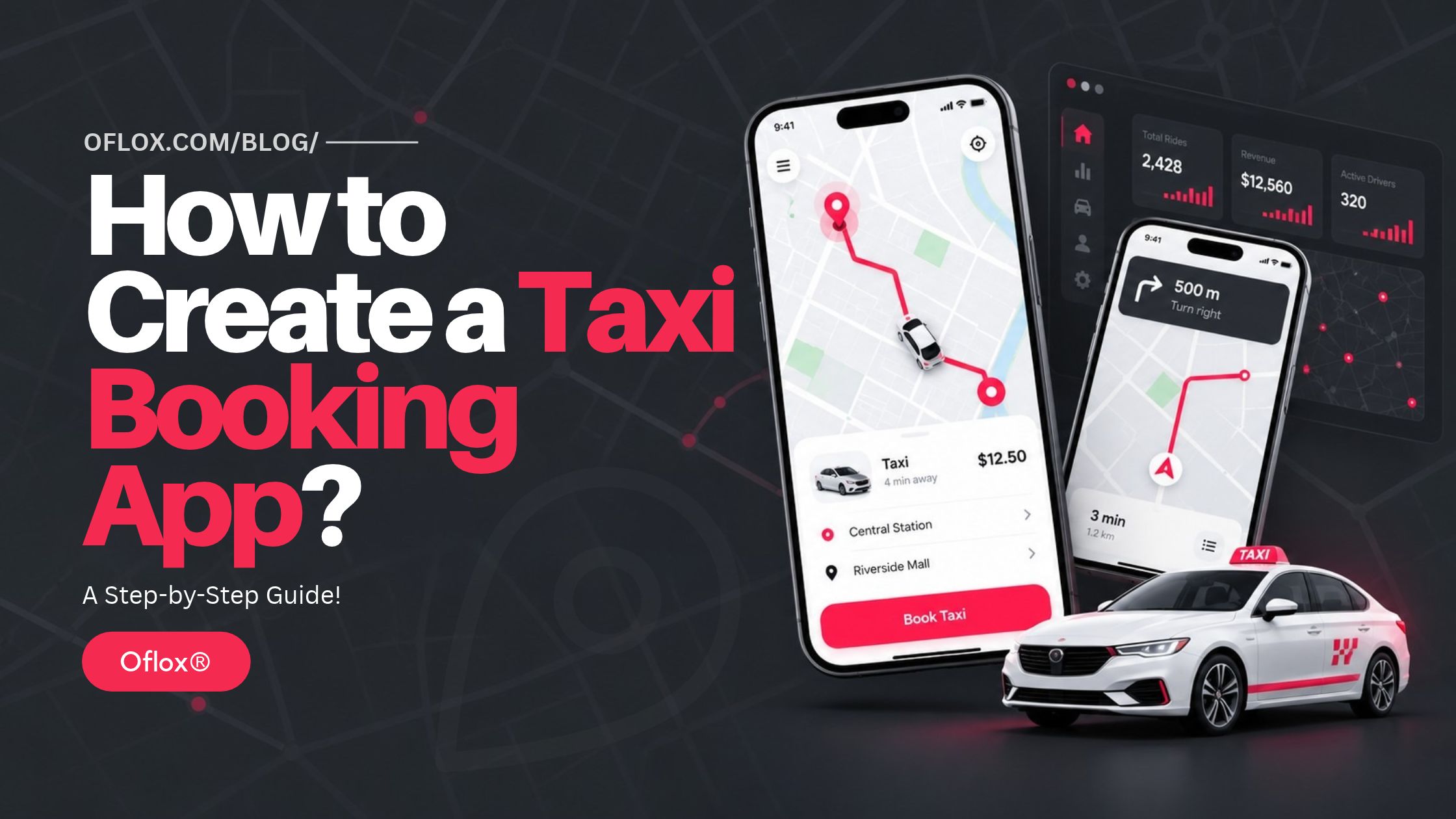
In this guide, we will explore how to create a taxi booking app step by step, compare essential features and technology options, explain development cost considerations, and share practical tips for launching and growing your service.
Let’s explore it together!
Table of Contents
What Is a Taxi Booking App?
A taxi booking app is a digital platform that allows passengers to request or schedule rides, connects them with available drivers, calculates fares and manages trip updates and payments. A complete taxi booking system usually includes a passenger app, a driver app, an admin dashboard and a shared backend.
The backend is the central system that stores bookings and applies business rules. An API is the connection through which the apps communicate with that system.
For example, when a passenger requests a ride, the backend checks the service area, identifies eligible drivers, manages acceptance and sends booking updates to both sides.
Taxi Booking Software vs a Ride-Hailing Marketplace:
An existing taxi operator may need software to manage its own vehicles and bookings. A marketplace connects passengers with independent drivers or fleet partners.
Both need reliable technology. However, a marketplace must also balance driver supply, passenger demand, partner settlements and wider operational responsibilities.
Understanding this difference helps you choose the right features, budget and operating model.
Why Create a Taxi Booking App?
A well-planned taxi app can reduce booking friction and improve visibility across your business.
Passengers get clearer pickup information, trip records and payment choices. Drivers receive structured requests and earnings information. Operators can monitor bookings without depending entirely on phone calls and spreadsheets.
Useful business benefits include:
- Direct customer relationships and repeat bookings.
- Better visibility into vehicle availability.
- More consistent fare communication.
- Faster investigation of complaints and payment issues.
- Data for improving service areas and operating hours.
- Opportunities for airport, hotel and corporate partnerships.
These benefits depend on execution. An app cannot compensate for frequent cancellations, unavailable drivers or unanswered support calls.
For a smaller operator, reliable scheduled pickups may create more value than launching every feature offered by a national platform.
A Brief History of Taxi Booking Apps
Taxi booking traditionally depended on street hailing, taxi stands and telephone dispatch. Operators assigned vehicles through calls, radios or manual records.
Smartphones, mobile internet, digital maps and GPS made it possible to connect passengers and drivers through a shared digital system.
Uber’s own founding account records a New York test in January 2010 and a San Francisco launch on 31 May 2010. It provides one example of the early development of smartphone-based ride services.
Over time, taxi platforms expanded beyond instant booking into scheduled rides, digital payments, business travel and specialised transport.
The lesson for a new business is practical: technology should match how customers travel in your market, including local addresses, languages, payment habits and connectivity.
How Does a Taxi Booking App Work?
A taxi booking app connects passengers with available drivers and manages each stage of the journey. Here’s how the process works.
A typical booking follows this sequence:
- The passenger selects pickup and drop locations.
- The system checks availability and displays a fare estimate or quote.
- The passenger confirms the request.
- Eligible drivers receive an offer.
- One driver accepts and receives the pickup details.
- The passenger sees driver information and arrival updates.
- The driver verifies the passenger and starts the trip.
- The trip ends, payment is recorded and a receipt becomes available.
The admin team needs visibility throughout this journey.
If no driver accepts, the app should provide a clear outcome rather than leave the passenger watching an endless loading screen.
Scheduled bookings need an additional process: reservation, advance allocation, reminders and a recovery plan if the assigned driver becomes unavailable.
Choose Your Taxi App Business Model
Your business model affects the product, operating costs and revenue structure.
| Model | How it operates | Suitable starting point |
|---|---|---|
| Owned fleet | Your business operates the vehicles | Established taxi companies |
| Driver marketplace | Independent drivers accept bookings | Businesses able to build local supply |
| Fleet partner network | Partner operators provide vehicles | Regional travel businesses |
| Scheduled transfers | Customers reserve trips in advance | Airport, station and hotel transfers |
| Corporate transport | Organisations book employee travel | B2B operators with recurring contracts |
Possible revenue models include commissions, driver subscriptions, corporate contracts and service fees where permitted.
Put the rules in writing. Drivers should understand payouts, deductions and cancellation policies. Passengers should understand what the displayed fare includes.
Avoid introducing a wallet, lending product or complex subscription system until the underlying business need and regulatory implications are clear.
How to Create a Taxi Booking App?
Here is a step-by-step guide to creating a taxi booking app, from researching your market to launching your service.
1. Research One Specific Market
Start with a defined service area and customer problem.
Speak with passengers, drivers, fleet owners, hotels and local businesses. Ask when bookings fail, which routes are difficult and what customers currently do instead.
Useful questions include:
- Are customers looking for immediate or advance bookings?
- Which hours have the greatest unmet demand?
- What causes drivers to reject requests?
- Which pickup points are confusing?
- How do customers prefer to pay?
- What would make them book again?
An illustrative Dehradun service might begin with airport transfers and selected city routes. That is a planning example, not evidence of local demand. Validate the opportunity through interviews and actual booking enquiries.
Record findings in a short research document before commissioning development.
2. Validate Demand and Driver Supply
A working marketplace needs passengers and available vehicles in the same place at the same time.
Before a full build, test interest through a landing page, callback form or manually coordinated booking pilot. Meet applicable operating requirements before carrying passengers commercially.
Track enquiries, accepted fares, completed trips, cancellations and repeat requests. Also record whether enough drivers were available during promised service hours.
If customers enquire but reject the price, the problem may be positioning or economics. If they accept but no driver arrives, the problem is supply.
This distinction prevents spending development money on the wrong issue.
3. Define Your Minimum Viable Product
An MVP, or minimum viable product, is the smallest version that can deliver a complete, dependable service.
For taxi booking, that usually means:
- Passenger registration.
- Pickup and destination selection.
- Pricing.
- Booking confirmation.
- Driver assignment.
- Trip status updates.
- Payment recording.
- Customer support.
Separate requirements into launch essentials and later improvements.
Loyalty points, multi-stop trips and advanced subscriptions can wait if they do not support the initial service promise.
Write acceptance criteria for every important feature. For example:
When no driver accepts within the configured search period, the passenger receives an availability message and can safely retry.
Clear acceptance criteria make proposals easier to compare and completed work easier to verify.
4. Map the Complete Booking Lifecycle
Document every booking state before designing screens.
Typical states include:
- Requested.
- Searching.
- Assigned.
- Driver arriving.
- Arrived.
- In progress.
- Completed.
- Cancelled.
- Expired.
Record who can trigger each change. A passenger may cancel an eligible booking, while only the assigned driver should start that trip after the required verification.
Keep payment states separate. A completed ride may still have a pending payment; a cancelled booking may have a refund in progress.
The backend should enforce these rules. Otherwise, two drivers could accept the same request or a delayed message could incorrectly reopen a completed booking.
5. Review Operating and Compliance Requirements
For an Indian launch, assess the Motor Vehicle Aggregator Guidelines, 2025, alongside the applicable state or union territory framework. The central guidelines are an important reference; local licensing and implementation must be checked for your operating model.
Create a requirements register covering licences, driver and vehicle checks, insurance, fare rules, safety processes, complaints and records. Assign an owner to each item.
India’s DPDP Rules, 2025, were notified with phased implementation. Check which provisions apply on your launch date rather than assuming every obligation began together.
Translate the relevant requirements into product tasks, operating procedures and vendor contracts before development is finalised.
6. Design Simple Passenger and Driver Experiences
Create wireframes for booking, accepting, starting, completing and cancelling trips. Then test a clickable prototype with intended users.
Passengers should immediately understand:
- The pickup location.
- The fare basis.
- The selected vehicle category.
- The current booking status.
- How to contact support.
Drivers need readable requests, clear action buttons and limited typing. Test screens in daylight and on affordable phones.
Include landmark instructions because an address pin may point to the wrong gate or road. Let passengers correct pickup details before confirmation.
Design error messages early. “Payment is being verified” is more useful than showing a generic failure when the transaction status is uncertain.
7. Choose Custom Development or a White-Label Platform
White-label software offers an existing product under your branding. Custom development gives you greater control over workflows and integrations.
| Approach | Main advantage | Main consideration |
|---|---|---|
| White-label platform | Faster access to standard features | Licensing, restrictions and vendor dependence |
| Custom development | Control over product and architecture | Higher initial effort and ownership responsibility |
| No-code prototype | Quick validation of simple workflows | Limits for complex real-time operations |
Request a demonstration using your actual booking scenarios, including cancellations and failed payments.
Check source ownership, data export, account ownership, maintenance terms and exit support. A low setup fee may be less attractive once recurring charges and restrictions are included.
8. Build the Backend and Integrations
The backend manages users, drivers, vehicles, bookings, pricing, payments and notifications.
For a first launch, a modular monolith is often a sensible engineering choice: one deployable application with clearly separated business modules. More distributed architecture becomes useful when measured scale or organisational needs justify it.
Maintain a durable database record for important actions. Use background jobs for receipts and other tasks that can complete asynchronously.
External services should have timeout and recovery behaviour. If a map or messaging provider is unavailable, the app should explain the problem and preserve the booking state.
9. Implement Dispatch, Maps and Live Tracking
Dispatch decides which driver receives a booking. Start by filtering drivers by availability, vehicle category, service permissions and recent location. Then shortlist nearby candidates and compare pickup travel times.
A driver across a river may appear close on the map but take longer to reach the passenger. Road travel time is usually more useful than straight-line distance alone.
Google’s route matrix API can calculate distances and durations between multiple origins and destinations. This supports comparisons between shortlisted drivers and a pickup point.
Avoid calculating routes for the entire fleet on every request. Test matching quality alongside API usage and response time.
10. Integrate Payments and Settlements
Decide which payment methods your service will accept and how money reaches drivers or fleet partners.
Use a suitable payment provider and verify transaction status on the server. A success animation or screenshot should not be treated as payment confirmation.
Razorpay’s documentation explains signature verification, duplicate webhook handling and events arriving out of order. Build these conditions into payment processing.
Use idempotency: processing the same event again must not create another charge, refund or earnings entry.
Maintain records for fares, commissions, cash collections, refunds and payouts. Reconcile these records against provider reports regularly, with an exception queue for mismatches.
11. Test Difficult Real-World Conditions
Test the complete journey on real devices and actual roads.
Important scenarios include:
- Weak internet.
- Stale GPS positions.
- Denied permissions.
- App restarts.
- Screen locking.
- Driver rejection.
- Sudden loss of connectivity.
Android restricts background location access and expects it to be necessary for core functionality. Permissions and implementation need to match the actual use case.
Also test two drivers accepting simultaneously, repeated booking taps, delayed payment confirmation and a refund request after cancellation.
Run security and load checks appropriate to the launch. Most importantly, rehearse incident handling with the operations team before accepting public bookings.
12. Launch in a Controlled Area and Improve
Begin with a limited geography, defined operating hours and enough verified drivers for the promised service.
Train drivers and support staff. Check settlement accuracy, emergency escalation and complaint handling before increasing marketing spend.
Monitor:
- Booking completion rate.
- Pickup time.
- Cancellation reasons.
- Repeat usage.
- Driver availability.
- Contribution per ride.
Review results by area and time slot.
Expansion should follow dependable operations and acceptable economics. Adding another city creates new supply, support and compliance work, even when the software is already built.
Essential Taxi Booking App Features
Here are the essential features your taxi booking app should include to support a smooth booking experience.
1. Passenger App Features
Passengers need a clear path from enquiry to completed journey.
- Phone verification and account access.
- Pickup and destination selection with landmarks.
- Vehicle categories and understandable pricing.
- Immediate or scheduled booking, according to scope.
- Driver, vehicle and booking information.
- Arrival updates and trip tracking.
- Available payment options and receipts.
- Cancellation rules, support and safety access.
- Trip history and feedback.
Keep sensitive information visible only when needed. Shared trip links should expire and reveal only appropriate journey details.
2. Driver App Features
Drivers need online and offline controls, booking offers, pickup instructions, navigation, passenger verification and trip actions.
Include earnings records, settlement status, support access and document renewal reminders. A driver should be able to distinguish gross fares from deductions and money already collected in cash.
Unclear earnings screens create avoidable disputes.
3. Admin Dashboard Features
The admin panel is essential for resolving situations the apps cannot handle automatically.
| Function | Why it matters |
|---|---|
| Driver and vehicle approval | Controls who can provide service |
| Booking and dispatch view | Helps recover delayed or failed assignments |
| Fare and service-area settings | Keeps operations within approved scope |
| Refund and settlement tools | Supports accurate financial handling |
| Complaint and incident records | Preserves context and accountability |
| Role permissions and audit logs | Restricts and records sensitive actions |
Give staff access according to their responsibilities.
A support executive handling a pickup complaint does not automatically need permission to change payout details.
5+ Technology & Tools for Taxi App Development
Choose technology according to team skills, location behaviour, integration requirements and maintenance capacity.
| Layer | Options to evaluate | Decision factor |
|---|---|---|
| Mobile apps | Flutter, React Native, native Android/iOS | Device behaviour and team expertise |
| Backend | Node.js, Django, Spring Boot | Maintainability and integration fit |
| Database | PostgreSQL; PostGIS where useful | Transactions and geographic queries |
| Temporary data | Redis where justified | Fast access to short-lived information |
| Live updates | WebSockets with reconnect handling | Timely trip status delivery |
| Maps | Google Maps Platform or regional alternatives | Local route quality, terms and costs |
| Payments | Suitable regulated payment providers | Methods, refunds and settlement model |
| Delivery tools | Git, CI/CD and issue tracking | Controlled releases and accountability |
These are evaluation options, not a compulsory stack or a claim that every product suits every project.
Test location behaviour before committing to a framework. Cross-platform code can reduce duplication, but device permissions and platform-specific work still need attention.
Keep backend secrets out of mobile applications. Restrict client-facing map keys using the provider’s supported controls.
How Much Does It Cost to Create a Taxi Booking App?
Cost depends on platforms, workflows, integrations, design, testing, security and post-launch responsibilities.
The following are illustrative planning allowances, not surveyed market averages or Oflox® quotations. They assume outsourced development for an Indian project; actual proposals may differ substantially.
| Product scope | Illustrative allowance | Illustrative timeline |
|---|---|---|
| Clickable prototype | ₹75,000–₹2.5 lakh | 2–5 weeks |
| White-label pilot setup | ₹2–₹8 lakh | 4–10 weeks |
| Custom single-city MVP | ₹12–₹30 lakh | 4–7 months |
| More complex platform | ₹35 lakh–₹1 crore or more | 8–15 months or more |
The custom MVP allowance assumes:
- Rider and driver apps built with a shared cross-platform approach.
- A basic admin panel.
- A backend.
- Standard maps and payments.
- Limited launch scope.
Separate native apps or complex dispatch can raise effort considerably. Allow separately for legal work, operating licences, insurance, taxes, driver onboarding, marketing and working capital. Timelines depend on team capacity and external approvals.
Understand Taxi App Unit Economics
Gross booking value is the total value of bookings; it is not automatically the platform’s revenue.
Consider this simplified hypothetical commission model:
| Item per completed ride | Amount |
|---|---|
| Customer fare | ₹300 |
| Driver entitlement | ₹240 |
| Platform share | ₹60 |
| Assumed variable platform costs | ₹25 |
| Contribution before fixed costs and tax | ₹35 |
Variable costs might include payment processing, communications, support and incentives. Their actual amounts depend on contracts and usage.
If fixed monthly costs are ₹3,50,000 and contribution remains ₹35 per ride, the simple break-even calculation is:
₹3,50,000 ÷ ₹35 = 10,000 completed rides per month.
This example excludes tax, financing and several operational complexities. Its purpose is to show why completed profitable rides matter more than app downloads.
Common Challenges and Practical Solutions
A reliable taxi booking app needs to handle everyday problems well. Below are key challenges and solutions to consider.
- Driver Shortages and Cancellations: Measure availability by service area and time slot. Recruit around actual demand, explain earnings clearly and investigate rejection reasons. Offer passengers honest availability information. Promising immediate pickup everywhere can damage trust quickly.
- Location Errors and Connectivity Gaps: Show when a location was last updated. Support landmark notes and sensible reconnect behaviour. Do not present a stale driver position as a live reading. Preserve active trip information when the app restarts.
- Safety and Privacy: A safety button needs a monitored response process, escalation rules and trained staff. Test who receives an alert and what happens when they cannot respond. Limit location collection and staff access to defined purposes. Maintain a retention schedule that balances applicable record obligations with privacy requirements.
- Fraud and Operational Abuse: Review unusual booking patterns, repeated promotions, suspicious refunds and account takeovers. Apply stronger checks to payout account changes. Flag anomalies for review and allow legitimate users to challenge incorrect decisions. Automated risk scores should support accountable operations.
Real-World Examples and Product Lessons
Uber is a recognisable example of an on-demand ride service, while traditional taxi businesses demonstrate the importance of dispatch and local operating knowledge.
Study the customer problem behind a feature rather than copying a competitor’s screens. For example, an airport transfer service may prioritise flight details, luggage requirements and advance allocation.
A corporate transport service may need employee permissions, billing references and monthly reconciliation. A small local fleet might gain more from a dependable dispatch dashboard and repeat-booking flow than from complex demand forecasting.
These examples illustrate different product priorities. They do not establish that a particular model will succeed in your city.
Expert Planning Tips and Common Mistakes
Get ownership of your domain, app-store accounts, cloud accounts, repositories and payment accounts clearly documented.
Ask developers to demonstrate recovery from failures, not only a successful booking. Request an export of bookings and settlement records before accepting a vendor’s data portability claim.
Common mistakes include:
- Launching across too large an area.
- Building advanced features before proving repeat demand.
- Treating the admin panel as optional.
- Ignoring cash reconciliation and refunds.
- Collecting unnecessary location data.
- Depending on one vendor without an exit plan.
- Spending heavily on downloads before fixing cancellations.
Set launch criteria in advance. These should include verified supply, working payment reconciliation, tested support escalation and no unresolved critical booking or security defects.
Future Trends in Taxi Booking Apps
The following are planning directions rather than guaranteed predictions.
- Better Demand Forecasting: Once reliable booking data exists, forecasting may help operators plan shifts and position vehicles. Start with understandable rules before introducing complex models.
- Electric Vehicle Operations: EV fleets may need charging availability, battery range and charging downtime in dispatch decisions. Vehicle counts alone do not show usable supply.
- Regional Language and Voice Journeys: Voice input and local-language interfaces could reduce booking friction. Confirm recognised destinations visually before creating a trip.
- More Accountable Automation: Automated support can answer routine questions, while refunds, disputes and safety incidents still need clear escalation and human oversight.
- Stronger Operational Integration: Fleet maintenance, corporate billing and partner settlement may become more valuable than adding another passenger-facing feature. Evaluate every trend against a measurable customer or operating problem.
FAQs:)
A. Research a defined market, validate demand and driver supply, select a business model, define your MVP and review operating requirements. Then design and build passenger, driver and admin experiences, integrate maps and payments, test real-world failures and launch a controlled pilot.
A. You can use no-code tools for a prototype or simple booking workflow. A white-label platform can provide more complete functionality. Production dispatch, background tracking, payments and safety operations still require technical evaluation, configuration and maintenance.
A. A limited custom MVP might be planned over four to seven months under the assumptions used in this guide. The actual schedule depends on team size, platforms, integrations, reviews and readiness of your operating processes.
A. Check the phones used by your intended passengers and drivers. Android may be a practical starting point for some Indian services, but validate this with your audience. Cross-platform development can support both major platforms when scope and budget allow.
A. The answer depends on your operating model, location and applicable state or union territory rules. Review the central 2025 guidelines and relevant local framework with qualified advisers before launch. App-store approval does not establish transport compliance.
A. It can retain selected information and recover after disconnection. However, reliable new matching, live updates and payment verification normally require connectivity. Clearly communicate limited connectivity and preserve authoritative trip records on the server.
A. Possible models include commissions, subscriptions, corporate contracts and permitted service fees. Profit depends on completed rides, driver costs, variable expenses and fixed operating costs. More bookings do not guarantee better margins.
A. Build the booking journey your initial market needs, with basic dispatch, payment records, support and admin controls. Keep the launch area small. Postpone features that do not improve booking completion, safety, driver operations or repeat usage.
Conclusion:)
Creating a taxi booking app starts with understanding your customers, drivers, and the transport service you want to provide.
Begin with a focused service area, essential booking features, transparent pricing, and reliable driver assignment. Support these with secure payments, accurate trip updates, and accessible customer support.
Test your app in real-world conditions, monitor completed rides and cancellations, and use feedback to improve your service before expanding.
At Oflox®, the practical lesson is straightforward: successful taxi app development requires dependable technology and well-managed daily operations.
“A successful taxi booking app earns customer trust through reliable pickups, clear pricing, and support when it matters.” — Mr Rahman, Oflox®
Read also:)
- How to Secure Website Admin Panel: A Step-by-Step Guide!
- How to Prepare for AI Bubble Burst: A Step-by-Step Guide!
- 10+ Best AI Voice Calling Agents in India: A Complete Guide!
Are you planning to create a taxi booking app, and which features matter most to your business? Share your ideas, challenges, or development questions in the comments below.