This complete guide will explain PPC Advertising vs Social Media Marketing, how both marketing strategies work, their major benefits, key differences, ROI potential, and how businesses can choose the right approach according to their digital marketing goals.
Digital marketing has become one of the most important ways for businesses to reach potential customers, increase website traffic, generate leads, improve brand awareness, and grow their online presence.
However, with so many digital marketing channels available today, choosing the right strategy can sometimes become difficult.
This is where understanding PPC Advertising and Social Media Marketing becomes important.
PPC (Pay-Per-Click) Advertising is a paid digital marketing method where businesses can promote their products or services to targeted audiences and generally pay when users click on their advertisements. It is commonly used for generating quick traffic, leads, sales, and measurable conversions.
On the other hand, Social Media Marketing focuses on using platforms such as Facebook, Instagram, LinkedIn, YouTube, and X to publish content, engage audiences, increase brand visibility, and build long-term customer relationships.
Both strategies can play an important role in a successful digital marketing campaign. However, their cost, targeting methods, audience behaviour, engagement potential, performance metrics, and marketing objectives can be quite different.
PPC advertising is generally suitable for businesses looking for faster traffic and measurable conversions, while social media marketing can be particularly useful for brand awareness, audience engagement, community building, and long-term customer relationships.
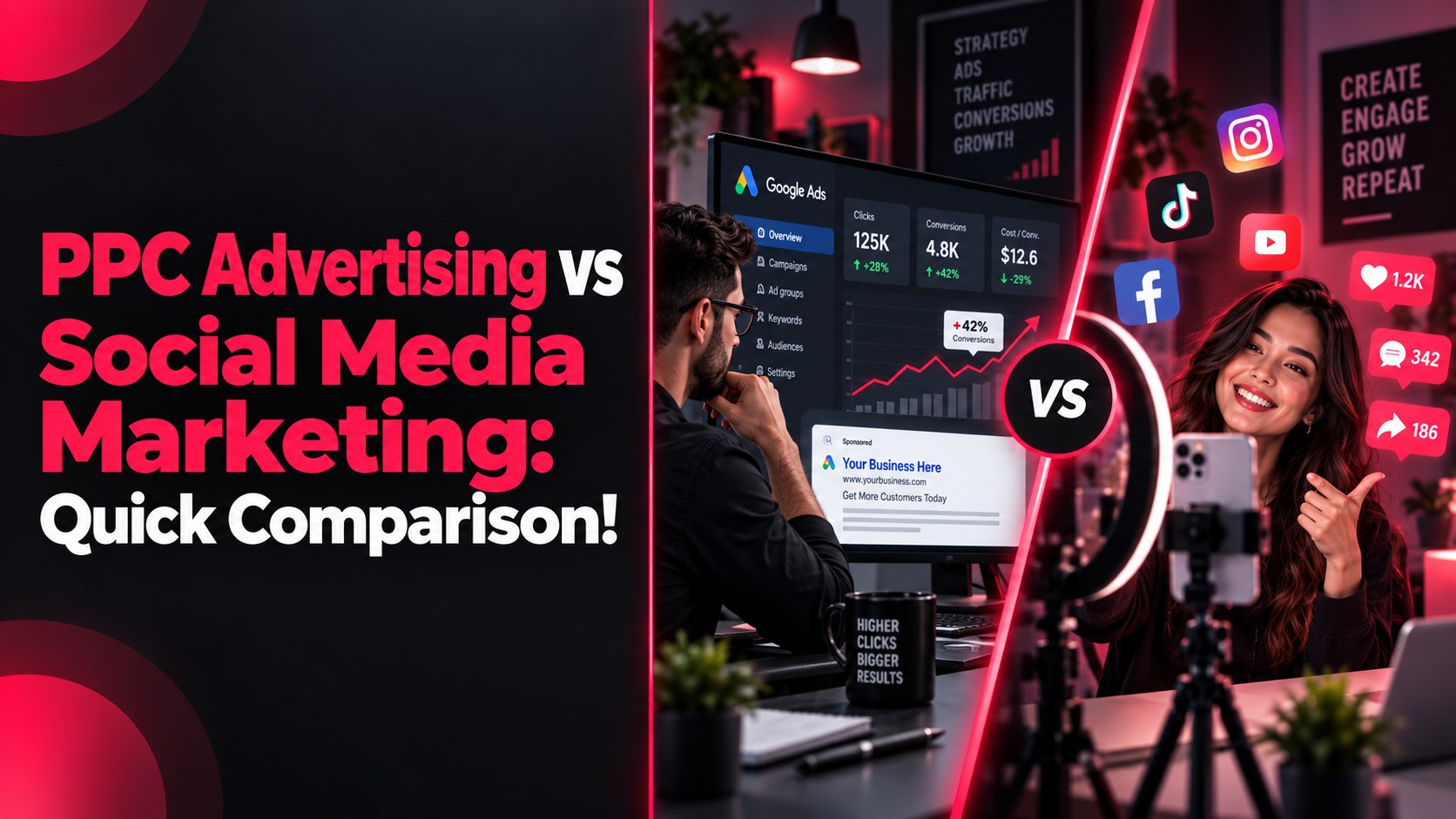
Whether you are a business owner, digital marketer, startup founder, marketing professional, or someone planning to promote a product or service online, understanding the difference between PPC and social media marketing can help you make better marketing decisions and use your budget more effectively.
Let’s explore it together.
Table of Contents
PPC Advertising: A Quick Overview of Its Mechanics
PPC advertising is a model where businesses pay a fee each time their ad is clicked. This method is particularly effective for targeting specific keywords that potential customers are searching for. One niche-specific detail in PPC is the use of KPI Dashboarding, which allows marketers to track the effectiveness of their campaigns in real time by monitoring key performance indicators such as click-through rates and conversion rates. By understanding these metrics, businesses can adjust their bids and strategies to maximize their advertising budget. Additionally, utilizing Digital Marketing Services can enhance the effectiveness of these campaigns.
A significant advantage of PPC is the immediacy of results. Once a campaign is launched, ads appear promptly in search engine results, driving traffic almost instantaneously. Additionally, the ability to target ads geographically ensures that businesses reach the right audience, thereby optimizing campaign performance. However, the cost-per-click can vary significantly depending on the competitiveness of the keywords chosen.
Social Media Marketing: Engaging Audiences Effectively
Social media marketing involves creating and sharing content on platforms like Facebook, Instagram, and Twitter to engage and grow a business’s audience. A key aspect of this strategy is Agile Sprint Planning, which allows marketing teams to quickly adapt to trends and consumer feedback, ensuring content remains relevant and engaging. This flexibility is crucial in a rapidly changing digital landscape.
Engagement is the hallmark of social media marketing. By fostering a two-way conversation with audiences, businesses can build brand loyalty and increase customer retention. Unlike PPC, social media allows for organic growth through shares and likes, which can amplify a brand’s reach without additional costs. However, measuring the direct ROI can be challenging due to the qualitative nature of metrics like engagement and brand sentiment.
Comparing ROI: PPC Versus Social Media Campaigns
When evaluating the ROI of PPC and social media campaigns, it’s essential to consider both direct and indirect benefits. PPC campaigns typically offer a clear and measurable ROI through conversions and sales figures. According to recent data from Statista, businesses often see a 200% ROI on their PPC investments. In contrast, social media marketing’s ROI can be more challenging to quantify, as it often manifests through enhanced brand awareness and customer engagement.
Another critical factor in this comparison is the concept of Benchmarking Metrics. By establishing benchmarks for each campaign type, businesses can evaluate performance against industry standards and historical data. This analysis helps in identifying which strategy yields better results in specific contexts. For instance, a business focused on immediate sales might find PPC more effective, whereas one aiming for long-term brand building might prefer social media marketing.
For businesses offering Digital Marketing Services, understanding these nuances is vital in crafting campaigns that align with client objectives while maximizing returns on advertising spend.
Choosing the Right Strategy for Your Digital Marketing Goals
The decision between PPC advertising and social media marketing ultimately depends on your specific business objectives and target audience. If immediate traffic and measurable conversions are your primary goals, PPC may be the more suitable choice. On the other hand, if building a community and enhancing brand loyalty are your priorities, social media marketing might be the better option.
Utilizing tools such as a RACI Matrix can facilitate decision-making by clarifying roles and responsibilities within your marketing team, ensuring that all aspects of your strategy are aligned with your business goals. Furthermore, integrating both strategies can often yield the best results, leveraging the strengths of each to create a comprehensive digital marketing approach.
FAQs:)
A. PPC Advertising mainly focuses on paid traffic, targeted clicks, leads, and measurable conversions, while Social Media Marketing focuses more on brand awareness, audience engagement, content sharing, and community building.
A. It depends on your business goals. PPC may be more suitable for quick traffic and conversions, while Social Media Marketing can be more useful for long-term brand growth and audience engagement.
A. PPC usually requires a direct advertising budget because businesses pay for clicks or campaign activity. Social Media Marketing can include both organic and paid methods, so its cost can vary depending on the strategy.
A. Yes. Many businesses use both strategies together. PPC can help generate faster leads and conversions, while Social Media Marketing can support brand awareness, customer engagement, and long-term audience growth.
A. PPC generally gives faster results because paid ads can start driving targeted traffic soon after the campaign is launched. Social Media Marketing usually takes more time to build consistent engagement and organic reach.
Conclusion:)
We hope this article has helped you understand the difference between PPC Advertising and Social Media Marketing, how both strategies work, and which approach can support different digital marketing goals.
PPC Advertising plays an important role in generating quick website traffic, targeted leads, measurable conversions, and immediate campaign visibility. It allows businesses to target specific keywords, audiences, locations, and customer intent while tracking important performance metrics such as clicks, CPC, conversions, and return on advertising spend.
On the other hand, Social Media Marketing focuses more on brand awareness, audience engagement, content distribution, community building, and long-term customer relationships. Social platforms allow businesses to communicate directly with their audience and build stronger brand visibility over time.
However, choosing between PPC and Social Media Marketing is not only about deciding which strategy is better. Businesses should consider factors such as marketing objectives, target audience, budget, competition, campaign duration, customer behaviour, and expected results before selecting the right approach.
In many situations, businesses can achieve stronger results by combining both strategies. PPC can help capture high-intent customers and generate faster conversions, while Social Media Marketing can support brand awareness, engagement, and long-term audience growth. The original comparison similarly notes that integrating both approaches can create a more comprehensive digital marketing strategy.
“Successful digital marketing is not about choosing between paid reach and social engagement—it is about using the right strategy for the right audience at the right time.” — Oflox®
Read also:)
- Marketing Automation vs SEO Services: Quick Comparison!
- Social Media Agency vs Influencer Marketing: Quick Comparison!
- What Is JavaScript Async? A Complete Beginner’s Guide!
Have questions or suggestions about PPC Advertising or Social Media Marketing? Share them in the comments below and help other businesses understand which digital marketing strategy can work better for different goals.