This detailed guide explains everything you need to know about What Is a Reverse Proxy Server, including its meaning, history, working process, architecture, features, benefits, challenges, popular tools, real-world examples, best practices, and common mistakes.
Modern websites and web applications are expected to be fast, secure, and always available, even when handling thousands or millions of users at the same time. But have you ever wondered how popular platforms like Google, Netflix, Amazon, and Microsoft manage massive traffic while keeping their backend servers protected? One of the key technologies behind this is the Reverse Proxy Server.
Instead of allowing users to connect directly to a web server, a reverse proxy acts as an intelligent gateway that receives incoming requests, applies security and performance optimisations, and forwards them to the appropriate backend server. This improves website speed, strengthens security, balances traffic, manages SSL/TLS encryption, and ensures high availability—making reverse proxies an essential part of modern web infrastructure.
Whether you’re a student, web developer, system administrator, DevOps engineer, or business owner, understanding reverse proxy servers is an important step toward building secure and scalable applications.
Let’s explore it together.
Table of Contents
What Is a Reverse Proxy Server?
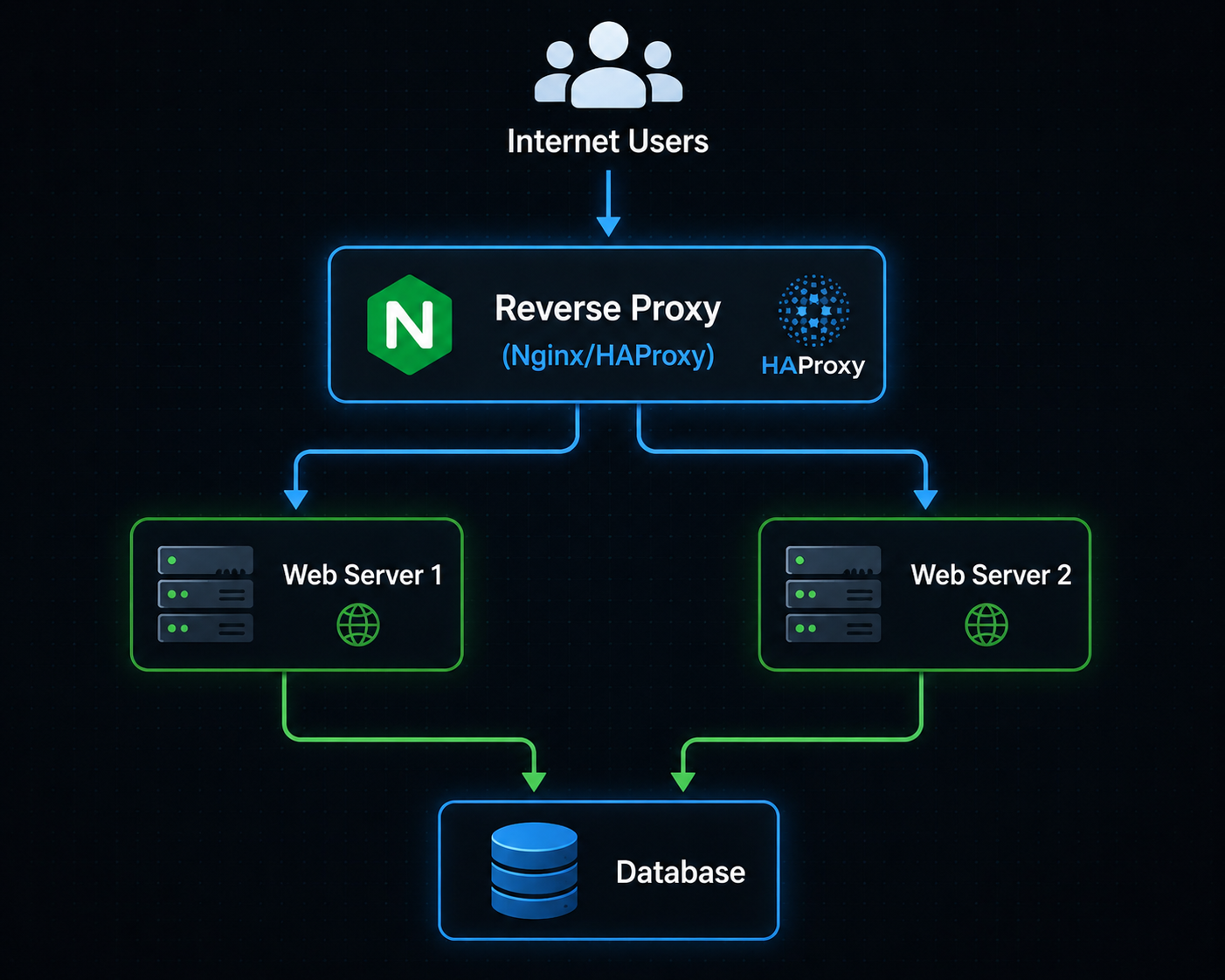
A Reverse Proxy Server is a server positioned between users (clients) and one or more backend servers. It receives incoming requests from users, processes them if necessary, and forwards them to the appropriate backend server.
Instead of users communicating directly with the web server, they only interact with the reverse proxy.
After receiving the response from the backend server, the reverse proxy sends it back to the user.
This means the backend servers remain hidden from the public internet.
Easy Real-Life Example
Imagine visiting a luxury hotel. You don’t directly walk into the manager’s office to request a room. Instead, you first meet the receptionist.
The receptionist:
- Receives your request
- Checks availability
- Contact the appropriate department
- Returns with the response
You never communicate directly with the hotel’s internal staff.
The receptionist acts exactly like a Reverse Proxy Server.
| Hotel | Reverse Proxy |
|---|---|
| Guest | Client |
| Receptionist | Reverse Proxy |
| Hotel Staff | Backend Servers |
| Room Service | Web Application |
Why Is a Reverse Proxy Server Important?
As websites become larger and internet traffic continues to grow, directly exposing backend servers to users becomes risky and inefficient.
A reverse proxy solves many modern infrastructure challenges.
It provides:
- Better security
- Faster website loading
- SSL management
- Load balancing
- High availability
- Traffic optimization
- Attack protection
- Server anonymity
- Caching
- Better scalability
Without reverse proxies, many enterprise websites would struggle to handle millions of requests efficiently.
History and Background of Reverse Proxy Servers
The concept of proxy servers dates back to the early days of the internet.
Initially, organisations primarily used forward proxies to control employee internet access and improve browsing performance.
As websites became larger during the late 1990s and early 2000s, companies faced new challenges:
- Increasing web traffic
- Cyber attacks
- Server overload
- Hardware limitations
- Growing demand for secure HTTPS communication
To address these issues, engineers introduced reverse proxy servers, which focused on protecting web servers rather than users.
Over time, reverse proxies evolved into intelligent traffic managers capable of:
- SSL/TLS termination
- Load balancing
- Content caching
- Web Application Firewall (WAF) integration
- API gateway functionality
- Rate limiting
- DDoS mitigation
Today, reverse proxies are a standard component of cloud computing, Kubernetes clusters, container platforms, CDNs, and enterprise web infrastructure.
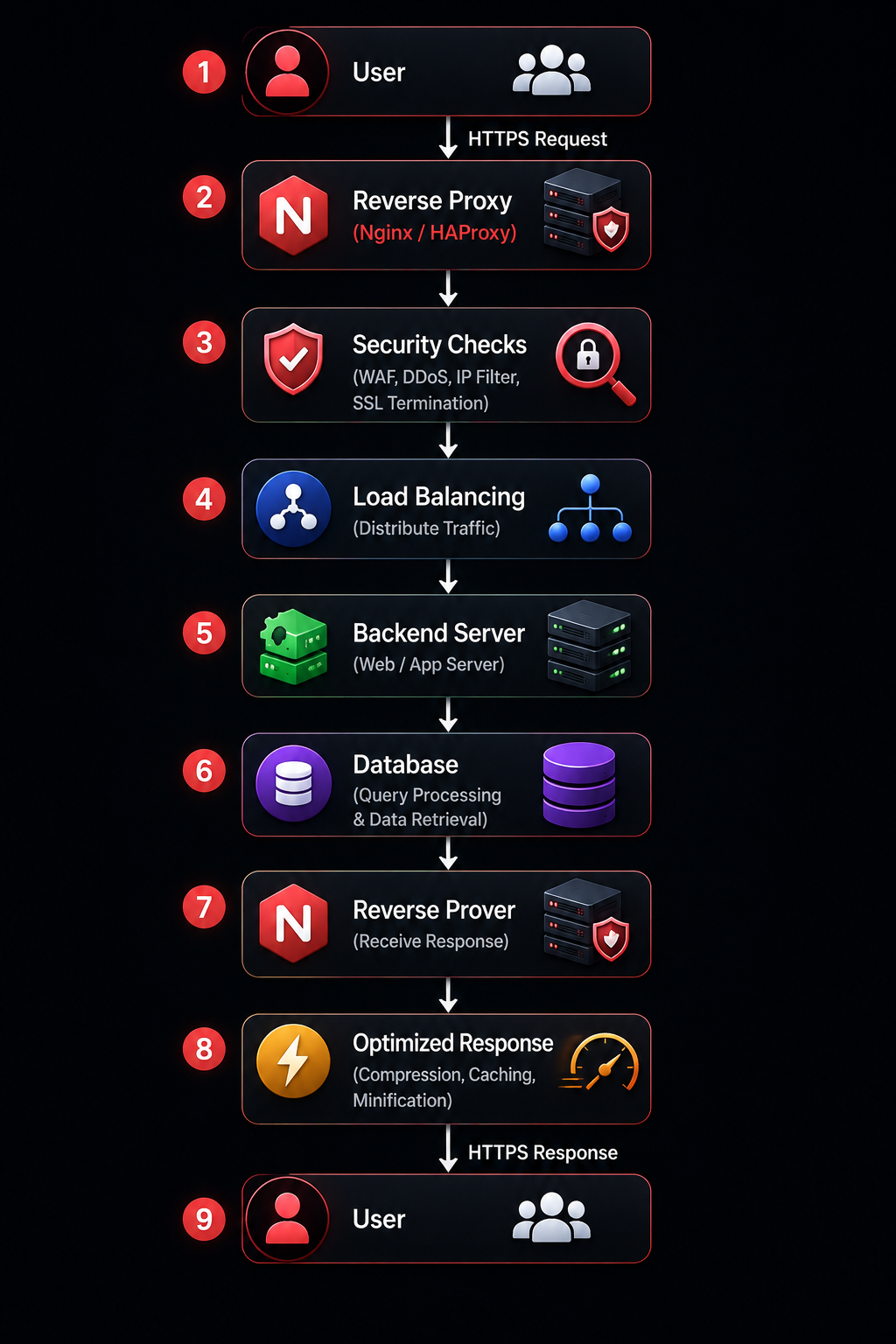
How Does a Reverse Proxy Server Work?
Understanding the working process is easier than it sounds.
Let’s break it down step by step.
1. User Sends a Request
A user types:
www.example.cominto their browser. The browser sends an HTTPS request.
2. Request Reaches the Reverse Proxy
Instead of reaching the web server directly, the request first arrives at the Reverse Proxy.
The proxy receives every incoming request.
3. Reverse Proxy Inspects the Request
The proxy may:
- Check SSL certificates
- Inspect headers
- Verify security rules
- Apply firewall policies
- Check cache
- Block malicious traffic
- Authenticate users
4. Select Backend Server
If multiple servers exist, the reverse proxy decides where to send the request.
It may use:
- Round Robin
- Least Connections
- IP Hash
- Weighted Routing
- Geographic Routing
- Health Checks
5. Backend Server Processes Request
The selected backend server processes the request.
Examples:
- Fetch product details
- Login user
- Retrieve database records
- Generate webpage
- Process payment
6. Response Returns to Reverse Proxy
The backend server sends the generated response back to the reverse proxy.
7. Reverse Proxy Optimizes Response
Before sending data back, it may:
- Compress files
- Cache responses
- Add security headers
- Encrypt data
- Remove sensitive server information
8. User Receives Response
Finally, the browser receives the webpage without ever knowing which backend server actually handled the request.
Reverse Proxy Architecture
Request Flow Explained
Real-World Example of a Reverse Proxy
Imagine an online shopping platform during a major festive sale.
Within seconds, millions of customers begin browsing products, adding items to their carts, and placing orders.
If every customer connected directly to a single backend server, that server could quickly become overloaded, leading to slow performance or even downtime.
Instead, the platform places a reverse proxy in front of multiple application servers. The reverse proxy receives all incoming requests, filters suspicious traffic, manages SSL encryption, distributes users across healthy servers, serves cached content when possible, and forwards each request to the most appropriate backend server.
As a result, customers experience faster page loads, improved reliability, and a secure shopping experience—even during peak traffic.
This is why leading companies such as Google, Netflix, Amazon, Microsoft, and many large SaaS providers rely on reverse proxy technology as a core part of their infrastructure.
Why Modern Websites Rely on Reverse Proxies
Today, reverse proxy servers are widely used because they help organisations:
| Challenge | How a Reverse Proxy Helps |
|---|---|
| Heavy website traffic | Distributes requests across multiple servers |
| Cyber attacks | Filters and blocks malicious traffic |
| Slow loading speed | Uses caching and compression to improve performance |
| SSL certificate management | Handles HTTPS encryption centrally |
| Backend server exposure | Hides internal server details from the internet |
| High availability | Routes traffic only to healthy servers |
| Scaling applications | Makes it easy to add or remove backend servers |
| Maintenance | Allows backend servers to be updated without affecting users |
Key Features of a Reverse Proxy Server
A reverse proxy server offers much more than simply forwarding requests. It acts as a smart gateway that improves security, performance, reliability, and scalability. Below are the most important features that make reverse proxies an essential part of modern web infrastructure.
1. Load Balancing
One of the most valuable features of a reverse proxy is load balancing.
Instead of sending all requests to a single server, the reverse proxy intelligently distributes traffic across multiple backend servers.
This prevents server overload and ensures better performance.
Common Load Balancing Algorithms:
| Algorithm | Description |
|---|---|
| Round Robin | Requests are distributed equally among servers. |
| Least Connections | New requests go to the server with the fewest active connections. |
| Weighted Round Robin | More powerful servers receive more traffic. |
| IP Hash | Users consistently connect to the same backend server. |
| Least Response Time | Chooses the fastest available server. |
Benefits:
- Better performance
- Improved uptime
- Easy scalability
- Reduced server overload
2. SSL/TLS Termination
Handling HTTPS encryption requires CPU resources.
Instead of every backend server performing encryption and decryption, the reverse proxy handles SSL/TLS.
This is called SSL Termination.
Advantages:
- Reduced backend server workload
- Centralised certificate management
- Easier certificate renewal
- Faster application performance
3. Security Protection
Reverse proxies significantly improve security by hiding backend servers from public users.
Users never communicate directly with application servers.
The reverse proxy can:
- Block malicious requests
- Filter suspicious traffic
- Hide server IP addresses
- Prevent server fingerprinting
- Integrate with Web Application Firewalls (WAF)
4. Caching
Many websites repeatedly serve the same content.
Instead of asking backend servers every time, the reverse proxy stores frequently requested pages.
When another user requests the same content, it is delivered instantly from the cache.
Cached Content Examples:
- Images
- CSS files
- JavaScript
- Product pages
- Blog articles
- API responses
Result:
- Faster websites
- Lower server load
- Better user experience
5. Compression
Reverse proxies reduce the size of responses before sending them to users.
Common compression methods include:
- Gzip
- Brotli
Benefits include:
- Faster loading
- Lower bandwidth usage
- Better Core Web Vitals
- Improved SEO performance
6. Web Application Firewall (WAF) Integration
Many reverse proxies integrate with WAF solutions.
The firewall blocks attacks before they reach the application.
Common attacks stopped include:
- SQL Injection
- Cross-Site Scripting (XSS)
- Directory Traversal
- Command Injection
- Bot attacks
7. Rate Limiting
A reverse proxy can limit how many requests a client can send within a specific period.
Example:
100 requests per minute
If a client exceeds the limit, additional requests are blocked or delayed.
This helps prevent:
- API abuse
- Brute-force attacks
- Login abuse
- Spam traffic
8. Health Checks
The reverse proxy continuously monitors backend servers.
If a server becomes unavailable, traffic is automatically redirected to healthy servers.
Users remain unaware of server failures.
9. URL Routing
Requests can be routed to different services based on rules.
Example:
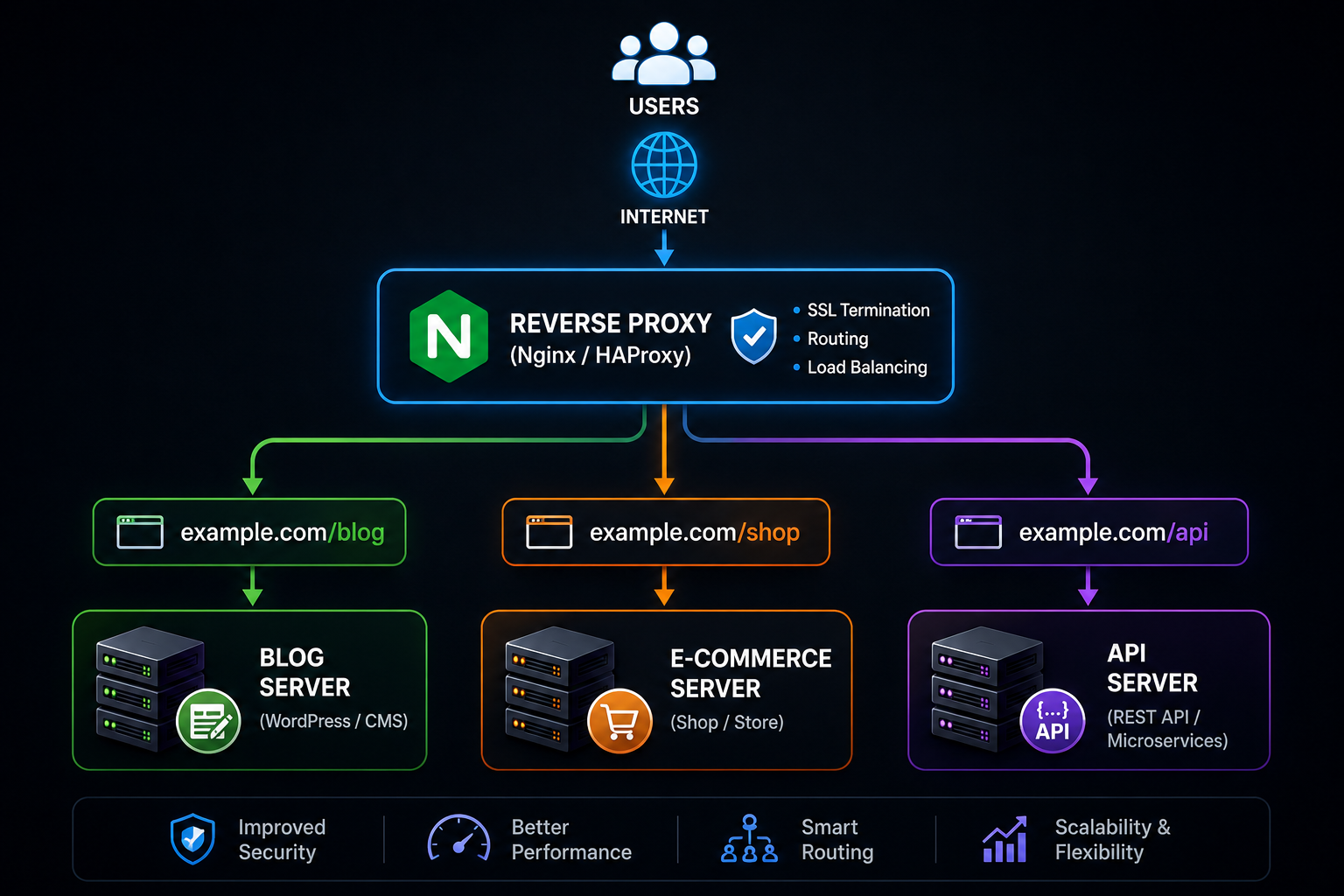
This is widely used in microservices architecture.
10. Logging and Monitoring
Every request can be logged.
Administrators can monitor:
- Response time
- Error rate
- Traffic source
- Geographic traffic
- Server health
- Security events
Benefits of Using a Reverse Proxy Server
Reverse proxies provide advantages for organisations of every size.
1. Improved Website Security
Backend servers remain hidden from users. Attackers cannot directly discover internal infrastructure.
Security improves through:
- IP hiding
- Request filtering
- WAF integration
- SSL management
- Bot detection
2. Better Website Performance
Features such as caching, compression, and intelligent routing significantly improve website speed.
Users experience:
- Faster loading
- Lower latency
- Better browsing experience
3. High Availability
If one backend server fails, requests automatically move to another healthy server.
This reduces downtime.
4. Scalability
As traffic grows, administrators simply add more backend servers.
The reverse proxy automatically distributes requests.
No major application changes are required.
5. Centralised SSL Management
Rather than installing certificates on every backend server, administrators manage certificates only on the reverse proxy.
This simplifies maintenance.
6. Reduced Backend Workload
The reverse proxy performs many resource-intensive tasks:
- SSL encryption
- Compression
- Caching
- Traffic routing
Backend servers can focus on business logic.
7. Easier Maintenance
Servers can be updated individually.
Traffic is temporarily redirected to other servers during maintenance.
Users experience minimal disruption.
8. Better SEO Performance
Fast-loading websites often provide a better user experience.
Reverse proxies contribute by:
- Reducing latency
- Improving Core Web Vitals
- Enabling compression
- Supporting CDN integration
These improvements can indirectly support search engine optimisation.
Challenges and Limitations
Despite many advantages, reverse proxies also have limitations.
1. Additional Infrastructure
A reverse proxy introduces another server layer.
This requires:
- Configuration
- Monitoring
- Maintenance
2. Configuration Complexity
Incorrect settings may cause:
- Redirect loops
- SSL errors
- Routing failures
- Broken applications
Experienced administration is important.
3. Single Point of Failure
If only one reverse proxy is deployed and it fails, the entire application may become unavailable.
This is why enterprises usually deploy redundant reverse proxies.
4. Hardware Costs
Large organisations may require:
- Multiple proxy servers
- High-performance hardware
- Additional networking equipment
Cloud-based reverse proxies can reduce some infrastructure costs.
5. Debugging Complexity
Requests pass through several layers:
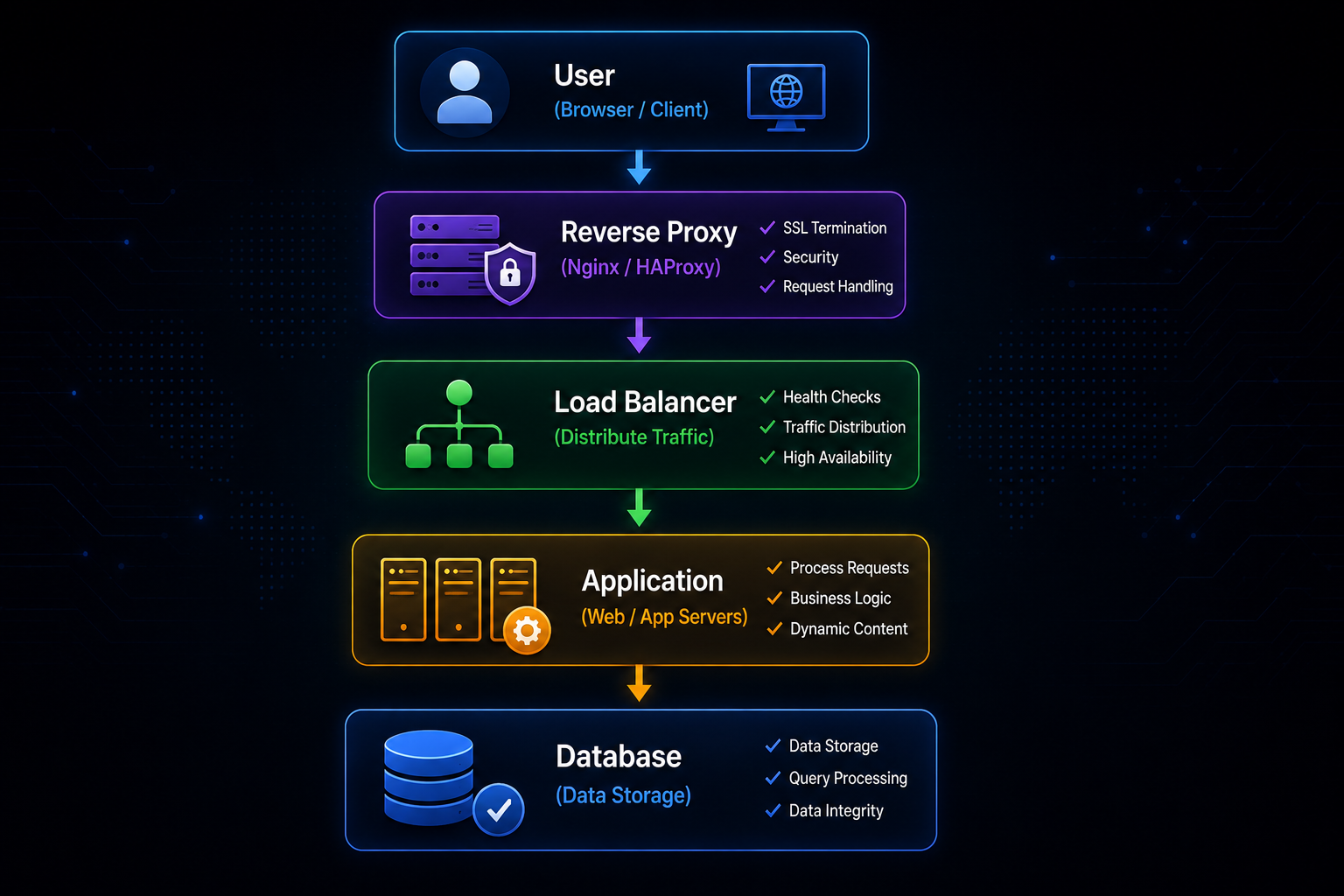
Troubleshooting becomes more complex than in simple architectures.
Popular Reverse Proxy Tools
Many reverse proxy solutions are available today.
Each has different strengths.
| Tool | Best For | Open Source |
|---|---|---|
| Nginx | High-performance web applications | Yes |
| Apache HTTP Server | Traditional web hosting | Yes |
| HAProxy | Enterprise load balancing | Yes |
| Traefik | Docker & Kubernetes environments | Yes |
| Envoy Proxy | Cloud-native microservices | Yes |
| Caddy | Automatic HTTPS configuration | Yes |
| Microsoft IIS ARR | Windows Server environments | No |
| Cloudflare | Global CDN and reverse proxy services | No (service) |
| AWS Application Load Balancer | AWS cloud applications | Managed service |
| Google Cloud Load Balancer | Google Cloud deployments | Managed service |
Reverse Proxy vs Forward Proxy
These two technologies are often confused.
| Feature | Reverse Proxy | Forward Proxy |
|---|---|---|
| Works For | Servers | Clients |
| Purpose | Protect backend servers | Protect client identity |
| Location | In front of servers | In front of users |
| User Awareness | Usually invisible | Often configured by users or organisations |
| Main Goal | Performance and security | Privacy and access control |
Simple Analogy:
- Forward Proxy: Represents the user when accessing the internet.
- Reverse Proxy: Represents the server when responding to users.
Reverse Proxy vs Load Balancer
Although many reverse proxies include load balancing, the two are not identical.
| Reverse Proxy | Load Balancer |
|---|---|
| Security features | Primarily traffic distribution |
| SSL termination | May or may not terminate SSL |
| Caching | Usually unavailable |
| Compression | Usually unavailable |
| URL routing | Limited in many dedicated load balancers |
| WAF integration | Less common in standalone load balancers |
Many enterprise products combine both capabilities.
Reverse Proxy vs VPN
| Reverse Proxy | VPN |
|---|---|
| Protects servers | Protects users |
| Routes web traffic to backend applications | Encrypts all supported network traffic between user and VPN server |
| Improves website performance | Focuses on privacy and secure remote access |
| Used by website owners | Used by internet users and organisations |
Reverse Proxy vs CDN
A Content Delivery Network (CDN) and a reverse proxy often work together.
| CDN | Reverse Proxy |
|---|---|
| Distributes content globally | Manages requests to backend servers |
| Uses edge locations | Typically sits in front of the application infrastructure |
| Focuses on reducing latency | Focuses on security, routing, caching, and traffic management |
| Best for static content delivery | Supports both dynamic and static request handling |
Many CDN providers also include reverse proxy functionality.
Real-World Examples of Reverse Proxy Servers
Reverse proxy servers power many of the world’s most popular websites and online services, helping them deliver secure, fast, and reliable experiences to millions of users every day.
1. E-commerce Website
During a festive sale, thousands of customers visit simultaneously.
The reverse proxy:
- Distributes traffic
- Caches product pages
- Handles SSL
- Protects checkout servers
2. Banking Portal
A bank uses a reverse proxy to:
- Hide internal servers
- Encrypt communications
- Prevent DDoS attacks
- Enforce security policies
3. Streaming Platform
Video platforms use reverse proxies to:
- Route users efficiently
- Balance traffic
- Improve availability
- Deliver cached content where appropriate
4. SaaS CRM Platform
A CRM application serves customers worldwide.
The reverse proxy routes requests to different application clusters based on availability and infrastructure design, helping maintain consistent performance.
5. Government Services Portal
Public service websites often experience spikes during deadlines.
A reverse proxy helps:
- Distribute traffic
- Reduce downtime
- Filter malicious requests
- Improve reliability during peak demand
Expert Tips for Using Reverse Proxy Servers
Deploying a reverse proxy effectively requires careful planning and ongoing management. Keep these best practices in mind:
- Choose a reverse proxy that matches your infrastructure and traffic needs.
- Enable HTTPS and keep SSL/TLS certificates up to date.
- Use health checks to avoid sending traffic to unhealthy servers.
- Configure caching carefully so frequently accessed content is served quickly while dynamic data remains accurate.
- Apply rate limiting to reduce abuse and brute-force attempts.
- Integrate a Web Application Firewall (WAF) for an additional layer of protection.
- Monitor logs, latency, and error rates to identify issues early.
- Test configuration changes in a staging environment before deploying them to production.
- Maintain backup configurations and document routing rules for easier recovery.
- Review security settings regularly as applications and traffic patterns evolve.
Common Reverse Proxy Mistakes
Even experienced administrators can make configuration errors. Avoid these common mistakes:
- Exposing backend server IP addresses to the public.
- Using expired or incorrectly configured SSL certificates.
- Forgetting to enable health checks for backend servers.
- Caching sensitive or personalised content unintentionally.
- Ignoring security headers such as HSTS and Content Security Policy (CSP).
- Not setting request rate limits for public-facing APIs.
- Running only a single reverse proxy without redundancy, creating a single point of failure.
- Failing to monitor logs, which can delay detection of attacks or performance issues.
- Misconfiguring routing rules, causing redirect loops or unavailable services.
- Skipping regular software updates, leaving known vulnerabilities unpatched.
Future Trends of Reverse Proxy Servers
As web applications become more distributed and AI-driven, reverse proxy servers will continue evolving beyond simple traffic forwarding. They are becoming intelligent traffic management platforms capable of improving security, performance, automation, and observability.
Here are some of the major trends expected in 2026 and beyond.
1. AI-Powered Traffic Management
Artificial Intelligence will increasingly help reverse proxies make smarter routing decisions.
Instead of relying only on static algorithms, AI will analyse:
- Server health
- Traffic patterns
- User behaviour
- Network congestion
- Resource utilisation
This enables faster responses and better load distribution.
2. Zero Trust Security Integration
The Zero Trust security model is becoming the standard for modern organisations.
Future reverse proxies will verify every request before forwarding it to backend servers.
Key features include:
- Continuous authentication
- Identity verification
- Device validation
- Risk-based access control
3. Cloud-Native Reverse Proxies
As more businesses migrate to cloud platforms, reverse proxies will become tightly integrated with cloud-native technologies such as:
- Kubernetes
- Docker
- Serverless computing
- Multi-cloud deployments
Dynamic service discovery and automatic scaling will become standard capabilities.
4. Edge Computing Integration
Instead of processing requests only in central data centres, reverse proxies will increasingly operate at edge locations closer to users.
Benefits include:
- Lower latency
- Faster content delivery
- Reduced bandwidth usage
- Better user experience
5. Advanced API Gateway Features
Modern applications rely heavily on APIs.
Future reverse proxies will provide richer API management features such as:
- API authentication
- Request validation
- Rate limiting
- Version management
- Analytics
- Developer portals
6. Smarter Security Detection
Machine learning will help reverse proxies detect unusual behaviour automatically.
Examples include:
- Bot detection
- DDoS attack mitigation
- Credential stuffing detection
- Automated threat intelligence
- Real-time anomaly detection
7. Better Observability
Reverse proxies will offer deeper visibility into application performance through:
- Distributed tracing
- Real-time dashboards
- Detailed logging
- Performance analytics
- AI-assisted troubleshooting
This will help administrators identify bottlenecks more quickly.
8. Green and Energy-Efficient Infrastructure
Sustainability is becoming a priority for data centres.
Future reverse proxies will optimise traffic routing to reduce:
- CPU usage
- Power consumption
- Network overhead
- Carbon footprint
FAQs:)
A. A reverse proxy server is an intermediary server that receives requests from users, forwards them to backend servers, and returns the response while improving security, performance, and scalability.
A. Its primary purpose is to protect backend servers, manage incoming traffic, improve website performance, and enhance availability.
A. A forward proxy represents the client and controls outbound internet access, while a reverse proxy represents one or more servers and manages inbound requests from users.
A. Yes. Nginx is one of the world’s most popular reverse proxy servers and is widely used for load balancing, caching, SSL termination, and traffic routing.
A. Yes. It can improve speed by caching content, compressing responses, reducing backend server load, and optimising request routing.
A. No. A reverse proxy improves security but does not replace a firewall. It is commonly used alongside network firewalls and Web Application Firewalls (WAFs) as part of a layered security strategy.
A. Yes. Cloudflare operates as a reverse proxy service by sitting between users and origin servers. It also provides CDN, DDoS protection, caching, SSL management, and additional security features.
A. Not always. A simple personal website may not require one. However, websites expecting higher traffic, handling sensitive data, or requiring improved security and scalability can benefit significantly from using a reverse proxy.
A. Yes. A single reverse proxy can route requests to multiple websites or applications based on the requested domain name, URL path, or other routing rules.
Conclusion:)
A Reverse Proxy Server is much more than an intermediary between users and backend servers—it is a critical component of modern web infrastructure that enhances security, performance, scalability, and reliability. By acting as the gateway for incoming traffic, it protects backend servers from direct exposure, balances workloads across multiple servers, manages SSL/TLS encryption, caches frequently requested content, and helps websites remain fast and available even during peak traffic.
As businesses continue embracing cloud computing, microservices, Kubernetes, edge computing, and AI-driven applications, reverse proxies will become even more intelligent and essential. Features such as AI-powered traffic routing, Zero Trust security, advanced API management, and real-time threat detection are shaping the future of reverse proxy technology, making it a cornerstone of next-generation digital infrastructure.
Whether you’re a student learning networking, a web developer building scalable applications, a system administrator managing enterprise servers, or a business owner looking to improve website performance, understanding how reverse proxy servers work is an invaluable skill. Mastering this technology will help you design secure, high-performing, and future-ready web applications that can confidently handle the growing demands of the modern internet.
“A reverse proxy doesn’t simply stand between users and servers; it builds a secure, scalable bridge that powers the modern internet.” — Mr Rahman, Founder of Oflox®
Read also:)
- What Is a Load Balancer? A Complete Guide for Beginners!
- How AI Is Reshaping the Future of Work: A Complete Guide!
- How to Improve Student Learning Experience: A Complete Guide!
Have you ever used or configured a Reverse Proxy Server? Share your experience or questions in the comments below—we’d love to hear from you!