This article provides a detailed guide about What Is Distillation in AI Models, how teacher and student models work, and how businesses can use this technique to build more efficient AI systems.
Have you ever wondered how a smaller AI model can perform useful tasks that were first demonstrated by a much larger model?
Large AI models can deliver impressive results, but running them may require expensive hardware, considerable memory, and ongoing infrastructure spending. These requirements can make deployment difficult for startups, mobile applications, and businesses serving thousands of users.
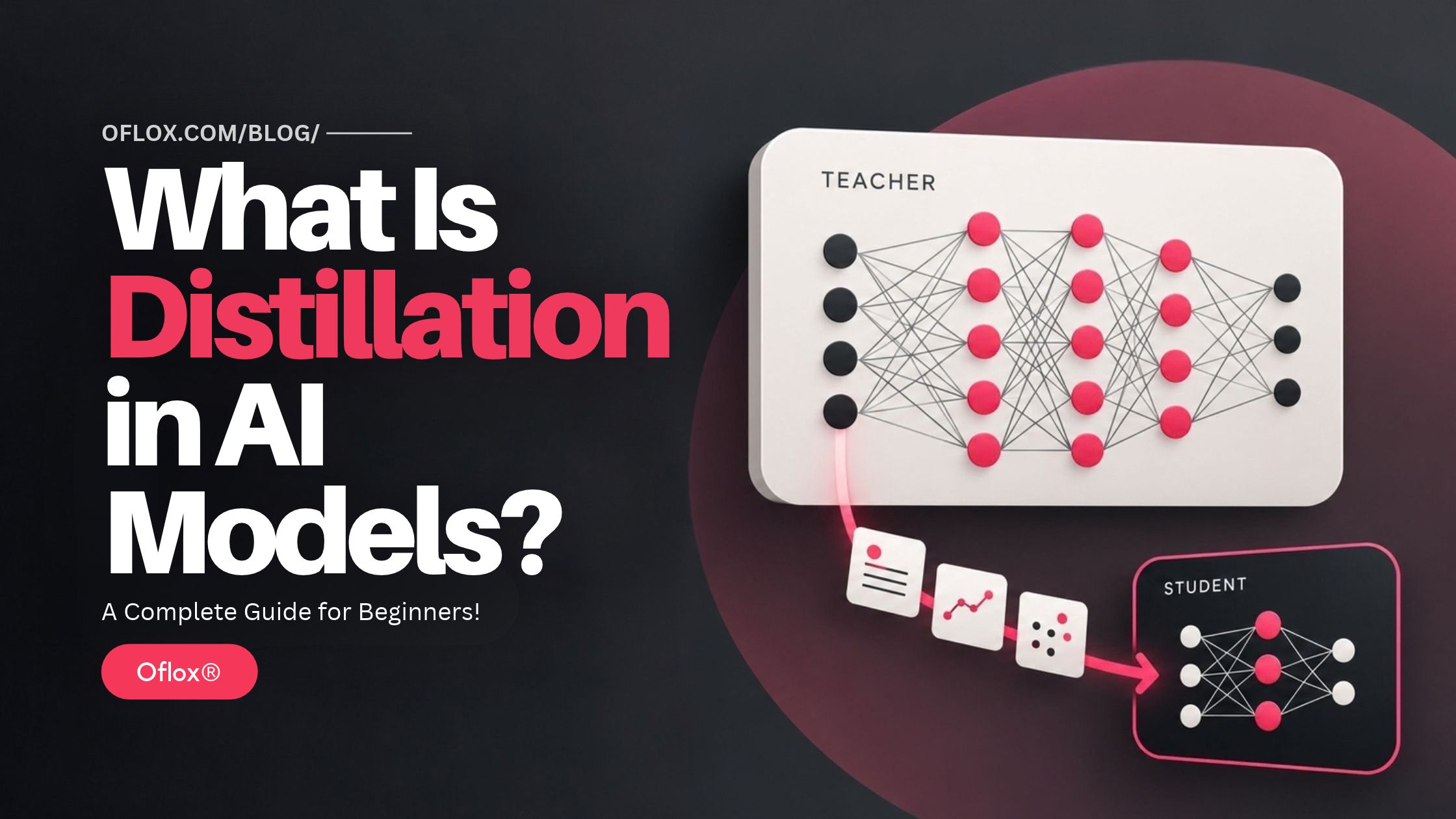
AI model distillation offers a way to transfer selected capabilities from a teacher model to a student model. The student is often smaller and designed for a more affordable deployment environment.
Think of an experienced trainer helping a junior employee handle a specific responsibility. The junior employee learns from examples and feedback, then performs the work independently. However, their ability still depends on the quality of that training and the complexity of the task.
For students, developers, digital marketers, and business owners, understanding distillation helps answer an important question: how much AI capability does an application actually need, and what is the most practical way to deliver it?
Let us understand the concept step by step.
Table of Contents
What Is Distillation in AI Models?
Distillation in AI models is a training technique in which a student model learns from a teacher model’s predictions, generated responses, or internal representations. Its purpose is to transfer useful behaviour, often into a smaller model that is easier to deploy.
The teacher provides training signals. The student adjusts its own parameters to learn from those signals.
In a typical project:
- The teacher model performs the target task well.
- The student model is designed for the intended deployment conditions.
- A transfer dataset supplies examples for learning.
- A training objective measures how well the student follows the desired behaviour.
The student does not need to reproduce every capability of the teacher. A model built for customer enquiry classification may only need to recognise enquiry categories accurately.
Distillation also does not necessarily mean copying the teacher’s weights. The student may have a different architecture and learn through outputs instead.
Although smaller students are common, model size alone does not define distillation. The defining feature is learning from another model’s guidance.
Why Is AI Model Distillation Important?
A successful AI product needs more than strong benchmark scores. It must also respond within an acceptable time, fit available infrastructure, and remain affordable to operate.
Distillation can help address these requirements.
1. It Can Reduce Serving Costs
A suitable student may require less computation per request than the teacher.
For a high-volume application, even a modest reduction can matter. However, savings must include the cost of generating training data, training the student, evaluating it, and maintaining it.
A small application may never recover those initial expenses.
2. It Can Improve Response Time
A smaller architecture may process requests faster on the target hardware.
Actual response time also depends on input length, output length, batching, network delays, and the inference engine. A lower parameter count does not automatically guarantee a faster user experience.
3. It Can Support Limited Hardware
Some applications must run on devices with restricted memory or computing power.
Examples include mobile applications, industrial equipment, and local document-processing systems. A carefully designed student may make deployment possible where the teacher is impractical.
4. It Can Create Focused Models
A business may need one narrow capability rather than a broad conversational assistant.
Distillation can support models focused on:
- Classifying customer enquiries.
- Extracting product attributes.
- Recognising document types.
- Identifying review sentiment.
- Following a specific response format.
5. It Can Support Local Processing
If the student runs locally, an application may process requests without sending every input to an external teacher.
This can support privacy goals, but privacy still depends on training data, application design, logging, access controls, and infrastructure security.
History and Background of Knowledge Distillation
Distillation developed from research into making complex predictive systems easier to deploy.
In 2006, Cristian Buciluă, Rich Caruana, and Alexandru Niculescu-Mizil published Model Compression. Their work explored training compact neural networks to approximate the behaviour of larger ensembles.
In 2015, Geoffrey Hinton, Oriol Vinyals, and Jeff Dean published Distilling the Knowledge in a Neural Network. Their influential approach used softened prediction distributions to provide richer guidance than a single correct label.
Later research applied distillation to language models, computer vision, and other tasks.
A well-known language-model example is DistilBERT, introduced in 2019. Its paper reported a model with 40% fewer parameters than BERT, 60% faster performance in the reported evaluation, and retention of approximately 97% of BERT’s language-understanding performance. These figures describe that research setup; they are not universal promises for distilled models.
More recently, distillation has also involved training language models on responses generated by stronger models.
How Does Distillation in AI Models Work?
The process usually begins with a deployment goal and ends with independent evaluation of the student.
1. Define the Task
Decide exactly what the student should do.
“Build a smaller AI model” is too broad. A useful objective might be:
Classify English and Hinglish customer messages into six enquiry categories within the application’s response-time limit.
Define the expected inputs, outputs, languages, error tolerance, and hardware.
2. Select a Suitable Teacher
Choose a teacher that performs well on the actual task.
A model with strong general benchmark results may still misunderstand your product terminology or regional language patterns.
Test representative examples before generating a large training dataset.
3. Choose the Student
Select a student architecture with enough capacity for the task.
A simple classification problem may need a compact encoder. A conversational task may require a generative language model.
The student should meet your operational requirements, but also have sufficient capacity to learn the desired behaviour.
4. Prepare Representative Data
Collect examples resembling real usage.
For an Indian customer-support application, these might include:
- Formal English.
- Simple conversational English.
- Hinglish.
- Spelling mistakes.
- Short, incomplete messages.
- Ambiguous requests.
- Queries outside the supported scope.
Keep training, validation, and final test data separate.
5. Produce Teacher Guidance
Depending on the method, the teacher may supply:
- Class probabilities.
- Generated answers.
- Structured outputs.
- Intermediate features.
- Rankings or scores.
Access matters. A text-only API may provide answers without exposing logits or internal representations.
6. Train the Student
The student learns through an objective that rewards the intended behaviour.
Classical distillation may combine teacher guidance with verified labels. Response-based LLM distillation may train the student on selected prompt–response pairs.
7. Evaluate the Result
Compare the distilled student against:
- The teacher.
- The same student trained without distillation.
- Simpler alternatives.
- The application’s acceptance requirements.
Check quality, latency, memory, cost, and failure patterns.
8. Deploy and Monitor
After release, monitor real inputs and performance.
A model trained on yesterday’s product catalogue may struggle after major catalogue changes. Distillation produces a trained model, not an automatically updated copy of its teacher.
Hard Labels, Soft Targets, and Temperature Explained
These terms are central to understanding classical knowledge distillation.
1. What Are Hard Labels?
A hard label identifies the expected class directly.
For a product image, the label might be:
Running shoe.
During ordinary supervised training, the model learns to assign the correct class a high score.
2. What Are Soft Targets?
Soft targets contain a distribution across possible classes.
Consider this illustrative teacher output:
| Product category | Teacher probability |
|---|---|
| Running shoe | 0.78 |
| Casual shoe | 0.18 |
| Sandal | 0.04 |
The output suggests that the image resembles a casual shoe more than a sandal.
That information can help guide learning beyond the single correct label. However, a teacher’s probabilities should not automatically be treated as perfectly calibrated real-world confidence.
3. What Does Temperature Do?
In classical distillation, temperature changes how sharply softmax converts model scores into probabilities.
A higher temperature generally makes the distribution softer, revealing differences among less likely classes. Teacher and student distributions are compared using the same distillation temperature.
A common classification objective is:
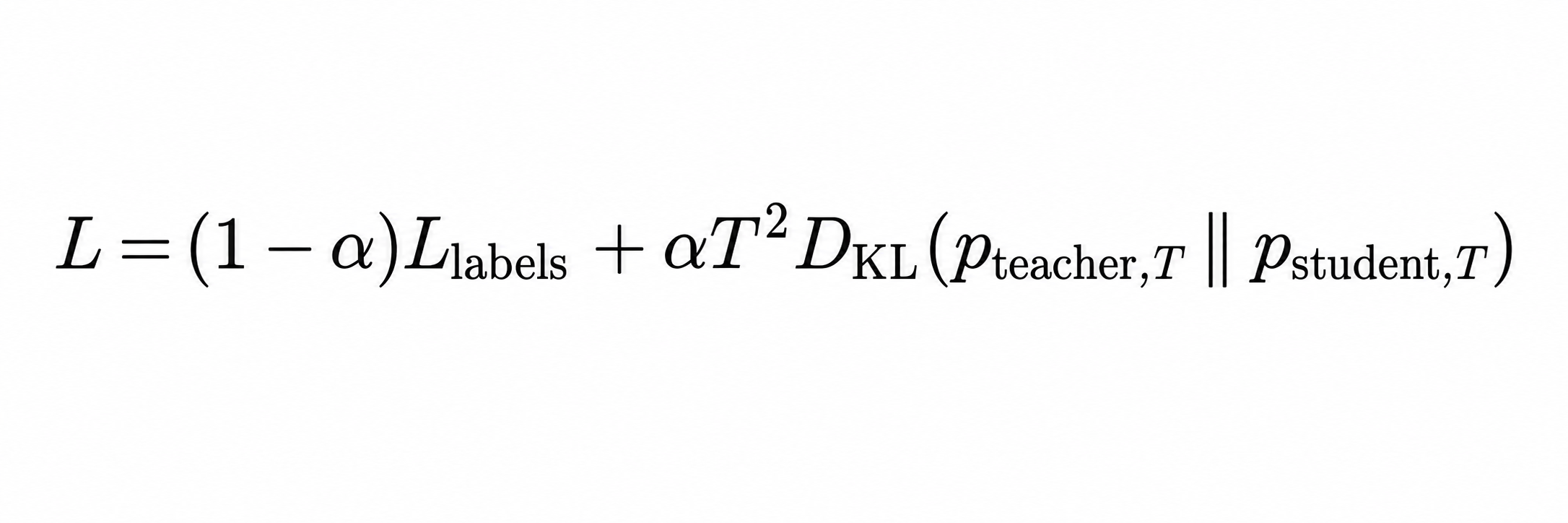
Here, T controls softness, while a balances label learning and teacher imitation. This is a common formulation, not the objective used by every distillation method.
Distillation temperature should also be distinguished from the sampling temperature used when generating text. They appear in different parts of the workflow.
Types of Distillation in AI Models
Different methods transfer different forms of guidance.
| Method | Learning signal | Typical application |
|---|---|---|
| Response-based distillation | Predictions or output distributions | Classification and language modelling |
| Feature-based distillation | Intermediate representations | Vision and representation learning |
| Relation-based distillation | Relationships among examples or features | Embedding and similarity tasks |
| Sequence-level distillation | Generated output sequences | Translation and text generation |
| Self-distillation | Guidance from the model itself or related versions | Improving learning within a model family |
1. Response-Based Distillation
The student learns from the teacher’s outputs. For classification, these may be probability distributions. For generative models, they may involve token-level predictions.
This is often the easiest method to understand because the teacher’s observable behaviour supplies the guidance.
2. Feature-Based Distillation
The student learns from intermediate features inside the teacher. For example, a vision model may learn representations that help identify shapes and objects.
Teacher and student feature dimensions may differ, so the training setup may require projection layers or other alignment methods.
3. Relation-Based Distillation
The student learns relationships rather than only individual outputs. For an embedding system, the objective might preserve which examples are similar and which are different.
This can be useful when the structure of the representation matters.
4. Sequence-Level Distillation
The teacher produces complete output sequences, and the student learns from them.
Examples include translated sentences and generated answers. The quality and variety of these sequences matter. Repeatedly training on narrow outputs can limit the student’s behaviour.
5. Self-Distillation
Self-distillation uses guidance from within a model or from related versions of it.
A separate, larger teacher is not always required. This shows why distillation is broader than simply reducing parameter count.
Offline vs Online Distillation
Distillation methods can also differ in how teacher guidance is produced.
- Offline distillation uses an already trained teacher. Its outputs can be cached or generated during student training.
- Online distillation involves models learning together, potentially exchanging guidance while training.
There is another distinction in generative modelling: off-policy versus on-policy data.
On-policy distillation can use sequences generated by the student, with the teacher providing feedback on those sequences. Research explores this approach to address differences between training examples and the outputs students produce during use.
These terms describe different aspects of training, so they should not be used interchangeably.
What Is Distillation in Large Language Models?
LLM distillation uses a teacher language model to guide the training of a student language model. The guidance may include generated responses, token distributions, or other training signals.
A practical response-based workflow might be:
- Prepare representative prompts.
- Generate teacher responses.
- Check and filter the responses.
- Train a student on the selected examples.
- Evaluate it on unseen tasks.
1. Example: A Product-Description Assistant
Suppose an online store needs descriptions with a consistent structure.
The teacher receives product specifications and generates descriptions containing:
- A short introduction.
- Verified product features.
- Suitable usage information.
- A fixed output format.
Editors check that the descriptions do not invent specifications. The approved examples become training material for the student.
The student may learn the format and style, but factual product information still needs to come from reliable inputs.
2. What About Reasoning Distillation?
Some workflows use teacher-generated reasoning examples to train students on mathematical, coding, or analytical tasks.
DeepSeek’s original R1 release included distilled Qwen- and Llama-based models trained using samples generated by DeepSeek-R1. This illustrates capability transfer through generated training data rather than simple copying of the teacher’s architecture.
A generated explanation is not proof of correctness. Evaluate final answers, consistency, and performance on unfamiliar problems.
Distillation vs Other AI Techniques
These approaches solve different problems and can sometimes be combined.
| Technique | Main purpose | What changes? |
|---|---|---|
| Distillation | Learn from a teacher | Student parameters through training |
| Fine-tuning | Adapt a model to data or tasks | Existing model parameters or adapters |
| Quantisation | Use lower numerical precision | Representation of weights or activations |
| Pruning | Remove selected model components | Weights, connections, or structures |
| RAG | Retrieve information during use | Context supplied to the model |
| Prompt engineering | Improve instructions | Input prompts |
1. Distillation vs Fine-Tuning
Fine-tuning adapts a pretrained model.
Distillation describes where the learning guidance comes from. If teacher-generated responses are used to fine-tune a student, the workflow involves both.
2. Distillation vs Quantisation
Quantisation represents values using lower precision.
Distillation trains a student to learn useful behaviour. A distilled student can later be quantised, but the combined result requires fresh evaluation.
3. Distillation vs Pruning
Pruning removes selected parts of an existing model.
Distillation may instead train a separate student architecture. The methods can be combined, but neither guarantees an acceptable quality–efficiency balance.
4. Distillation vs RAG
RAG retrieves relevant information during inference.
Distillation changes learned behaviour through training. If an application needs current policy documents or frequently changing prices, retrieval may still be necessary.
Key Features and Benefits of Distilled AI Models
The benefits depend on the student architecture and the task.
- Independent Operation: Once trained, a student can often perform its task without consulting the teacher for every request. This separates the training process from the serving process.
- Potentially Lower Memory Requirements: A smaller student may require less memory for its weights. Total runtime memory also includes activations, caches, framework overhead, and concurrent requests.
- Focused Behaviour: A student can be trained around a narrow application. For example, an enquiry classifier may recognise business categories without needing broad conversational abilities.
- More Flexible Deployment: An efficient student may support deployment on less expensive servers or selected local devices. Hardware compatibility and inference support still need checking.
- Better Use of Existing Model Expertise: Teacher guidance can supplement human-labelled data. However, synthetic labels are useful only when they are sufficiently accurate and representative.
- Improved High-Volume Economics: A modest reduction in cost per request can become meaningful at scale. The correct comparison is total operating cost at an acceptable quality level.
Practical Examples of AI Model Distillation
The following are illustrative scenarios, not reported Oflox® implementations.
1. Customer Enquiry Classification
A digital agency receives messages about SEO, websites, advertising, training, and unrelated topics.
A teacher helps label representative enquiries. A student learns to route messages to the appropriate team. Evaluate ambiguous messages and mixed-language inputs carefully.
2. Review Sentiment Analysis
An ecommerce business classifies reviews as positive, negative, or mixed.
Teacher guidance may help with subtle wording. However, sarcasm, regional expressions, and multilingual reviews need separate evaluation.
3. Document Extraction
A business wants structured fields from standard documents. A teacher generates candidate outputs, reviewers verify them, and a student learns the extraction format.
Keep scanned-image quality and OCR errors in the evaluation process.
4. Image Classification
A larger vision model guides a compact model that identifies product categories.
The student is tested on blurred photographs, different lighting, unfamiliar backgrounds, and new product designs.
5. Content Categorisation
A publisher assigns articles to editorial categories.
A student may learn classification from teacher-labelled examples. Human review remains useful for overlapping topics and taxonomy changes.
6. Support Reply Drafting
A student drafts responses for common support questions.
Changing policies should come from reliable source material, potentially through retrieval. Evaluate escalation behaviour as well as answer quality.
5+ Tools and Frameworks for AI Distillation
Choose tools according to the training signal and deployment plan.
| Tool or resource | Useful role |
|---|---|
| PyTorch | Custom training objectives and model experiments |
| Hugging Face Transformers | Loading and training supported models |
| Hugging Face Datasets | Preparing and processing training datasets |
| Hugging Face TRL | Supported LLM training workflows |
| ONNX Runtime | Serving and benchmarking compatible exported models |
| Experiment-tracking tools | Comparing quality, cost, and training settings |
1. PyTorch
PyTorch is suitable when developers need control over teacher outputs, student training, and custom losses.
Its official distillation tutorial demonstrates approaches involving output guidance and hidden representations.
2. Hugging Face TRL
TRL’s Generalized Knowledge Distillation Trainer provides a specialised workflow for supported generative distillation setups.
Check the current documentation and version requirements before implementation.
3. Deployment Tools
A serving runtime does not replace the training process.
After export or optimisation, test output consistency and benchmark the actual application workload.
How to Implement AI Model Distillation
Here is a practical project checklist.
1. Record Acceptance Criteria
Define measurable requirements:
- Task accuracy or quality.
- Maximum acceptable latency.
- Memory limit.
- Supported languages.
- Output-format requirements.
- Escalation conditions.
2. Establish Baselines
Test a simple solution and the student without teacher guidance. For predictable tasks, rules or an ordinary supervised classifier may already meet the requirement.
3. Check Usage Rights
Review teacher access terms, model licences, dataset permissions, and intended commercial use. Technical access alone does not establish permission for every training workflow.
4. Build the Transfer Dataset
Collect representative examples, remove unnecessary personal information, and reduce duplication. Split by customer, document source, or other relevant grouping where needed to prevent leakage.
5. Generate and Review Guidance
Record teacher versions and generation settings. Use checks appropriate to the task: schema validation, factual verification, code execution, or human review.
6. Train and Compare
Start with a manageable experiment. Change one major factor at a time so that improvements can be attributed to data, architecture, or training settings.
7. Test the Full Application
Include preprocessing, retrieval, inference, and post-processing. A model-only benchmark may miss the main source of application delay.
8. Release Gradually
Use a controlled rollout and monitor quality. Provide a fallback for unsupported or uncertain cases.
Challenges and Limitations of AI Distillation
Here are the key challenges and limitations of AI distillation you should understand before training and deploying a student model.
- Teacher Mistakes Can Be Learned: An incorrect teacher response can become a training target. Filtering and verified examples help, but they do not eliminate every error.
- Student Capacity Is Limited: A small student may handle routine tasks while struggling with complex reasoning or unfamiliar situations. Compression targets should follow application requirements.
- Dataset Coverage May Be Weak: Clean English examples may not represent real Hinglish messages. Missing rare cases can create serious weaknesses despite strong average results.
- Training Can Be Expensive: Teacher generation, training runs, evaluation, and maintenance all contribute to cost. Distillation is not automatically economical for low-volume use.
- Teacher Signals May Be Restricted: Some interfaces expose only text responses. Methods requiring logits or hidden states may therefore be unavailable.
- Existing Biases May Transfer: Teacher-generated data can contain uneven behaviour across languages, groups, or topics. Evaluate relevant slices rather than relying only on an overall score.
- Knowledge Can Become Outdated: The student does not automatically learn new teacher capabilities or changing business information. Plan refreshes or use external information sources where appropriate.
- Fluent Outputs Can Hide Errors: A student may produce polished answers while missing the underlying task. For extraction, check field accuracy. For coding, run tests. For factual answers, verify claims.
How to Measure a Distilled Model’s Performance
Measure the deployed result across several dimensions.
| Dimension | Example measure |
|---|---|
| Classification quality | Precision, recall, macro-F1 |
| Extraction quality | Field accuracy and schema validity |
| Generation quality | Task success and human review |
| Speed | Median and p95 latency |
| Memory | Peak memory under realistic load |
| Cost | Cost per successful task |
| Reliability | Failure and escalation rates |
| Language coverage | Results for each supported language |
P95 latency means 95% of measured requests finish within that duration.
It is useful because average latency can hide slow experiences.
Also distinguish teacher agreement from correctness. A student that reproduces the teacher’s mistakes can achieve high agreement without meeting the application’s requirements.
An Illustrative Cost Calculation
Suppose a business makes these planning assumptions:
| Item | Assumed amount |
|---|---|
| Initial distillation project cost | ₹1,20,000 |
| Monthly teacher-serving cost | ₹40,000 |
| Monthly student-serving cost | ₹15,000 |
| Additional student maintenance | ₹5,000 |
Monthly estimated savings would be:
₹40,000 − ₹15,000 − ₹5,000 = ₹20,000The simple payback period would be:
₹1,20,000 ÷ ₹20,000 = 6 monthsThese figures are hypothetical.
Real calculations should account for traffic changes, quality differences, fallback usage, retraining, and staff time. Savings matter only if the student delivers acceptable outcomes.
Expert Tips for Better Distillation Results
- Start with a Narrow Task: A clear task makes data collection and evaluation easier.
- Choose the Teacher Through Testing: Select the teacher using representative examples rather than model size alone.
- Prioritise Data Quality: A smaller set of reliable examples can be more useful than a large collection of unchecked outputs.
- Evaluate Indian Language Patterns: Test the English, Hindi, Hinglish, abbreviations, and spelling variations your audience uses.
- Reserve an Independent Test Set: Do not repeatedly tune against the final test set.
- Measure Difficult Cases Separately: Track rare categories, ambiguous inputs, and unsupported requests.
- Compare Total Costs: Include training and maintenance alongside inference spending.
- Combine Techniques Carefully: Distillation, quantisation, retrieval, and routing can work together, but each change needs validation.
- Keep a Fallback: Route complex cases to human review or another suitable system.
- Document the Workflow: Record teacher versions, dataset sources, filtering rules, settings, and known limitations.
Common Mistakes to Avoid
- Assuming a larger teacher is always more suitable.
- Training on unchecked generated answers.
- Using near-duplicate examples across training and testing.
- Ignoring unsupported languages.
- Measuring only parameter count.
- Treating teacher agreement as proof of accuracy.
- Expecting distillation to provide live information.
- Removing fallback behaviour too early.
- Confusing response fine-tuning with probability-based distillation.
- Promising universal accuracy or savings percentages.
The most useful question is: does this student deliver the required result under the application’s real operating conditions?
FAQs:)
A. Distillation means training a student model using guidance from a teacher model. The student learns useful behaviour and may be easier to deploy.
A. The name describes transferring useful learned behaviour into another model. It does not mean extracting a complete database of the teacher’s knowledge.
A. No. Smaller students are common, but learning from teacher guidance is the defining feature.
A. No. Fine-tuning adapts an existing model. Distillation describes learning from a teacher. A workflow can involve both.
A. It can outperform the teacher on a particular task or evaluation, depending on training and data. That does not establish broader superiority.
A. No. Incorrect or unsupported outputs can remain, and teacher errors may transfer to the student.
A. Yes. Students can learn from generated responses. Methods requiring probability distributions need suitable access or approximations.
A. Potentially, if it fits local hardware and the application does not require network services. Offline operation also affects access to current information.
A. Usually not for the student’s ordinary inference. Some applications still use teacher fallbacks or periodic refreshes.
A. It can be, especially for repeated tasks at sufficient volume. Simpler solutions may be more practical when usage is low or requirements change frequently.
Conclusion:)
Distillation in AI models transfers useful behaviour from a teacher to a student through training. It can support smaller, faster, and more affordable systems when the student is well matched to the application.
Success depends on a suitable teacher, representative data, enough student capacity, and independent evaluation. A distilled model should be judged by the work it performs, the errors it makes, and the resources it requires.
For businesses, start with a focused task and compare the result against simpler alternatives. Measure quality and cost together, then expand only when the evidence supports it.
“An efficient AI model should balance capability, speed, and cost. Distillation helps explore that balance, while careful testing shows whether it works.” — Mr Rahman, Founder & CEO, Oflox®
Read also:)
- What Is OSINT in Cyber Security: A Complete Guide for Beginners!
- What Is OAuth 2.0 Authentication: A Complete Guide for Beginners!
- What Is Replication in Database? A Complete Guide for Beginners!
Have you considered which repeated task in your business could benefit from a focused AI model? Begin with that task, define the required outcome, and test whether distillation offers a practical improvement.