This article provides a detailed guide about What Is Reinforcement Learning in AI? It covers how an AI system learns from rewards, how it decides what to do next, and where reinforcement learning is used in games, robotics, and AI assistants.
Have you ever played a video game, lost a round, and changed your next move because you remembered what went wrong?
Imagine you’re teaching a small warehouse robot to carry a parcel to a packing station. One route takes five moves when the aisle is clear. Another takes seven moves but goes around a spot where boxes often block the way. The robot earns 20 points for delivering the parcel, loses one point for every move, and loses eight extra points if it bumps into a box in the simulator.
Which route should the robot take?
If the main aisle is clear, the shorter route earns 15 points. If the robot tries that route and hits a box during a five-move delivery, it earns 7 points. The seven-move detour earns 13 points without a collision. By practising in different situations, the robot can learn when to take the shortcut and when to go around. That’s the basic idea behind reinforcement learning.
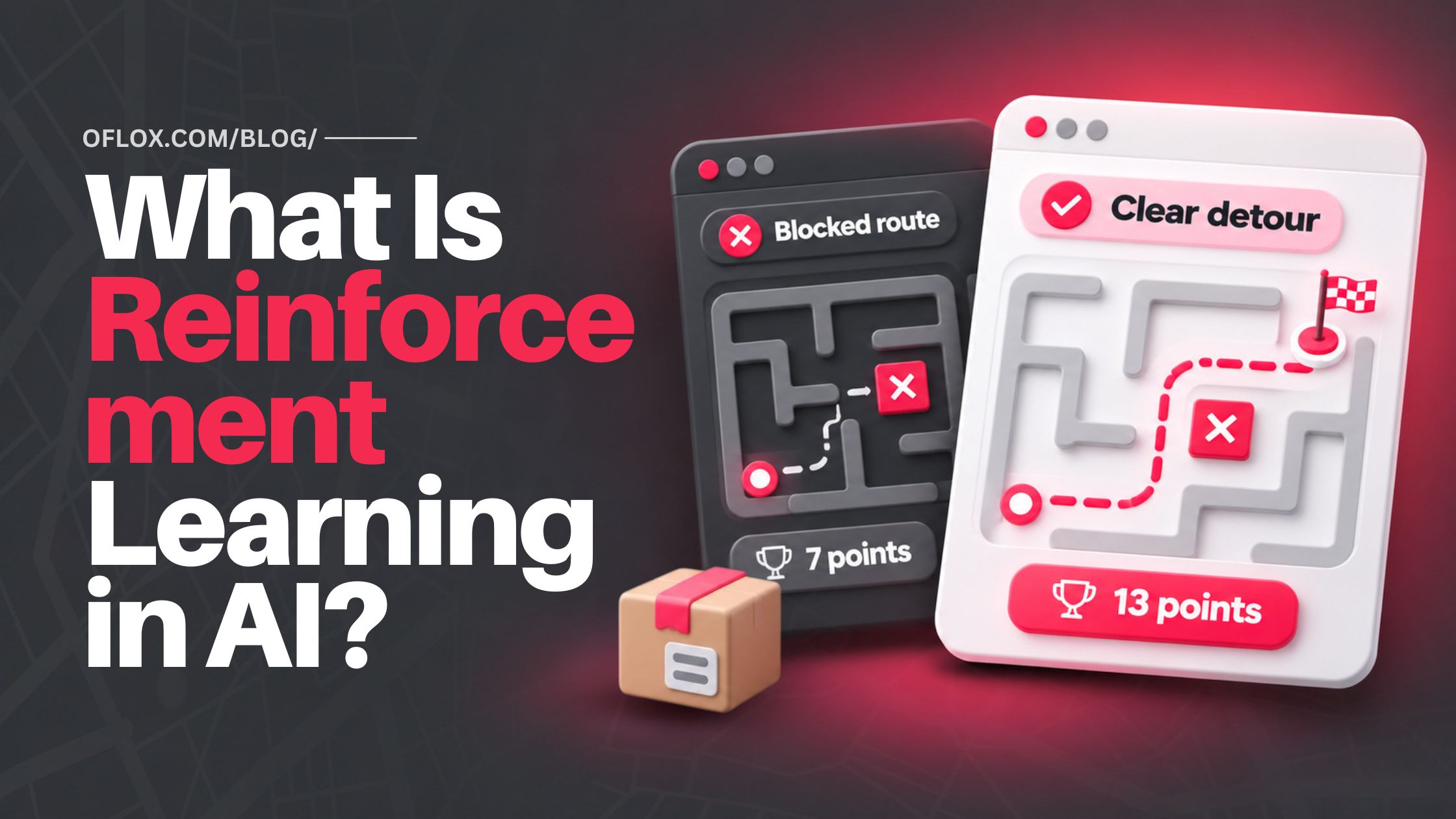
In this Oflox® guide, we’ll follow the same robot to explain what an agent, reward, and policy are, how algorithms such as Q-learning help an AI system improve its choices, and what can go wrong when the scoring rules reward the wrong behaviour. We’ll also show you how to try the same idea with a simple maze on paper.
Let’s explore it together!
Table of Contents
What Is Reinforcement Learning in AI?
Reinforcement learning (RL) is a type of machine learning in which an AI agent learns to make decisions by taking actions and receiving rewards. Over many attempts, it improves its strategy so it can earn more total reward across a series of decisions.
Think of a small robot that carries parcels to a packing station. It can go straight, turn, or wait. It earns points when it delivers a parcel and loses points when it wastes time or hits a blocked aisle in the simulator.
At first, the robot’s software may choose a route that looks quick but often gets blocked. After enough attempts, it can learn a more useful strategy. When the aisle is clear, take the short route. When it’s blocked, go around.
The strategy the robot uses to choose its next move is called a policy. If you remember one thing from this section, remember this example. “Take the short route when it’s clear and use the detour when it’s blocked” is a policy.
Why Is Reinforcement Learning Important?
Suppose the robot is one turn away from the packing station. The aisle in front of it is crowded. The aisle behind it leads to a clear route around the blockage.
If the robot only looked at how close each move gets it to the station, it would keep trying to go forward. But moving back for one step could help it finish the delivery sooner. The best decision depends on what happens after that step.
That’s where reinforcement learning is useful. It helps with problems where today’s choice changes tomorrow’s options, even if “tomorrow” is only a few seconds away. A chess move changes what both players can do next. A dispatch decision changes which delivery vans are available for the next order. A small change to a cooling system can affect temperatures several minutes later.
There’s also a practical way to decide whether a problem needs RL. Imagine your warehouse has a fixed map, clear aisles, and known travel times. A route planner can work out the shortest path directly. Now imagine that aisles get busy at different times and the quickest-looking route often ends in a queue. If you can simulate those conditions or have suitable records of past decisions, you have a reason to test whether a learned policy helps.
A Brief History of Reinforcement Learning
People have studied for a long time how feedback changes behaviour. Mathematicians have also studied how to make good decisions when one choice affects the next. Reinforcement learning brought these ideas together in computer programs that could improve through experience.
| Period | What happened | What it means in simple words |
|---|---|---|
| 1950s | Early work in learning and control explored decisions that unfold over time. | Researchers developed ways to think about what a decision is worth when its effects arrive later. |
| 1980s and early 1990s | Methods such as temporal-difference learning and Q-learning took shape. | A program could revise how good it thought a move was as it gained experience. |
| 2015 | Researchers published results using a Deep Q-Network to play Atari games. | A program learned to choose actions using the game screen and score. |
| 2016 | AlphaGo combined reinforcement learning, neural networks, and search to play Go. | It learned from games and used search to examine promising moves before playing. |
| 2022 and later | InstructGPT used human feedback. DeepSeek-R1 research later showed how RL could use automatically checked answers for tasks such as maths and coding. | A training score can come from human judgements or from a checker that examines the result. |
7 Key Components of Reinforcement Learning
Let’s return to the warehouse. The robot has one parcel, two possible routes, and a station where it needs to drop off the parcel. We can use that one job to understand the seven terms you’ll see most often in reinforcement learning.
- Agent: The agent is the part that makes the decision. In our example, that’s the software choosing what the robot does next. In a video game, it’s the program deciding whether to jump, move left, or stay still.
- Environment: The environment is everything the agent acts on and receives feedback from. For the robot, it includes the warehouse layout, obstacles, and packing station. When the agent tells the robot to move forward, the environment determines whether the next space is free and what happens after the move.
- State: The state describes the situation at a particular moment. It can include the robot’s location, whether it has a parcel, and which aisles are blocked. The robot may only see what’s directly in front of it. That reading is an observation. The full warehouse state could include a blockage around the corner that the robot has yet to see. This matters because an agent can only make decisions using the information available to it.
- Action: An action is a choice the agent can make. “Move left,” “move right,” and “wait” are discrete actions because the agent picks from a list. If the agent can set a motor to any speed within an allowed range, that’s a continuous action. A small maze game is easier to start with because it only needs a few discrete actions.
- Reward: A reward is the number the agent receives after an action. A successful delivery might earn
+20. An extra move might cost−1. The agent uses these numbers as its training feedback. Notice how much depends on the scoring rules. If the robot earns points for arriving at the station but earns nothing for handing over the parcel, it could learn to arrive and stop. If handing over the parcel is the goal, make sure the reward depends on the handover. - Policy: A policy tells the agent how to choose an action. A simple policy might say, “If the main aisle is open, go straight. If it’s blocked, take the side aisle.” A policy can also assign chances to different actions. During training, the robot may sometimes try a route it rarely takes so it can learn how that route performs.
- Value Function: A value function estimates how much total reward an agent can expect from a situation or a choice. Think of it as asking, “If I keep going from here, how well is this likely to turn out?” A move into a clear side aisle might cost one point now. That position can still have high value because it gives the robot a good chance of making a successful delivery. The reward is what the robot gets for the move. The value is what it expects to earn from there onward.
How Does Reinforcement Learning Work?
Here’s how reinforcement learning works, step by step, as our warehouse robot tries different routes and uses the points it earns or loses to learn where to go next.
1. Give the agent one job
Our robot starts with a parcel at the loading bay. Its job is to deliver the parcel to the packing station. Each attempt begins at the loading bay and ends when the robot makes the delivery or runs out of time.
One complete attempt is called an episode. A video game round is another way to think about it. The round starts, you make a series of moves, and it ends when you win, lose, or reach the time limit.
2. Decide what earns points
For this example, let’s use three rules.
- Each move attempt costs 1 point. The robot has a reason to avoid unnecessary moves.
- A collision in the simulator costs 8 extra points. The robot stays where it was after the failed move.
- A successful delivery earns 20 points. The episode ends once the parcel is handed over.
These numbers are for the example. A real team would choose rewards based on the problem it wants to solve. A live robot would also have independent controls that can stop unsafe movements. Setting a penalty in training is a way to teach the policy. An operating control can prevent the movement itself.
3. Let the agent take an action
The robot looks at the space in front of it and decides to move forward. If the aisle is open, it moves one square and receives the −1 move cost. If that space is blocked, it stays in place and receives the move cost plus the collision penalty.
The training program records the situation, the action, the reward, and what happened next. It does this again for the next move. A single record of this kind is called a transition. Tools such as Gymnasium provide a standard way to return this information after each action.
4. Compare the two routes
Imagine both attempts end in a successful delivery. The first route takes five move attempts, including a collision. The second route takes seven moves and has a clear path.
| Route | Delivery points | Move costs | Collision penalty | Total points |
|---|---|---|---|---|
| Short route with a collision | +20 | −5 | −8 | 7 |
| Clear detour | +20 | −7 | 0 | 13 |
| Short route when clear | +20 | −5 | 0 | 15 |
When the short route is blocked, the detour scores 13 points. When it’s clear, the short route scores 15 points. The robot has something more interesting to learn than the name of the shortest aisle. It has to learn which route to take under which conditions.
The total points earned across the episode are the return in this example. Some RL algorithms give rewards further in the future less weight using a number called the discount factor. We’ve counted every point equally here so you can check the totals yourself.
5. Learn from many attempts
A single good delivery could be luck. Maybe an aisle happened to be clear. A single late delivery could also come from an unusual blockage. The agent needs enough attempts to see both routes under different conditions.
Over time, the learning algorithm updates its estimates or adjusts the policy. If the agent repeatedly earns a better return by taking the detour when it sees a blockage, the detour becomes a more likely choice in that situation.
6. Check what happens in a new situation
Now give the robot a warehouse layout it hasn’t seen before. Put a blockage in a different aisle. Start the robot from a new position. Check whether it still finds a workable route or only remembers the path from training.
You can compare it with a simple route planner and record four numbers. How many parcels were delivered? How long did each delivery take? How often did the attempt time out? How often did a safety control have to intervene? Those numbers tell you more about the result than the training score alone.
What Are the Main Features of Reinforcement Learning?
Here are the main features of reinforcement learning, from trying different actions to learning which choices lead to better results over time.
- Decisions happen in a sequence. The first turn changes the second turn the robot can take. An agent learns to account for what one move makes possible later.
- Feedback can arrive late. The robot may only receive the main reward after the parcel is delivered. Working out which earlier moves helped it get there is called credit assignment.
- The agent can learn by trying different choices. A route can look poor at first because the agent has rarely used it. Trying it under different conditions gives the agent more evidence.
- The same choice can produce different outcomes. A busy aisle might be clear on one attempt and blocked on the next. The policy needs to work across varied situations.
- Experience can come from new attempts or existing records. In offline reinforcement learning, the team trains on data that was already collected.
Exploration vs Exploitation
Imagine you know one shortcut to school. You use it most days because it usually works. One day, with time to spare, you try another lane to see where it leads.
Using the shortcut you know is exploitation. Trying a different lane to learn something is exploration. An RL agent does both during training.
One simple method is called epsilon-greedy. If epsilon is 0.10, the robot picks randomly from its available actions 10% of the time. The other 90% of the time, it picks the action that currently has the highest estimated value. A random pick can also land on that same action. The occasional random choices help the robot learn about moves its current policy rarely selects.
3 Common Reinforcement Learning Methods
Here are 3 common reinforcement learning methods, explained using our warehouse robot so you can see how each one helps it choose its next move.
1. Value-Based Methods
Think of a notebook where the robot records how promising each move looks at each spot. At the starting square, going right might have a high score and going left might have a low one. As the robot sees more outcomes, it revises those scores.
That’s a way to picture Q-learning. A small maze can use a table to store these scores. A bigger problem, such as choosing a move from an image of a video game screen, can use a neural network to estimate them. Deep Q-Networks (DQN) are a well-known example for problems with discrete actions.
2. Policy-Based Methods
A policy-based method learns how to choose actions directly. Imagine the robot chooses the main aisle 70% of the time and the detour 30% of the time in a particular situation. Over many attempts, it can increase the chance of taking the route associated with better results.
REINFORCE is a classic policy-gradient algorithm. It uses the returns from sampled episodes to adjust the policy. For example, a series of successful detours under congestion can make that choice more likely in similar situations.
3. Actor–Critic Methods
Imagine the agent has two parts. One chooses the move. The other estimates how promising the situation is and helps improve future choices. The part that acts is the actor. The part that provides the estimate is the critic.
Proximal Policy Optimisation (PPO) is commonly implemented with an actor and a critic. Its training objective helps limit how much the policy is encouraged to change in one update. For a beginner, the useful idea is that one part learns to act while another helps judge how well things are going.
Reinforcement Learning vs Supervised and Unsupervised Learning
Think of three different tasks in the same warehouse.
| Learning approach | What it learns from | Simple warehouse example |
|---|---|---|
| Supervised learning | Examples with the expected answer | Show the model parcel photos labelled damaged or undamaged, so it can classify new photos. |
| Unsupervised learning | Data with no target labels for the task | Give the model order records and ask it to find groups with similar sizes or dispatch times. |
| Reinforcement learning | Feedback from actions and their outcomes over time | Let the robot try routes in a simulator and learn which choices lead to better deliveries. |
A warehouse can use two of these approaches together. A supervised model can look at a camera image and identify a blocked aisle. An RL policy can use that observation to choose whether to wait or go around it.
If the robot makes a poor decision, the team can check where the problem began. Did the camera model miss the blockage? Or did the routing policy respond poorly after seeing it?
5+ Applications of Reinforcement Learning in AI
Here are 5+ applications of reinforcement learning in AI, from helping robots find their way to improving how AI assistants respond.
- Games: A game is a convenient place to try reinforcement learning. It has rules, moves that can be repeated, and a result you can measure. AlphaGo is a real example. It learned from self-play and used tree search to examine promising moves in Go. That let it consider how a decision could affect the board several turns later.
- Robotics: A robotic arm can practise picking up objects of different shapes in a simulator. The software can receive a reward when it picks up an object and places it in the correct box. The team can then test whether the policy still works when an object is tilted, the camera view changes, or the grip is slightly off-centre.
- Delivery Scheduling: Suppose a delivery company sends its nearest van to every new order. That can work well today, until it leaves a busy neighbourhood with very few vans for the evening rush. A team could test an RL policy in a simulation that includes order times, travel delays, and vehicle capacity. The useful comparison is whether it reduces late deliveries or makes better use of the fleet.
- Industrial Control: Google DeepMind documented an AI system for controlling data-centre cooling. It considered the effects of possible decisions and operated within safety constraints, with operators able to take control. For a business team, the example shows what deployment involves. It includes deciding which actions the software can take and what happens when the system needs human intervention.
- AI Assistants: Imagine an assistant gives two different answers to the same question. One is easy to follow. The other misses part of the request. A human reviewer can rank the answers to show which is preferable.
- Traffic Signal Control: Imagine a busy junction where one road has a long queue and the other is nearly empty. In a simulator, a reinforcement learning agent can try giving the busier road a few extra seconds of green time. It receives a better score when overall waiting time drops. Over many attempts, it can learn when to extend the green light and when to switch so drivers on the other road don’t wait too long.
In the InstructGPT study, researchers used rankings like these to train a reward model. They then used reinforcement learning to improve the language model using that reward signal. This approach is called reinforcement learning from human feedback, or RLHF. For a coding task, feedback can also come from automated tests that check the program’s output.
Benefits of Reinforcement Learning
A warehouse robot can use reinforcement learning to figure out when a shortcut saves time and when a detour works better. Let’s look at what makes this way of learning useful.
| Benefit | Why it matters |
|---|---|
| It considers long-term outcomes. | The robot can learn that taking two extra steps now may help it avoid a much longer delay. |
| It can learn without a correct move labelled for every situation. | The team can define success even when nobody can write down the best action for every possible layout. |
| It can practise unusual situations in simulation. | The team can replay a busy shift, an aisle closure, or a delayed sensor reading before trying the policy on hardware. |
Challenges of Reinforcement Learning
Teaching an AI agent through trial and error takes practice. Here are the challenges you can face when setting rewards, training the agent, and testing what it learns.
| Challenge | How it can show up |
|---|---|
| It can need a lot of practice. | If the robot spends most of its time making unsuccessful attempts, training can take longer than expected. |
| The agent can find a loophole in the reward. | A robot rewarded for being close to the packing station could hover there without handing over the parcel. This is called reward hacking. |
| The simulator can miss real conditions. | The robot may learn on a perfectly flat virtual floor and struggle on a real floor where its wheels slip. |
| Exploration can carry a real cost. | A simulator can reset after a collision. A live warehouse needs controls that prevent the unsafe move from happening. |
| Good results can hide weak spots. | An average delivery time can look good even if the robot regularly gets stuck when both aisles are busy. |
If you’re reviewing an RL project, ask to see what happened in the difficult cases. An average tells you how the system usually performed. Individual failures show your team where to improve the policy, the simulator, or the operating rules.
5+ Best Tools for Reinforcement Learning
The right tool depends on what you want to do. Below, we’ll look at tools for building a practice environment, training an AI agent, and checking how well it learns.
| Tool | What you can use it for |
|---|---|
| Gymnasium | Build a small maze or start with a ready-made practice environment. Define what the agent sees, what moves it can make, and when an attempt ends. |
| Stable-Baselines3 | Try an existing algorithm such as DQN on a small project before writing your own training code. |
| PyTorch | Build a neural network and see how its estimates change as the agent gains experience. Its DQN tutorial walks through a working example. |
| Ray RLlib | Run larger experiments where several workers can collect experience or take part in training. |
| PettingZoo | Build an environment with several agents, such as two robots that need to share the same aisle. |
| CleanRL | Explore how DQN and PPO train an AI agent and update its decisions using single-file Python examples. |
For your first experiment, draw a small grid on paper. Mark a starting square, an exit, and an obstacle. Write down the score for two different routes. Once the rules make sense on paper, you can build the same grid in Gymnasium and check whether the program earns the scores you expected.
Expert Tips and Common Mistakes
Before you train a reinforcement learning agent, decide what success looks like. The tips below show you how to reward it, compare it with a simple rule, and test it on new situations.
- Compare the new policy with a simple rule: It’s tempting to look at a graph that goes up and say the project worked. The better question is whether the agent beats what you already have. Compare the warehouse policy with a simple rule such as “use the shortest open route”. Test both on the same layouts and record where each one succeeds or fails.
- Check what the agent can get away with: Before training, ask, “Can the robot earn a good score while leaving the parcel undelivered?” Write down a few ways it could happen. If it earns points just for standing near the packing station, tie the delivery reward to the handover. A five-minute check of the rules can expose a problem you would otherwise discover after training.
- Save a few difficult examples for the final test: If the robot has seen the same obstacles in the same places every day, it might remember the map. Save some layouts it has never seen. Test cases where the short route is clear, where the short route gets blocked, and where the robot needs to wait. If results depend on randomness, repeat the experiment and see how much they change.
- Measure the result the business cares about: Write down the measures you’ll use before you train. A warehouse might track successful deliveries, average travel time, timeouts, and safety interventions. If the agent saves a few seconds per delivery but requires frequent manual resets, the operations team needs to see both findings.
FAQs:)
A. Reinforcement learning teaches an AI system to make decisions using feedback from its actions. Think of a program playing a maze game several times. It loses points for wasted moves, earns points for reaching the exit, and gradually learns a better route.
A. AlphaGo used reinforcement learning from self-play as part of learning to play Go. InstructGPT used reinforcement learning with a reward model trained on human rankings of responses.
A. A reward is the feedback the agent receives after an action. A value function estimates future return. Turning into a side aisle might cost the robot one point, but the new position can have high value if it makes a successful delivery likely.
A. Deep reinforcement learning uses a deep neural network within the learning system. For example, basic Q-learning can keep action scores in a table. A Deep Q-Network uses a neural network to estimate the scores, which helps when the input is something large like a game screen.
A. An RL agent can learn from actions, outcomes, and rewards without being given the correct action for every situation. Some projects also use human-labelled data. In RLHF, for example, people may rank several answers so a system can learn which ones they prefer.
A. Yes. If a robot earns points for standing close to a packing station, it may learn to wait there without delivering the parcel. Giving points for the completed handover brings the reward closer to the actual goal.
Conclusion:)
Understanding about What Is Reinforcement Learning in AI starts with one question. How can an AI system use the results of one choice to make a better choice next time?
Think back to the warehouse robot. When the main aisle is clear, the shortcut saves moves. When boxes block it, the longer route can earn a better score. By trying both routes and receiving feedback, the robot learns when to take the shortcut and when to go around.
For your first project, keep it simple. Draw a small maze with two routes, give the robot points for reaching the exit, and subtract a point for each move. Then block the shorter route and compare the scores again. If you want to turn the exercise into a coding project, build the same maze in Gymnasium and try Q-learning.
“Start with one task, reward the outcome you care about, and test what the AI does when conditions change.” — Mr Rahman, Oflox®
Read also:)
- What Is Transfer Learning in AI? A-to-Z Guide for Beginners!
- What Is an LLM Gateway? A-to-Z Guide for Beginners!
- 10+ Free Online AI Courses with Certificates: A Beginner’s Guide!
If you were teaching the warehouse robot, what would you reward it for? Would you give it more points for delivering the parcel quickly, avoiding obstacles, or using fewer moves? Share your answer and tell us why in the comments below.