This article provides a complete guide on What Is a Knowledge Graph, including its meaning, importance, history, architecture, working process, components, features, benefits, challenges, popular tools, real-world applications, expert tips, common mistakes, FAQs, and future trends.
Every day, we generate and interact with enormous amounts of data—from search engines, social media, e-commerce websites, business applications, and AI tools. However, raw data alone has limited value unless computers can understand how different pieces of information are connected. This is where a Knowledge Graph becomes one of the most powerful technologies in modern artificial intelligence and data management.
Unlike traditional databases that store information in separate rows and columns, a Knowledge Graph connects entities such as people, companies, products, places, and events through meaningful relationships. These connections enable machines to understand context, answer complex questions, discover hidden insights, and deliver smarter search results. Whether you ask Google who founded a company, receive personalised recommendations on an e-commerce platform, or interact with an AI assistant like ChatGPT, Knowledge Graph technology often works behind the scenes to make those experiences more accurate and intelligent.
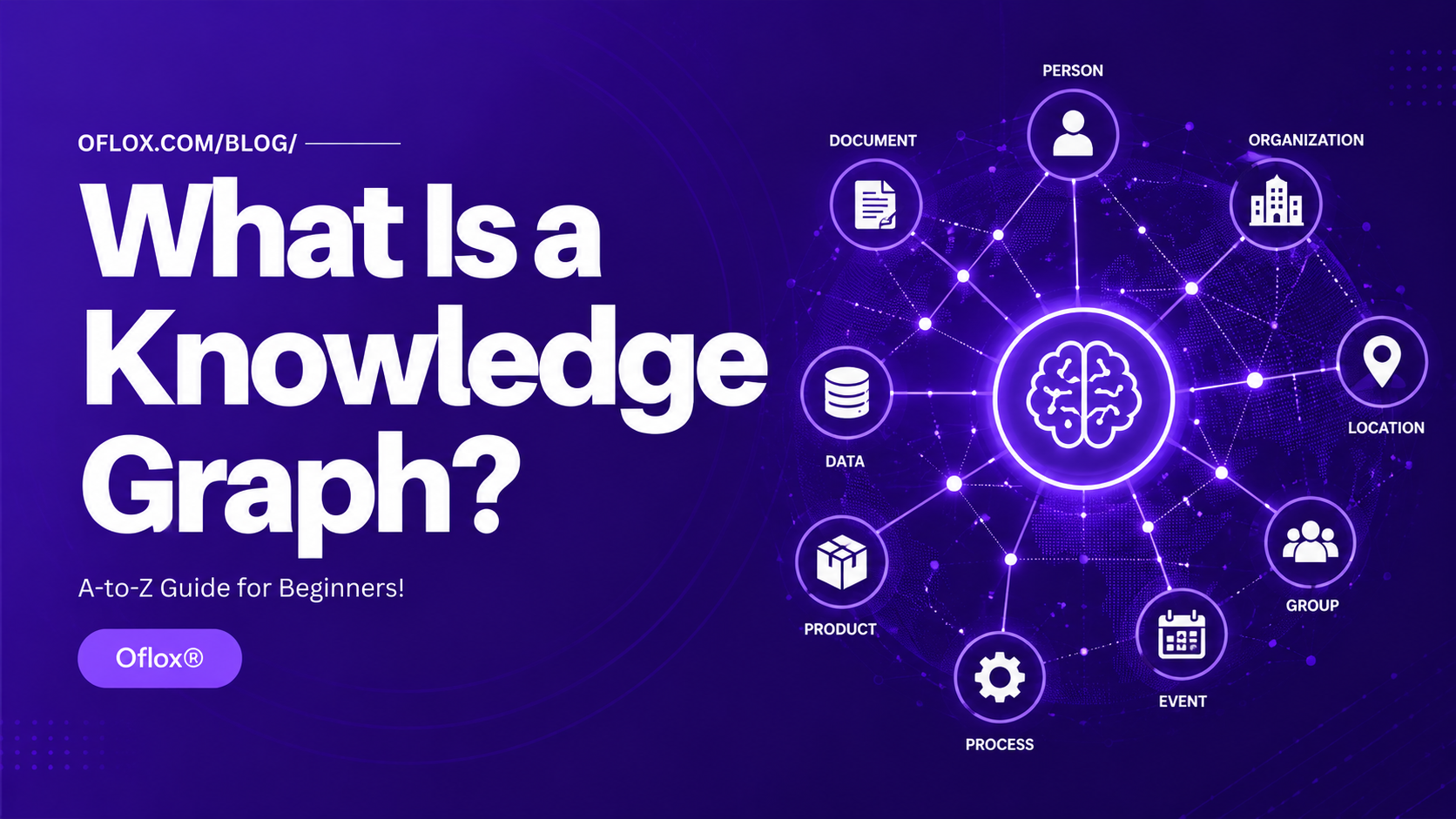
As AI continues to evolve, Knowledge Graphs have become a core component of semantic search, enterprise knowledge management, Retrieval-Augmented Generation (RAG), recommendation systems, fraud detection, healthcare analytics, and intelligent automation. By organising information as an interconnected network instead of isolated records, they help businesses and AI systems make better decisions using contextual knowledge rather than simple keyword matching.
Let’s explore it together.
Table of Contents
What Is a Knowledge Graph?
A Knowledge Graph is a structured representation of information where real-world entities and their relationships are connected in the form of a graph.
Unlike traditional databases that store data in tables, a Knowledge Graph stores information as connected nodes and relationships, allowing machines to understand the meaning behind data.
Think of it as a digital map of knowledge where every piece of information is linked to related information.
For example:
| Entity | Relationship | Entity |
|---|---|---|
| Bill Gates | Founded | Microsoft |
| Microsoft | Headquarters | Redmond |
| Satya Nadella | CEO Of | Microsoft |
| Windows | Developed By | Microsoft |
Instead of viewing these as separate records, a Knowledge Graph connects them into one intelligent network.
Whenever a user asks a question, AI can travel through these connections to find the correct answer.
Knowledge Graph in Simple Words
Imagine a huge family tree.
Every person is connected to:
- Parents
- Children
- Friends
- Schools
- Companies
- Cities
- Countries
Because everything is linked, finding information becomes very easy.
A Knowledge Graph works in exactly the same way.
Instead of only people, it connects:
- Products
- Companies
- Movies
- Diseases
- Medicines
- Countries
- Books
- Events
- Customers
- Businesses
Everything becomes interconnected.
Why Is a Knowledge Graph Important?
Modern businesses collect data from websites, mobile apps, CRMs, social media, IoT devices, and enterprise software. Without proper relationships, this information remains scattered and difficult to use.
A Knowledge Graph solves this challenge by creating meaningful connections between data points.
Why Businesses Need Knowledge Graphs?
| Traditional Database | Knowledge Graph |
|---|---|
| Stores isolated records | Stores connected knowledge |
| Hard to discover relationships | Relationships are instantly available |
| Limited flexibility | Highly flexible |
| Complex joins | Direct graph traversal |
| Data-centric | Meaning-centric |
| Schema-heavy | Easily expandable |
Major Reasons Knowledge Graphs Are Important
Here are the key reasons why Knowledge Graphs have become essential for modern businesses and AI applications.
1. Better Search Results
Search engines understand user intent instead of matching only keywords.
Example you’re searching:
Apple founderReturns Steve Jobs, not fruit-related pages.
2. Smarter Artificial Intelligence
Large Language Models and AI assistants use connected knowledge for better reasoning.
Examples include:
- ChatGPT
- Google Gemini
- Microsoft Copilot
3. Improved Decision-Making
Businesses can discover hidden relationships inside massive datasets.
For example:
Customer → Product → Complaint → Region → SupplierThis helps companies identify patterns quickly.
4. Personalized Recommendations
Streaming platforms and e-commerce websites use Knowledge Graphs to recommend relevant content.
Examples:
- Netflix
- Amazon
- Spotify
- YouTube
5. Fraud Detection
Banks can identify suspicious transaction networks by connecting:
- Accounts
- Devices
- Locations
- Transactions
- Users
6. Healthcare Intelligence
Doctors can connect:
- Symptoms
- Diseases
- Medicines
- Medical history
- Laboratory reports
to support faster diagnosis and treatment decisions.
History and Background of Knowledge Graphs
Although Google popularized the term Knowledge Graph in 2012, the underlying concepts have existed for decades.
1. 1960s–1980s: Semantic Networks
Researchers began exploring methods to represent knowledge as interconnected concepts instead of isolated facts.
The idea was simple:
Knowledge is more useful when relationships are known.2. 1990s: Ontologies
Scientists introduced ontologies to define structured relationships between concepts.
For example:
Car → Vehicle → TransportationComputers could now understand that every car is also a vehicle.
3. Early 2000s: Semantic Web
Tim Berners-Lee introduced the vision of the Semantic Web.
The goal was to make the internet understandable by machines rather than only humans.
Technologies such as:
- RDF
- OWL
- SPARQL
became the foundation of semantic data.
4. 2012: Google’s Knowledge Graph
Google officially launched the Knowledge Graph to improve search quality.
Instead of showing only web pages, Google began displaying:
- People
- Places
- Movies
- Companies
- Books
- Sports
- Events
directly in search results.
This changed the future of semantic search.
5. 2020–2026: AI Revolution
Knowledge Graphs have become a key component of:
- Generative AI
- Enterprise AI
- Retrieval-Augmented Generation (RAG)
- Intelligent Search
- Digital Twins
- Recommendation Systems
- Autonomous Agents
- Robotics
Today, they play an essential role in helping AI systems understand context, relationships, and real-world knowledge.
How Does a Knowledge Graph Work?
A Knowledge Graph transforms raw data into meaningful, interconnected knowledge through several stages.
1. Collect Data
Information is gathered from multiple sources, such as:
- Databases
- Websites
- APIs
- PDFs
- Emails
- CRM systems
- ERP software
- IoT devices
- Social media
2. Identify Entities
The system identifies important objects within the data.
Examples:
- Person
- Company
- Product
- Country
- City
- Disease
- Event
- Book
These become nodes in the graph.
3. Identify Relationships
Next, the system discovers how entities are connected.
Examples:
Google → Founded By → Larry PageGoogle → Headquarters → CaliforniaAndroid → Developed By → GoogleThese become edges in the graph.
4. Create the Graph Structure
The entities and relationships are organized into a graph.
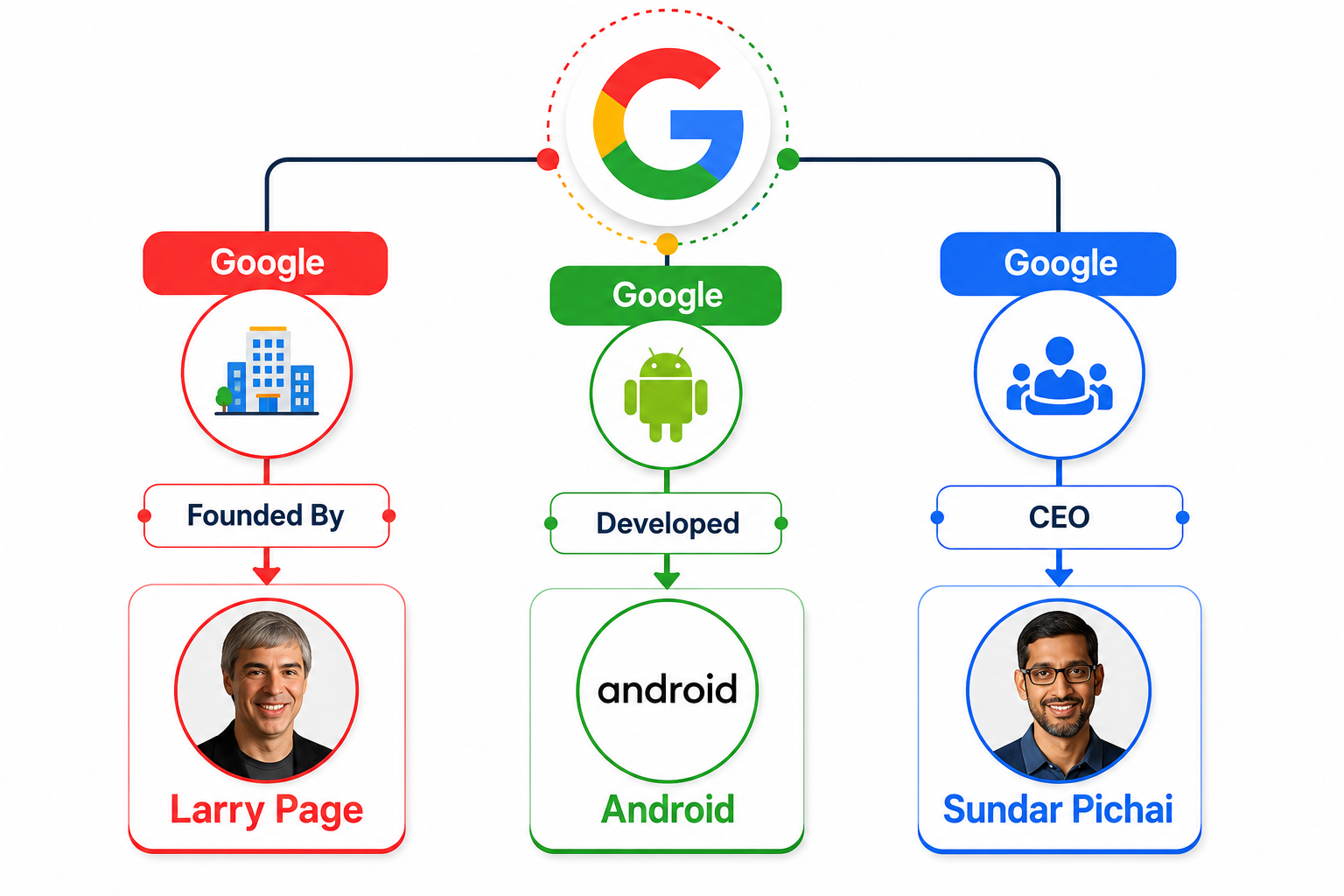
Now every connected fact can be queried efficiently.
5. Query the Knowledge Graph
When users ask a question, the system follows relationships to retrieve accurate answers.
Example:
Who is the CEO of the company that developed Android?Traversal:
Android → Developed By → Google → CEO → Sundar PichaiInstead of relying on keyword matching, the graph uses connected knowledge to answer intelligently.
Core Components of a Knowledge Graph
A Knowledge Graph is built from several fundamental building blocks.
1. Entities (Nodes)
Entities represent real-world objects or concepts.
Examples include:
- Person
- Company
- Product
- City
- Country
- University
- Disease
- Event
- Book
- Organisation
Every entity becomes a node in the graph.
2. Relationships (Edges)
Relationships define how two entities are connected.
Examples:
- Works At
- Founded
- Located In
- Owns
- Purchased
- Friend Of
- Parent Of
- Manufactured By
- Written By
These edges give meaning to the graph.
3. Properties (Attributes)
Properties describe additional details about entities or relationships.
For example, a Person entity may include:
| Property | Example |
|---|---|
| Name | Bill Gates |
| Birth Date | 28 October 1955 |
| Nationality | American |
| Occupation | Businessman |
| Net Worth | Dynamic value |
Attributes enrich the knowledge represented in the graph.
4. Ontology
An ontology defines the rules and vocabulary of the Knowledge Graph.
It specifies:
- Which entities exist
- What relationships are allowed
- How concepts relate to one another
For example:
- Every CEO must be a Person
- Every Company can have a Headquarters
- Every Product belongs to a Category
Ontologies help maintain consistency as the graph grows.
5. Graph Database
The completed Knowledge Graph is typically stored in a graph database, which is optimised for managing highly connected data.
Unlike relational databases that rely on complex joins, graph databases allow efficient traversal between related entities, making them ideal for semantic search, recommendation engines, fraud detection, and AI applications.
Key Features of a Knowledge Graph
Knowledge Graphs are much more than connected databases. They provide a semantic understanding of information, making AI systems smarter, faster, and more context-aware. Below are the key features that make Knowledge Graphs a powerful technology for modern applications.
1. Connected Data Structure
Unlike relational databases that organise information into tables, Knowledge Graphs connect every piece of information through meaningful relationships.
For example:
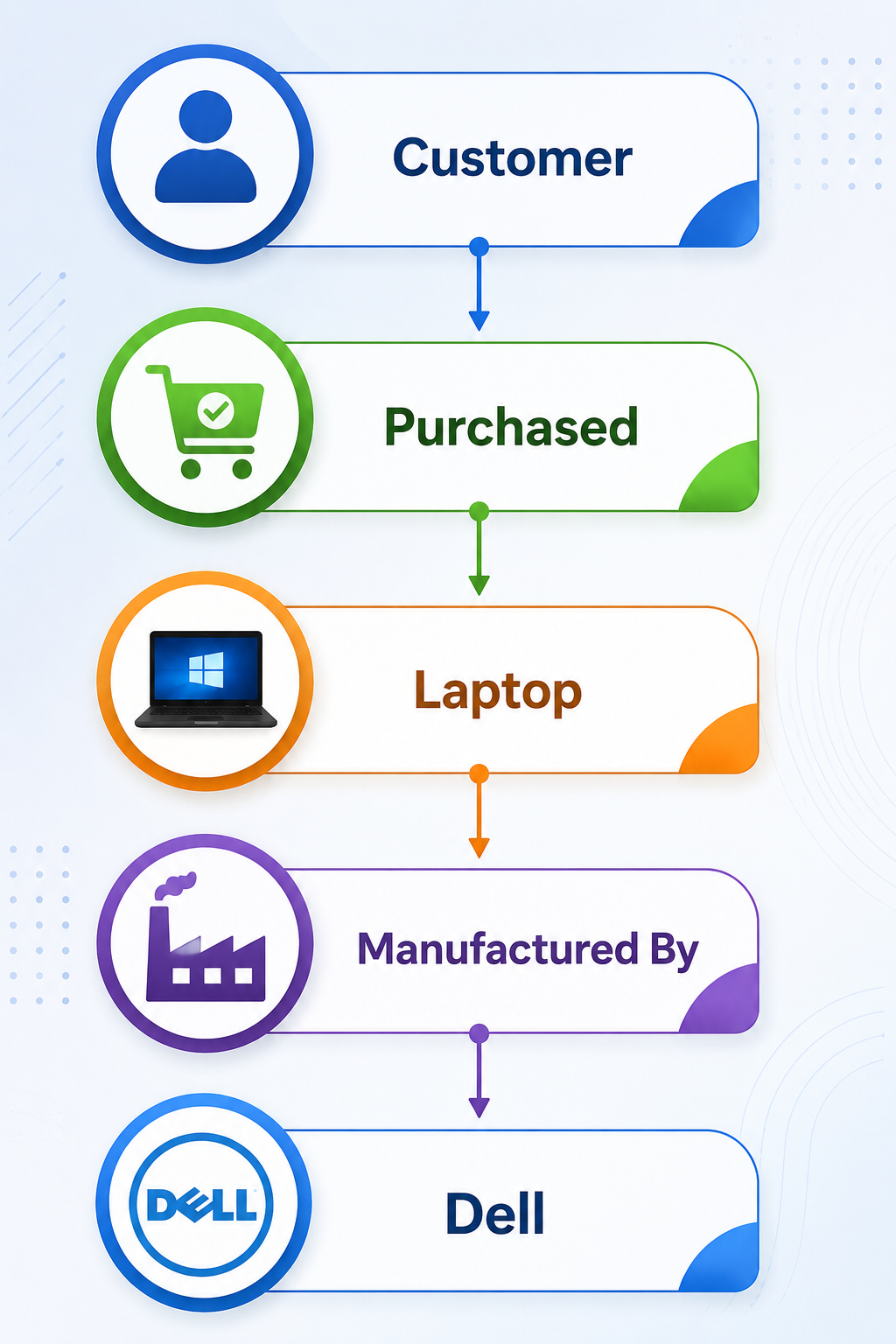
This interconnected structure allows systems to retrieve complex information quickly.
2. Semantic Understanding
A Knowledge Graph understands the meaning of data instead of simply storing values.
For example, it knows that:
- Delhi is a city.
- India is a country.
- Delhi is located in India.
This semantic understanding enables intelligent search and reasoning.
3. Flexible Schema
Traditional databases often require redesigning the schema whenever new data types are introduced.
Knowledge Graphs allow new entities and relationships to be added without major structural changes.
Example:
Initially:
Customer → Purchased → ProductLater, you can easily add:
Customer → Reviewed → Productwithout rebuilding the entire database.
4. Relationship-Based Queries
Knowledge Graphs excel at answering relationship-focused questions.
Examples include:
- Which employee reports to the Sales Manager?
- Which supplier manufactures this product?
- Which customer purchased products from the same brand?
These types of queries are much faster than in traditional databases.
5. Multi-Source Data Integration
Knowledge Graphs combine information from multiple systems into a single unified view.
Common data sources include:
- SQL Databases
- NoSQL Databases
- CRM Systems
- ERP Software
- Excel Files
- APIs
- Cloud Storage
- Websites
- PDFs
- Emails
This creates a centralised knowledge hub.
6. AI-Friendly Architecture
Knowledge Graphs provide structured context that improves AI applications such as:
- Intelligent Chatbots
- AI Search Engines
- Recommendation Systems
- RAG (Retrieval-Augmented Generation)
- Virtual Assistants
- Autonomous AI Agents
7. Explainable Results
One of the biggest advantages is transparency.
Instead of simply showing an answer, a Knowledge Graph can explain how it reached that answer.
Example:
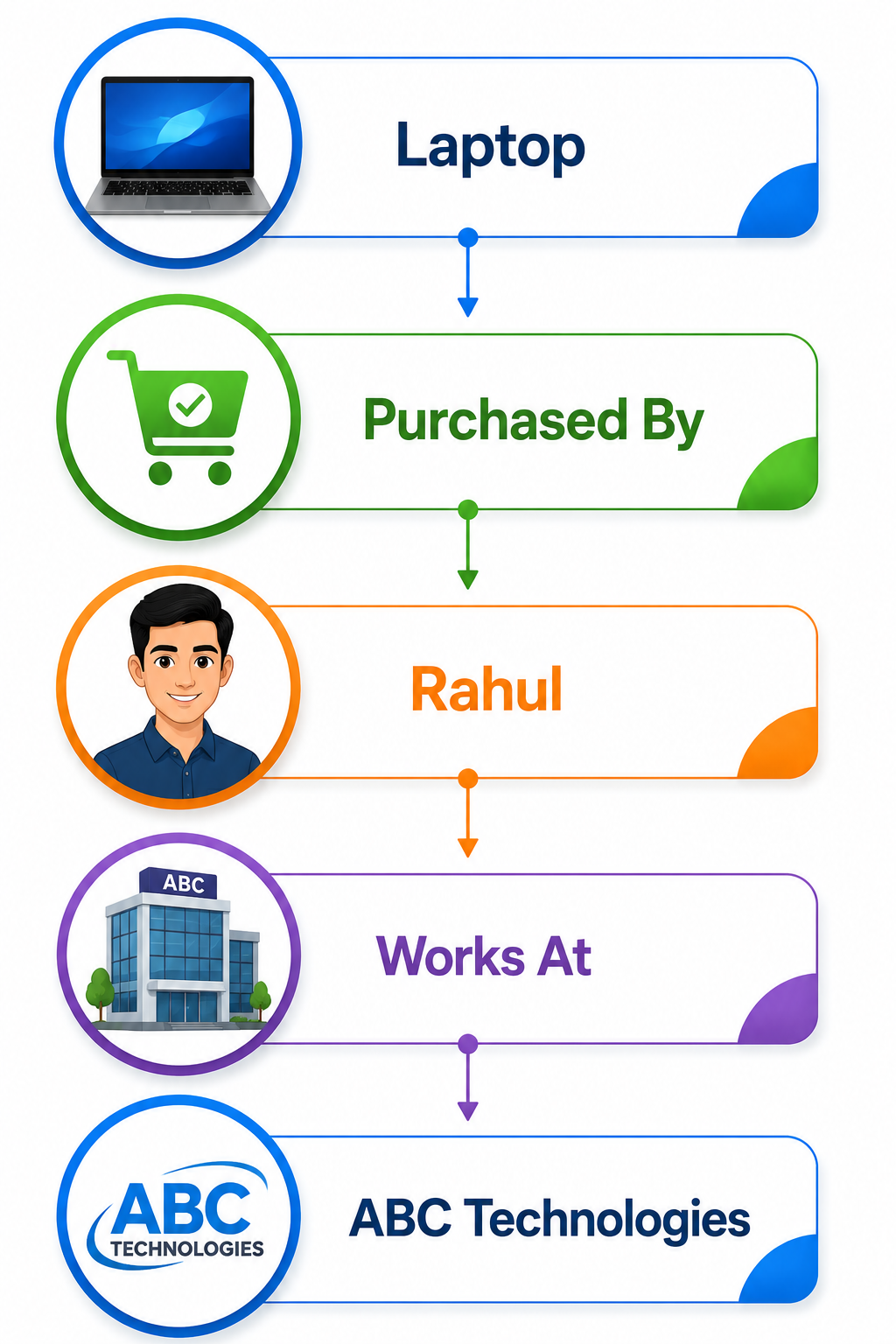
The reasoning path becomes visible.
8. Scalability
Modern Knowledge Graphs can manage:
- Millions of entities
- Billions of relationships
- Large enterprise datasets
- Real-time updates
This makes them suitable for organisations of all sizes.
Benefits of Using a Knowledge Graph
Knowledge Graphs provide significant advantages for businesses, AI systems, researchers, and developers.
1. Better Search Accuracy
Instead of matching keywords, Knowledge Graphs understand user intent.
Example Search:
CEO of TeslaThe system understands,
Tesla → CEO → Elon Muskwithout requiring an exact keyword match.
2. Improved AI Performance
Large Language Models perform better when combined with structured knowledge.
Benefits include:
- Better factual accuracy
- Reduced hallucinations
- Improved reasoning
- Context-aware responses
- More reliable outputs
3. Faster Decision-Making
Businesses can instantly discover hidden relationships between customers, products, suppliers, and transactions.
Example:
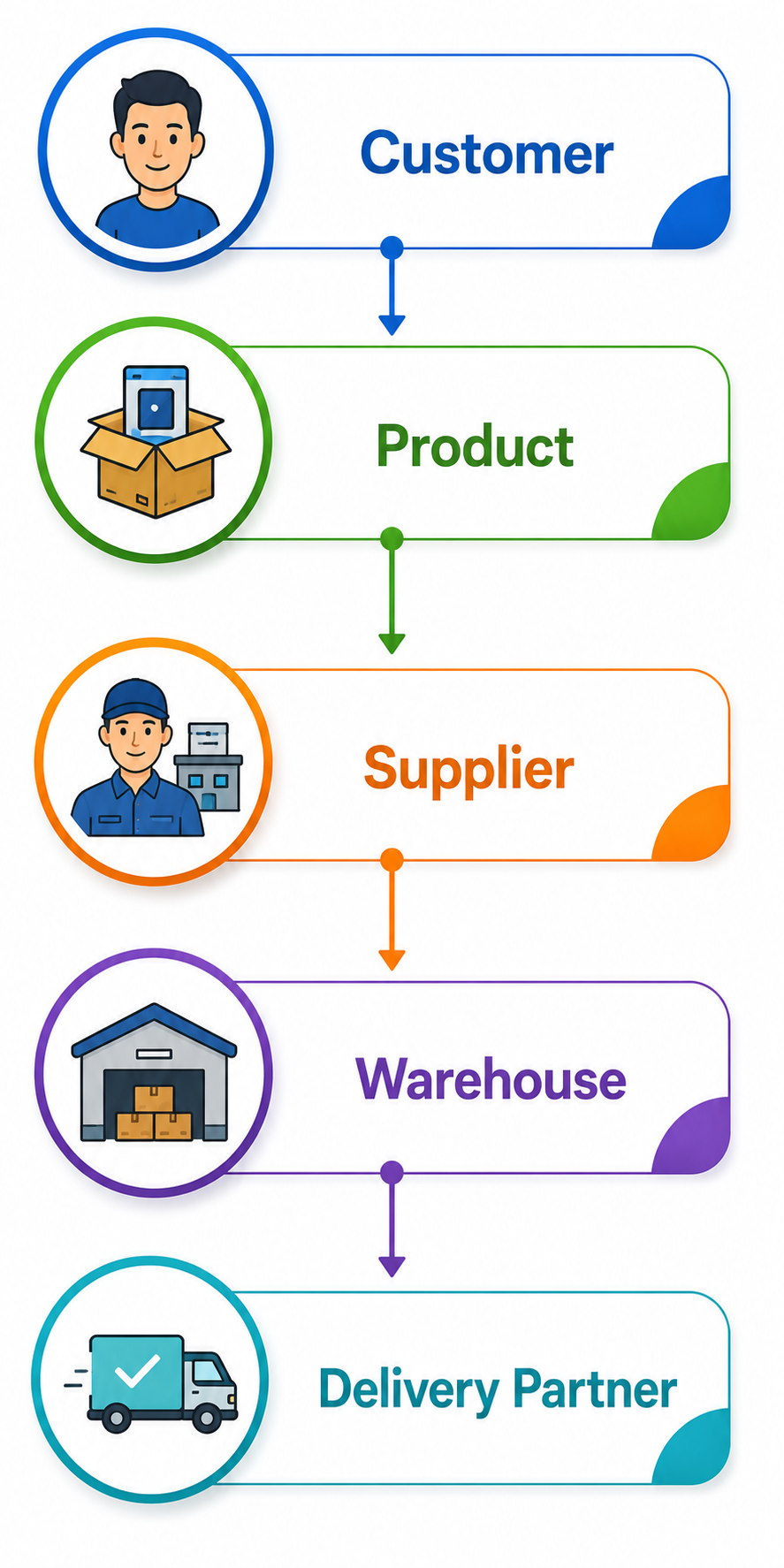
Managers can identify bottlenecks more quickly.
4. Better Customer Experience
Knowledge Graphs enable personalised experiences.
Examples include:
- Product recommendations
- Personalised search results
- Targeted advertisements
- Smart customer support
5. Enterprise Knowledge Management
Large organisations often struggle with scattered information.
Knowledge Graphs connect:
- HR Systems
- Finance
- Sales
- Marketing
- Legal
- Operations
creating a single source of truth.
6. Fraud Detection
Banks use Knowledge Graphs to identify suspicious transaction patterns.
Example:
Account A → Transferred To → Account B → Linked Device → Fraud ReportHidden fraud networks become easier to detect.
7. Healthcare Improvements
Doctors can analyse connected medical information.
Example:
Patient →Symptoms → Disease → Medicine → Recovery HistoryThis supports more informed clinical decisions.
8. Better Data Quality
Duplicate records can be identified by analysing entity relationships.
Benefits include:
- Cleaner data
- Reduced redundancy
- Improved consistency
- Better reporting
Benefits Summary Table
| Benefit | Business Impact |
|---|---|
| Better Search | Higher accuracy |
| AI Understanding | Smarter responses |
| Decision Support | Faster insights |
| Fraud Detection | Better security |
| Data Integration | Unified information |
| Recommendations | Improved customer engagement |
| Knowledge Sharing | Easier collaboration |
| Analytics | Better business intelligence |
Challenges and Limitations of Knowledge Graphs
Although Knowledge Graphs are powerful, they also present several challenges that organisations should consider.
1. Complex Data Integration
Combining data from different sources can be difficult.
Challenges include:
- Different formats
- Duplicate records
- Missing values
- Inconsistent naming
2. High Initial Cost
Building a large Knowledge Graph requires investment in:
- Infrastructure
- Data engineering
- Graph databases
- Skilled professionals
3. Data Quality Issues
A Knowledge Graph is only as reliable as the data it contains.
Poor-quality data leads to:
- Incorrect relationships
- Duplicate entities
- Inaccurate AI responses
4. Maintenance
Knowledge Graphs require continuous updates because businesses and real-world information change over time.
Examples:
- New products
- Employee changes
- Company mergers
- Address updates
5. Learning Curve
Technologies such as RDF, SPARQL, OWL, and graph databases may be unfamiliar to beginners.
Training is often necessary.
6. Performance Optimisation
Very large Knowledge Graphs containing billions of relationships require efficient indexing and query optimisation.
Without proper design, performance can degrade.
7. Privacy and Security
Sensitive information must be protected.
Common security concerns include:
- Data leakage
- Unauthorised access
- Compliance with privacy regulations
- Identity management
Challenges Summary
| Challenge | Solution |
|---|---|
| Poor Data Quality | Data cleansing |
| Complex Integration | ETL pipelines |
| Scalability | Distributed graph databases |
| Security | Access control and encryption |
| Maintenance | Automated data updates |
| Performance | Graph indexing and optimisation |
Popular Knowledge Graph Tools
Many commercial and open-source tools help organisations build and manage Knowledge Graphs.
| Tool | Best For |
|---|---|
| Neo4j | Enterprise graph databases |
| Amazon Neptune | AWS cloud applications |
| Stardog | Enterprise knowledge management |
| GraphDB | Semantic web projects |
| Apache Jena | RDF and semantic applications |
| Ontotext GraphDB | Large-scale semantic data |
| TigerGraph | High-performance analytics |
| ArangoDB | Multi-model database |
| AllegroGraph | AI and semantic reasoning |
| Memgraph | Real-time graph analytic |
1. Neo4j
One of the world’s most popular graph databases.
Features:
- Cypher query language
- Enterprise scalability
- Graph visualisation
- Large developer community
Best for:
- Recommendation systems
- Fraud detection
- Social networks
2. Amazon Neptune
A fully managed graph database service.
Advantages:
- Cloud-native
- High availability
- Supports RDF and Property Graph models
- Integrates with AWS services
3. Apache Jena
An open-source framework for Semantic Web applications.
Supports:
- RDF
- SPARQL
- OWL
- Linked Data
Ideal for academic research and semantic projects.
4. TigerGraph
Designed for handling extremely large graph datasets.
Used in:
- Financial services
- Telecommunications
- Manufacturing
- Government
How to Build a Knowledge Graph
Building a Knowledge Graph requires careful planning and structured execution. Below is a simplified workflow.
1. Define Business Goals
Start by identifying the problem you want to solve.
Examples:
- Improve search
- Detect fraud
- Recommend products
- Build an AI assistant
- Integrate enterprise data
2. Collect Data
Gather information from relevant sources such as:
- Databases
- APIs
- Websites
- Documents
- Excel files
- ERP systems
- CRM platforms
3. Clean the Data
Remove:
- Duplicate records
- Missing values
- Incorrect entries
- Inconsistent formats
High-quality data is essential for an accurate Knowledge Graph.
4. Identify Entities
Determine the key objects in your domain.
Example for an e-commerce business:
- Customer
- Product
- Order
- Supplier
- Warehouse
- Brand
5. Define Relationships
Specify how the entities connect.
Examples:
Customer → Purchased → ProductProduct → Manufactured By → BrandOrder → Delivered By → Courier6. Design the Ontology
Create rules that define:
- Entity types
- Relationship types
- Properties
- Constraints
A well-designed ontology keeps the graph consistent and scalable.
7. Choose a Graph Database
Select the platform based on your project needs.
Consider:
- Performance
- Scalability
- Query language
- Cloud support
- Cost
- Community support
8. Import the Data
Load the prepared entities and relationships into the graph database.
Data can be imported using:
- CSV files
- APIs
- ETL tools
- Batch processing
- Streaming pipelines
9. Query and Analyse
Use graph query languages to answer business questions and generate insights.
Typical tasks include:
- Finding shortest paths
- Discovering hidden relationships
- Identifying influential nodes
- Analysing communities
- Generating recommendations
10. Maintain and Update
A Knowledge Graph is a living system.
Regular updates ensure that:
- New entities are added.
- Relationships stay accurate.
- Outdated information is removed.
- AI systems continue to receive current knowledge.
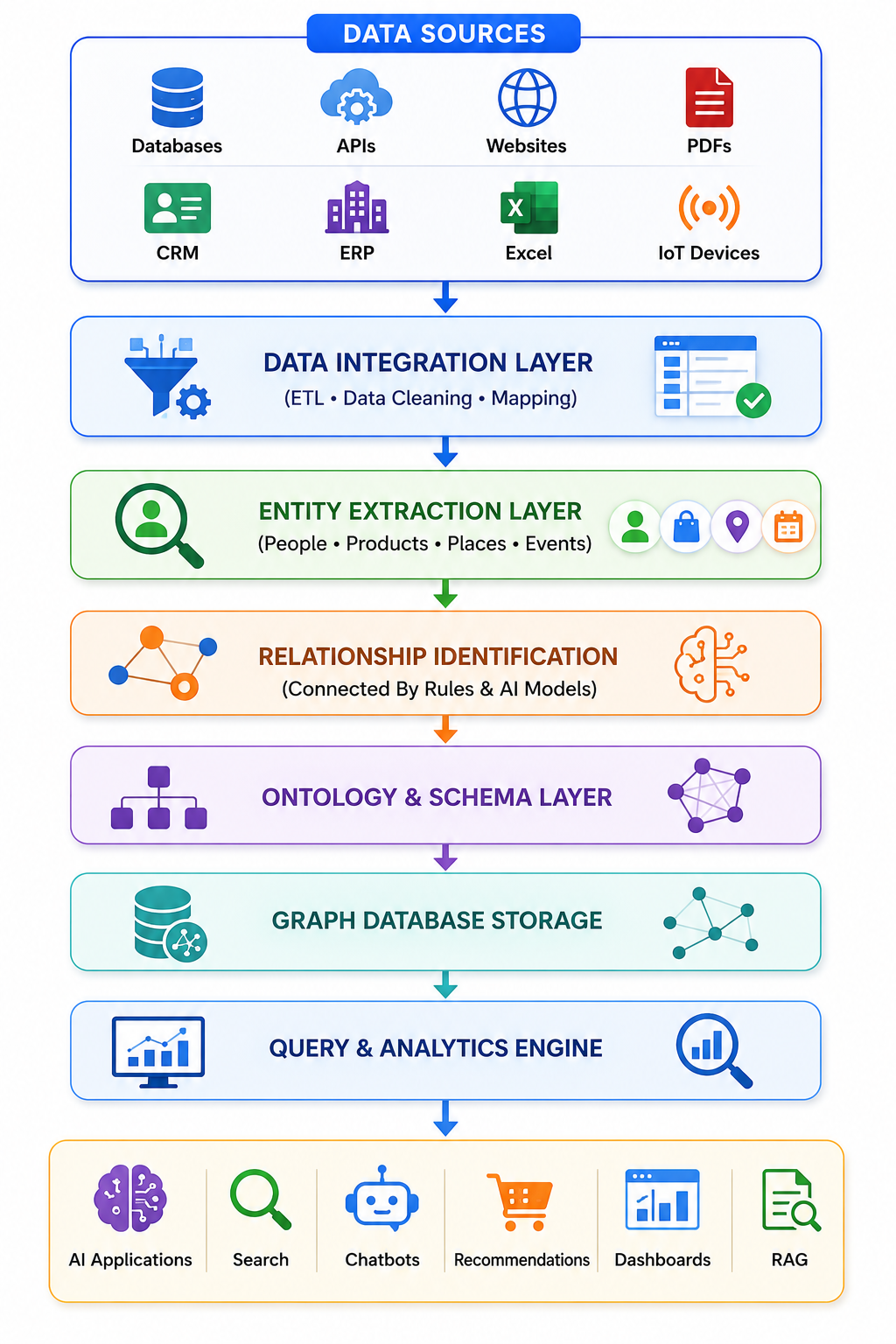
Knowledge Graph Architecture
A typical Knowledge Graph architecture consists of several interconnected layers.
Real-World Examples of Knowledge Graphs
Knowledge Graphs power many of the digital services we use every day. Here are some practical examples.
1. Google Search
Google’s Knowledge Graph connects billions of entities such as people, places, organisations, books, films, and events.
When you search for a famous person or company, Google can display a knowledge panel with structured information instead of only a list of web pages.
2. E-commerce Recommendations
Online shopping platforms analyse connections between:
- Customers
- Products
- Categories
- Brands
- Purchase history
- Reviews
This enables “Customers who bought this also bought…” recommendations.
3. Healthcare
Hospitals can connect:
- Patients
- Symptoms
- Diagnoses
- Lab reports
- Medicines
- Allergies
- Treatment history
to support better clinical decision-making.
4. Banking and Fraud Detection
Financial institutions build transaction graphs linking:
- Accounts
- Devices
- IP addresses
- Merchants
- Payment methods
- Locations
This helps uncover suspicious networks that may not be visible in traditional tabular data.
5. Supply Chain Management
Manufacturers use Knowledge Graphs to connect:
Supplier → Raw Material → Factory → Warehouse → Distributor → Retailer → CustomerThis improves visibility, inventory planning, and risk management.
6. Enterprise Knowledge Management
Large organisations connect employees, documents, projects, departments, policies, and expertise into a searchable knowledge network, making information easier to discover and reuse.
Expert Tips for Building a Successful Knowledge Graph
Building a Knowledge Graph is not only about connecting data—it is about connecting the right data in the right way. A well-designed Knowledge Graph can become one of the most valuable assets for your business or AI application.
Below are some practical tips that professionals follow.
1. Clearly Define Your Business Goal
Before building a Knowledge Graph, identify the problem you want to solve.
Examples:
- Improve website search
- Build an AI chatbot
- Detect fraud
- Recommend products
- Connect enterprise data
- Improve customer support
A clear objective helps avoid unnecessary complexity.
2. Focus on Data Quality
A Knowledge Graph is only as good as its data.
Always:
- Remove duplicate records
- Standardise naming conventions
- Validate information
- Keep data updated
Poor-quality data leads to poor AI decisions.
3. Design a Strong Ontology
Create a consistent structure before importing data.
Define:
- Entity types
- Relationship types
- Attributes
- Business rules
A strong ontology makes future expansion much easier.
4. Start Small
Avoid trying to connect every data source on day one.
Instead:
- Build a small pilot project.
- Test the results.
- Improve the model.
- Expand gradually.
This approach reduces risks and simplifies maintenance.
5. Automate Data Updates
Business data changes constantly.
Use:
- APIs
- ETL pipelines
- Event-driven updates
- Scheduled synchronisation
to keep the Knowledge Graph current.
6. Choose the Right Graph Database
Select a platform based on:
- Data size
- Query performance
- Cloud support
- Budget
- Scalability
- Team expertise
The wrong platform can limit future growth.
7. Optimise for AI Applications
If your goal is to support AI systems, ensure your Knowledge Graph includes:
- Rich metadata
- Contextual relationships
- Semantic labels
- Trusted data sources
This significantly improves AI reasoning and response quality.
8. Monitor Performance Regularly
Track metrics such as:
- Query response time
- Data freshness
- Duplicate entities
- Missing relationships
- Graph growth
- AI accuracy
Continuous monitoring keeps the graph healthy.
Common Knowledge Graph Mistakes
Many organisations face challenges because of avoidable mistakes during implementation.
- Treating It Like a Relational Database: A Knowledge Graph is relationship-first. Trying to design it exactly like SQL tables limits its potential.
- Ignoring Data Quality: Importing messy or duplicate data creates inaccurate relationships. Always clean data before importing it.
- Creating Too Many Entity Types: Some beginners define hundreds of unnecessary entity types. Keep the design simple and expand only when needed.
- Weak Ontology Design: Poorly defined relationships create confusion later. Invest time in planning your ontology before development.
- Forgetting Maintenance: Business information changes every day. Without updates, your Knowledge Graph quickly becomes outdated.
- Ignoring Security: Sensitive Enterprise Data Must Be Protected. Implement Role-based access, Encryption, Authentication, and Audit logs.
- Choosing the Wrong Database: Not every project requires an enterprise graph database. Select the technology based on actual business requirements.
Knowledge Graph vs Graph Database vs Traditional Database
Many beginners confuse these concepts. Although they are related, they serve different purposes.
| Feature | Traditional Database | Graph Database | Knowledge Graph |
|---|---|---|---|
| Data Structure | Tables | Nodes & Edges | Connected Knowledge |
| Focus | Data Storage | Relationship Storage | Meaning + Relationships |
| Semantic Understanding | No | Limited | Yes |
| AI Ready | Limited | Good | Excellent |
| Scalability | High | High | Very High |
| Flexible Schema | Limited | Yes | Yes |
| Best For | Business Transactions | Connected Data | AI, Search, Recommendations |
Industries Using Knowledge Graphs
Knowledge Graphs are transforming nearly every industry.
| Industry | Common Applications |
|---|---|
| Search Engines | Semantic search, knowledge panels |
| Healthcare | Diagnosis support, drug discovery |
| Banking | Fraud detection, risk analysis |
| Retail | Product recommendations |
| Education | Intelligent learning systems |
| Manufacturing | Supply chain optimisation |
| Government | Citizen services, public records |
| Telecommunications | Network management |
| Insurance | Claim analysis |
| Cybersecurity | Threat intelligence |
| Logistics | Route optimisation |
| Media | Content recommendations |
Future of Knowledge Graphs
Knowledge Graphs are expected to become even more important as AI systems continue to evolve. Here are some key trends shaping the future.
- AI-Native Knowledge Graphs: Future Knowledge Graphs will automatically update themselves using AI-powered entity extraction and relationship discovery.
- Better Generative AI: Large Language Models will increasingly combine with Knowledge Graphs to produce more accurate answers, Better reasoning, Lower hallucination rates, and improved explainability. This combination is already powering many Retrieval-Augmented Generation (RAG) systems.
- Real-Time Knowledge Graphs: Instead of daily updates, graphs will refresh continuously from IoT devices, APIs, Business applications, and streaming data, providing real-time intelligence.
- Enterprise Digital Twins: Large organisations will create digital representations of their operations by connecting Employees, Assets, Customers, Processes, and Suppliers into a single Knowledge Graph.
- Autonomous AI Agents: AI agents will rely on Knowledge Graphs to Plan tasks, retrieve verified information, understand business context, and make informed decisions.
- Personal Knowledge Graphs: Individuals may maintain their own Knowledge Graphs to organise Documents, Notes, Emails, Meetings, Projects, and Learning resources. creating highly personalised AI assistants.
- Stronger Data Governance: Future systems will place greater emphasis on Privacy, Security, Compliance, Data lineage, Explainability, and Trust, especially in regulated industries.
- Industry-Specific Knowledge Graphs: More organisations will build specialised Knowledge Graphs for sectors such as Healthcare, Finance, Manufacturing, Legal services, Education, and Retail to solve domain-specific problems.
FAQs:)
A. A Knowledge Graph is a network of connected entities and relationships that helps computers understand information semantically rather than treating data as isolated records.
A. Search engines, AI companies, banks, hospitals, e-commerce platforms, governments, educational institutions, and large enterprises use knowledge Graphs.
A. No. A graph database stores connected data efficiently, while a Knowledge Graph adds semantic meaning, ontologies, and reasoning capabilities on top of those connections.
A. Developers often use Python, Java, JavaScript, Scala, and Kotlin. Along with query languages such as SPARQL or Cypher.
A. Neo4j is one of the most widely used graph databases, while Amazon Neptune, TigerGraph, Stardog, and GraphDB are also popular choices.
A. Yes. Small businesses can use Knowledge Graphs for product catalogues, customer support, recommendation systems, internal knowledge management, and AI-powered search.
A. They provide structured, interconnected knowledge that helps AI systems understand context, relationships, and facts, leading to more accurate and explainable responses.
A. Yes. Knowledge Graphs support semantic SEO by helping search engines understand entities, relationships, and topical authority, which can improve visibility in modern search experiences.
Conclusion:)
As artificial intelligence continues to evolve, understanding relationships between data has become just as important as collecting the data itself. This is where Knowledge Graphs play a transformative role. Instead of storing isolated information, they connect entities, concepts, and relationships to create a meaningful network that machines can understand and use intelligently.
From powering search engines and AI assistants to improving healthcare, banking, e-commerce, cybersecurity, and enterprise decision-making, Knowledge Graphs have become a foundational technology for the modern digital world. They enable smarter search, better recommendations, faster insights, and more reliable AI systems by adding context to data rather than relying only on keywords or traditional database structures.
Although building a Knowledge Graph requires careful planning, high-quality data, and ongoing maintenance, the long-term benefits far outweigh the challenges. Organisations that invest in semantic data modelling today will be better positioned to leverage advanced AI, Retrieval-Augmented Generation (RAG), intelligent automation, and next-generation analytics in the years ahead.
Whether you are a student, developer, data engineer, business owner, or AI enthusiast, learning how Knowledge Graphs work will give you a strong foundation for understanding the future of intelligent information systems.
As AI continues to reshape industries, Knowledge Graphs will remain one of the key technologies that help machines move from simply processing data to truly understanding it.
“Data becomes truly valuable when relationships transform isolated information into meaningful knowledge. That is the real power of a Knowledge Graph.” — Mr Rahman
Read also:)
- What Is a Reverse Proxy Server? A Complete Beginner’s Guide!
- Best Payment Gateway for Small Business: A Quick Comparison!
- What Is a Load Balancer? A Complete Guide for Beginners!
Have you ever used or explored a Knowledge Graph? Share your experience or questions in the comments below—we’d love to hear from you!