This article provides a detailed guide to What Is Database Sharding, how it distributes data across database servers, and how businesses can use it to manage growing applications.
Have you ever wondered how a large online platform manages millions of customers, orders, messages, and transactions without storing everything on one overloaded database server?
As an application grows, its database must handle more than additional records. It also receives more searches, updates, transactions, and simultaneous requests. A larger server can help, but every server has practical limits. Businesses may eventually need to distribute their database workload across multiple machines.
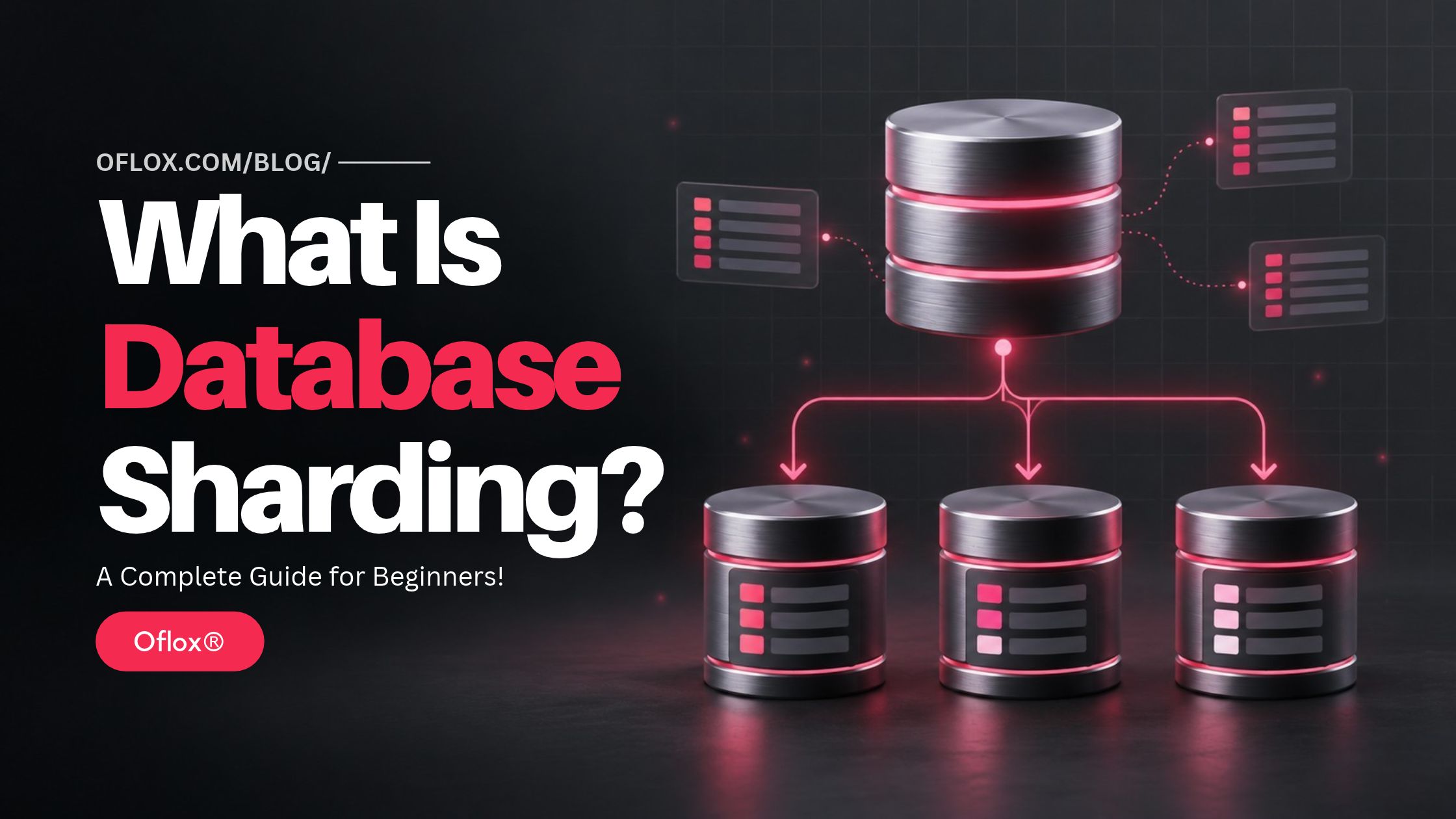
Database sharding is one approach to achieving this. It divides a dataset into smaller parts called shards, allowing different database nodes to handle different portions of the data.
For example, an online shopping platform could distribute customer records across several shards using customer IDs. A request for one customer can then be directed to the shard containing that customer’s information.
However, sharding introduces important decisions around routing, transactions, backups, and data distribution. It requires careful planning to deliver useful results.
For students, developers, digital marketers, and business owners, understanding database sharding helps explain how growing digital platforms manage data and why scaling involves more than upgrading hosting.
Let us understand the concept step by step.
Table of Contents
What Is Database Sharding?
Database sharding is a method of horizontal database scaling that divides a dataset into smaller, separate subsets called shards and distributes them across multiple database nodes. Each shard stores part of the overall data, while routing logic directs requests to the appropriate location.
In common row-based sharding, each shard contains different rows from the same logical table.
Suppose an application has a customers table containing three million records. A simplified range-based arrangement could look like this:
| Shard | Customer ID range | Stored data |
|---|---|---|
| Shard A | 1–1,000,000 | Customers within the first range |
| Shard B | 1,000,001–2,000,000 | Customers within the second range |
| Shard C | 2,000,001–3,000,000 | Customers within the third range |
The application still treats these records as one logical customer dataset. Physically, different subsets reside on different nodes.
A shard is a logical data unit, rather than necessarily one physical server. A node can host multiple shards, and a shard may have replicas on other nodes.
This distinction matters when planning capacity and availability.
A Simple Analogy: Database Sharding
Imagine a courier company operating through one warehouse.
Initially, that warehouse handles every parcel. As demand increases, sorting, storage, and dispatch become difficult.
The company opens several warehouses and assigns parcels using a clear distribution rule.
Database sharding follows a similar principle:
- The complete database represents the overall parcel workload.
- Shards represent separate portions of that workload.
- The shard key determines where each record belongs.
- Routing logic directs requests to the correct destination.
The distribution rule must match the workload. Otherwise, one warehouse—or one shard—may still receive most of the activity.
Why Is Database Sharding Important?
Sharding becomes useful when a workload needs more capacity than a suitable single-node architecture can reasonably provide.
Its importance comes from several practical needs.
- Managing Growing Data Volumes: Large applications accumulate customer profiles, messages, events, orders, and activity records. Distributing these records can increase total storage capacity and reduce the amount of data managed by each node.
- Distributing Write Activity: Read replicas can help serve eligible reads, but they do not necessarily remove pressure from a single primary handling writes. Sharding can distribute writes across multiple shard primaries when the data model and workload support it.
- Supporting More Concurrent Requests: Different shards can process independent requests simultaneously. For example, one shard might serve customer account updates while another handles orders belonging to different customers.
- Creating Capacity Headroom: A system operating close to its limits has less room for traffic spikes, maintenance, and unexpected growth. Sharding can provide additional capacity, although the benefit depends on balanced distribution and efficient routing.
- Supporting Data Placement: Some architectures assign particular datasets to selected regions or infrastructure groups. This can support location requirements and improve proximity to users. However, placement rules must also account for replicas, backups, logs, and downstream systems.
Sharding is important when it solves a measured capacity or placement problem. It is not automatically necessary for every growing website.
History and Background of Database Sharding
Database sharding developed from broader ideas in horizontal partitioning and distributed computing.
Earlier database deployments commonly scaled by upgrading one server with more memory, faster storage, or stronger processors. As internet applications expanded, some workloads exceeded what organisations could comfortably manage on a single machine.
Teams began distributing records across independent databases. Applications often handled the routing themselves, using customer IDs, account IDs, or other identifiers. This approach created new operational challenges. Developers had to manage data movement, query routing, schema changes, and failures across several databases.
Over time, specialised systems introduced more built-in support for distribution and administration.
Today, sharding may be implemented through:
- Application-controlled database routing.
- Database middleware.
- Database extensions.
- Native distributed database architectures.
The terminology varies between products. Systems may describe their distributed data units as shards, partitions, tablets, or ranges.
For example, CockroachDB distributes underlying key-value data through units called ranges. Its internal distribution approach differs from manually choosing a customer-to-server mapping.
Database Sharding vs Partitioning vs Replication
These concepts are related, but they solve different problems.
| Concept | Main purpose | What happens to the data? | Typical use |
|---|---|---|---|
| Sharding | Distribute storage and workload across nodes | Different subsets are assigned to different nodes | Horizontal scaling |
| Table partitioning | Divide a logical table into manageable parts | Rows are organised into partitions | Maintenance, pruning, retention |
| Replication | Maintain additional copies | The same data is copied to other nodes | Availability and eligible read scaling |
| Vertical scaling | Increase one server’s capacity | Data can remain on the same server | Expanding an existing deployment |
1. Is Sharding the Same as Partitioning?
Sharding is commonly described as horizontal partitioning across database nodes.
However, partitioning alone does not establish that data is distributed across independent servers.
For example, PostgreSQL supports declarative table partitioning and partition pruning. These capabilities help organise tables and avoid scanning irrelevant partitions, but do not by themselves provide automatic multi-node sharding.
2. Is Sharding the Same as Replication?
No. If three shards contain different customer groups, the dataset has been divided. If three nodes contain copies of the same customer group, that data has been replicated.
Many production architectures use both. Each shard has replicas to support its availability and recovery requirements.
How Does Database Sharding Work?
Database sharding combines data distribution with request routing. Here is a simplified step-by-step explanation.
1. Understand the Workload
Identify which records the application usually accesses together.
An order-management system may frequently retrieve one customer’s orders. A business dashboard may usually access one organisation’s campaigns and reports.
These access patterns influence the distribution design.
2. Select a Shard Key
A shard key is a field, or combination of fields, used to determine where a record belongs.
Possible choices include:
- customer_it
- tenant_id
- accoutn_id
- region_code
- A compound key combining multiple fields.
The best choice depends on queries, workload balance, and future growth.
3. Define the Distribution Rule
The system uses a rule such as:
- Assigning key ranges to shards.
- Hashing key values.
- Looking up assignments in a directory.
- Placing data according to zones or locations.
This rule establishes ownership of each data subset.
4. Store Records on Their Assigned Shards
When the application inserts a record, the routing layer identifies its destination.
For example, an order associated with customer 240517 is stored on the shard responsible for that customer.
Related records can also be placed together where the architecture supports it.
5. Route Reads and Updates
A request that includes the distribution key can often target a limited number of shards. A request lacking useful routing information may need to contact many shards.
This is why the application’s query design matters as much as the storage arrangement.
6. Combine Results When Necessary
Some requests need data from several shards. The system may execute multiple subqueries, collect their results, and combine them into one response.
A platform-wide sales total is a typical example.
7. Monitor and Rebalance
Over time, data and traffic may become uneven. The system may move data, split distribution units, or change assignments to use capacity more effectively.
Adding servers alone does not guarantee that an overloaded shard will receive relief.
Important Components of a Sharded Database
Understanding the following components makes sharding architecture easier to evaluate.
- Shards: These contain separate subsets of the overall dataset.
- Routing Layer: This determines which shards should receive a query. Routing may happen inside the application, through middleware, or within the database system.
- Distribution Metadata: The system needs a reliable way to know which shard owns which data. Depending on the architecture, this could involve a shard directory, range map, or other placement metadata.
- Replicas: Replicas maintain copies of shard data. Their behaviour depends on the replication mode, consistency settings, and failure-handling design.
- Monitoring and Administration: Operators need visibility into per-shard storage, request volume, latency, replication lag, and data movement. Without this visibility, an apparently healthy cluster can hide one overloaded shard.
Types of Database Sharding
Different strategies suit different access patterns.
1. Range-Based Sharding
Range-based sharding assigns consecutive key ranges to different shards.
For example:
| Shard | Assigned account IDs |
|---|---|
| A | Below 100,000 |
| B | 100,000–199,999 |
| C | 200,000 and above |
It can work well when queries frequently access nearby key values.
However, steadily increasing keys can concentrate new writes in the latest range. MongoDB’s documentation highlights both the range-query advantage and the importance of avoiding poor key distribution.
- Main advantage: Related ranges can be accessed efficiently.
- Main limitation: Some ranges may become much busier than others.
2. Hash-Based Sharding
Hash-based sharding applies a hash function to the key and uses the result for placement.
This can distribute records that would otherwise accumulate in one range.
MongoDB documents a trade-off: hashed distribution can improve balance, while range queries on the original field may require broader shard access. Equality queries can still support targeted routing.
- Main advantage: It can distribute many key values more evenly.
- Main limitation: Nearby original values may reside on different shards.
Hashing also does not solve every hotspot. A single extremely active customer remains concentrated if all that customer’s data shares one placement key.
3. Directory-Based Sharding
Directory-based sharding uses a lookup map.
For example:
| Tenant | Assigned shard |
|---|---|
| Company A | Shard 1 |
| Company B | Shard 3 |
| Company C | Shard 2 |
The mapping can support flexible assignments and special handling for large customers.
However, the directory becomes an important dependency. Its availability, caching, and update behaviour need careful design.
- Main advantage: Flexible placement.
- Main limitation: Additional routing infrastructure and consistency requirements.
4. Geography-Based Sharding
Data is assigned using a location-related rule.
For example, customer datasets may be placed in selected regional infrastructure.
This can help some location-sensitive workloads, but geographic groups may have unequal demand.
A region is also not necessarily a useful key for every query.
- Main advantage: More deliberate regional placement.
- Main limitation: Regional imbalance and cross-region operations.
5. Tenant-Based Sharding
A tenant is a customer organisation using a shared software platform. Tenant-based sharding groups records belonging to the same business.
For example, one company’s campaigns, leads, and reports can be stored together.
This approach is useful when most operations stay within one tenant. Its main challenge is handling a tenant that becomes substantially larger or busier than the others.
These categories can overlap. Tenant data may be distributed using hashing, directory assignments, or another placement mechanism.
How to Choose the Right Shard Key
Choosing the right shard key requires understanding your query patterns, data distribution, and future growth. Here are the key factors to consider before making your decision.
1. Support Common Queries
If most requests include tenant_id, distributing by tenant may support efficient routing. A key absent from most queries may force broad shard access.
2. Offer Enough Distinct Values
A key with only a few possible values limits distribution flexibility.
For example, a status field containing only active and inactive is usually a weak candidate.
3. Distribute Activity, Not Only Records
Equal row counts do not mean equal workloads.
One customer with heavy reporting activity can consume more resources than thousands of quiet customers.
Assess data size, reads, writes, and computational cost.
4. Avoid Uncontrolled Hotspots
Increasing timestamps, highly popular accounts, or concentrated regional demand can create hotspots.
Evaluate the combination of key and distribution strategy.
5. Keep Related Data Together
Co-locating frequently joined records can reduce network work.
Citus documents how using a shared tenant distribution column allows related distributed tables to be co-located for more efficient tenant-scoped queries.
6. Consider Future Changes
Think about customer growth, account transfers, mergers, and new query requirements.
A design that works for today’s workload may become restrictive later.
Before choosing, write down:
- The busiest query patterns.
- Expected large customers.
- Operations requiring transactions.
- Global reporting needs.
- Data-placement requirements.
- The strategy for moving data later.
Practical Database Sharding Examples
The following examples are illustrative designs, rather than descriptions of specific companies.
1. An E-Commerce Platform
An online store has customers, orders, and delivery records. Many customer-facing requests ask for one customer’s order history.
A customer-based distribution strategy can keep those records together.
However, a product popularity report may need information from every shard. The platform could send order events to a separate reporting system for this purpose.
Lesson: Design customer transactions and business analytics according to their different access needs.
2. A Marketing SaaS Platform
A marketing platform stores leads, campaigns, and performance summaries for several businesses.
Most users only access their organisation’s records.
Using tenant_id can support local queries:
SELECT campaign_id, campaign_name
FROM campaigns
WHERE tenant_id = 1042
ORDER BY campaign_id;
A suitable routing layer can use the tenant identifier to locate the relevant data.
The query still needs appropriate indexing, access control, and pagination.
Lesson: Sharding complements query design; it does not replace it.
3. A Messaging Application
A messaging application needs efficient conversation retrieval.
Distributing by conversation_id may keep messages from one conversation together.
However, a user’s inbox spans several conversations. The application may need a separate access structure for that view.
Lesson: One distribution key rarely serves every feature equally well.
4. An Event Collection Platform
An application records large numbers of timestamped events.
Putting all current events on one time range can create a write hotspot.
A design may combine a stable distribution key with time-based organisation within each distributed dataset.
Lesson: Storage management and write distribution are separate design concerns.
Key Features of Database Sharding
A sharding solution should be assessed by its actual capabilities.
| Feature | Why it matters |
|---|---|
| Horizontal distribution | Adds capacity across nodes |
| Query routing | Directs requests towards relevant data |
| Placement metadata | Tracks data ownership |
| Rebalancing | Helps adjust uneven distribution |
| Replica integration | Supports shard availability |
| Migration tooling | Reduces manual data-movement work |
| Monitoring | Reveals hotspots and failures |
| Transaction support | Defines which operations remain atomic |
These features vary considerably between database products.
Automatic distribution does not mean automatic suitability. Application modelling and operating procedures still matter.
Benefits of Database Sharding
Here are the main benefits when the architecture matches the workload.
- Increased Storage Capacity: The dataset can grow across multiple nodes rather than relying on one server’s storage limits.
- Distributed Write Throughput: Independent writes can be processed by different shard primaries. The benefit depends on avoiding concentration in one shard.
- Smaller Local Working Sets: Each node may manage fewer records and smaller indexes. This can help some workloads use memory and storage more effectively.
- Parallel Processing: Independent operations can run concurrently across shards. Some distributed queries can also use parallel execution, although coordination creates overhead.
- More Flexible Capacity Planning: Teams can add infrastructure and redistribute data as demand changes. This flexibility is most useful when rebalancing procedures are reliable.
- Potential Failure Containment: A shard-specific incident may affect a subset of operations. However, shared routers, metadata services, and cross-shard dependencies can still create wider impact.
Sharding provides scaling opportunities, but performance and availability remain properties of the complete design.
Challenges and Limitations of Database Sharding
Before implementing database sharding, understand the additional complexity it introduces into queries, transactions, maintenance, and recovery.
- Cross-Shard Queries: A query without a useful distribution key may contact many shards. This is often called a scatter-gather query. The system must collect results, combine them, and account for slow or unavailable participants.
- Distributed Joins: Joining records on different nodes can require network transfers and coordination. Some systems support these operations well within defined limits. Others require substantial application changes. Co-location can help, but does not eliminate every distributed query.
- Cross-Shard Transactions: A transaction affecting multiple shards requires coordination to preserve the intended guarantees. Support varies by system. For example, transferring value between accounts on different shards is more complex than updating records inside one shard. Do not assume that a transaction API supports every distributed operation efficiently.
- Uneven Distribution: A cluster can have enough total capacity while one shard remains overloaded. Possible causes include a poor key, one large tenant, or a sudden concentration of traffic.
- Global Uniqueness: Independent auto-increment counters can produce overlapping identifiers. Applications may need globally unique IDs, central allocation, or appropriately scoped composite keys. A unique constraint on one shard does not automatically enforce uniqueness across every shard.
- Resharding Complexity: Changing the distribution can involve copying data, synchronising updates, validating results, and switching traffic. Temporary storage and operational capacity are necessary.
- Backup and Recovery Coordination: Restoring each shard to an unrelated moment can create inconsistent business data. Recovery procedures need to consider coordinated state and dependencies.
- Higher Operating Costs: More nodes bring additional spending on infrastructure, replicas, networking, monitoring, and administration. Sharding can be justified by capacity needs without being the cheapest option.
- More Complicated Schema Changes: Changes must reach all relevant shards reliably. Mixed schema versions may exist during deployment, so applications may need temporary compatibility.
How to Implement Database Sharding
Implementation should begin with evidence and end with rehearsed operations.
1. Confirm the Bottleneck
Measure query latency, CPU usage, storage latency, lock waits, connection pressure, and growth.
A slow query caused by a missing index is a different problem from exhausted write capacity.
2. Improve the Existing Deployment
Consider indexing, query changes, archiving, caching, partitioning, suitable replicas, and hardware improvements.
Choose the approach that addresses the measured problem.
3. Document Access Patterns
List important reads, writes, joins, transactions, and reports.
Identify which data must stay together.
4. Evaluate a Sharding Platform
Compare the system’s routing, transaction, migration, backup, and monitoring capabilities against your requirements.
Check the documentation for the exact deployment version.
5. Test Candidate Keys
Use realistic data distributions and customer activity.
Include large tenants and peak traffic rather than testing only evenly distributed records.
6. Prepare a Migration Plan
Specify:
- How historical records will be copied.
- How new changes will remain synchronised.
- How ownership will be tracked.
- How data will be validated.
- How traffic will switch.
- How rollback will work.
Uncoordinated dual writes can create missing, duplicated, or inconsistent records.
7. Rehearse on a Representative Environment
Test ordinary queries, failures, retries, restores, and data movement.
Include requests that span several shards.
8. Migrate with Explicit Validation
Compare more than row counts.
Validate key coverage, important business totals, sampled records, and update synchronisation.
9. Monitor After Cutover
Track per-shard health and customer-facing outcomes.
Successful migration means both correct data and acceptable application behaviour.
What Is Resharding?
Resharding is the process of changing how data is divided or assigned across shards.
It may involve:
- Splitting an overloaded shard.
- Merging smaller shards.
- Moving data to new nodes.
- Changing a distribution strategy.
Rebalancing and resharding are related, but not identical. Rebalancing may move existing data units without changing the shard key.
Vitess describes a resharding workflow that copies source data to destination shards, catches up through replication, compares data, and switches serving traffic.
An online workflow can reduce disruption, but its name is not a guarantee of zero interruption. Cutover behaviour, workload limits, and rollback conditions must be checked.
For example, documented Vitess traffic-switching behaviour includes stopping source writes while synchronisation catches up.
Database Sharding Tools and Technologies
These technologies illustrate different approaches.
| Technology | General approach | Main evaluation point |
|---|---|---|
| MongoDB | Native sharded clusters | Shard key and targeted query behaviour |
| Vitess | Sharding infrastructure for MySQL | Routing, Vindexes, migration workflows |
| Citus | Distributed PostgreSQL extension | Distribution columns and co-location |
| CockroachDB | Distributed SQL with internal ranges | Transactions, locality, operational fit |
| Application-managed sharding | Custom routing across databases | Engineering and maintenance burden |
MongoDB provides native routing and distribution mechanisms for sharded collections. Vitess provides VReplication workflows for operations including resharding and table movement.
Citus supports different multi-tenant distribution models, with corresponding modelling and query requirements. These are starting points for evaluation. Benchmark your actual workload before committing to a platform.
Expert Tips for Database Sharding
Use these practical principles to make better architecture decisions.
- Keep Frequent Operations Local: Prioritise queries and transactions that represent everyday customer activity.
- Measure Each Shard: Cluster-wide averages can hide one overloaded node.
- Track Tail Latency: Observe p95 and p99 response times alongside averages. These reveal the experience of slower requests.
- Plan for Large Customers: Decide whether a large tenant can be isolated or distributed differently.
- Maintain Migration Headroom: Data movement needs spare storage, network capacity, and processing resources.
- Control Retries: Use bounded retries and suitable backoff. Where operations can be repeated safely, design for idempotency. Uncontrolled retries can intensify an incident.
- Test Recovery Procedures: A backup is useful only when the team can restore it into a correct, functioning application.
- Separate Heavy Reporting Where Appropriate: An analytical pipeline can reduce repeated cluster-wide scans on transactional databases. Account for its freshness and reconciliation requirements.
- Treat Routing as Infrastructure: Version, monitor, and validate placement metadata. Incorrect routing can be as damaging as an unavailable database.
Common Database Sharding Mistakes
Avoid these frequent implementation errors.
| Mistake | Why it creates problems | Better approach |
|---|---|---|
| Sharding too early | Adds unnecessary complexity | Establish a measured need |
| Choosing a convenient key | May conflict with queries | Analyse access patterns |
| Counting rows only | Misses workload imbalance | Measure storage and activity |
| Assuming every query improves | Ignores coordination costs | Benchmark important queries |
| Ignoring cross-shard transactions | Creates correctness surprises | Define transaction requirements |
| Using naive modulo expansion | Can remap many records | Plan stable routing and migration |
| Skipping restore tests | Leaves recovery uncertain | Rehearse restoration |
| Adding shards without redistribution | Leaves hotspots unchanged | Move data deliberately |
A simple rule such as:
shard_number = customer_id % number_of_shardsis useful for teaching placement.
However, changing the shard count can change the destination of many existing IDs. Production expansion therefore needs an explicit migration strategy.
When Should You Use Database Sharding?
Sharding may be appropriate when:
- Write capacity is a confirmed limiting factor.
- The dataset exceeds a practical single-node design.
- Important operations can be distributed efficiently.
- Data-placement requirements justify distribution.
- The team can operate and recover the resulting system.
There is no universal row count at which sharding becomes necessary.
A database with many simple records may perform well, while a smaller database with expensive queries can struggle.
FAQs:)
A. Database sharding means dividing a dataset into smaller parts and storing those parts across database nodes. Routing logic helps the application find the required records.
A. A shard key is a field or combination of fields used to determine data placement. Examples include customer IDs and tenant IDs.
A. No. Queries targeting a limited portion of the data may benefit. Queries involving many shards can become more expensive because they require coordination.
A. Yes. SQL databases can use application-managed distribution, middleware, extensions, or native distributed architectures. Capabilities differ between systems.
A. No. Sharding divides data, while replication maintains copies. They are often used together.
A. No. Shards are logical units. A node can host several shards, and shard replicas may exist on other nodes.
A. The outcome depends on replicas, failover behaviour, and application dependencies. Without suitable redundancy, records on that shard may become unavailable.
A. Usually, simpler improvements should be evaluated first. Sharding is useful when its benefits justify the additional operational work.
A. Some systems support changing distribution keys or resharding. Others require extensive migration. Check your database’s documented capabilities before choosing a key.
A. Sharding controls data distribution. Security requires access controls, tenant isolation, encryption, monitoring, and other protections. Distribution alone does not secure data.
Conclusion:)
Database sharding helps growing applications distribute data and workload across multiple database nodes. It can expand storage capacity and write throughput when the distribution strategy matches actual usage.
Its success depends on choosing a suitable shard key, keeping important operations local, and preparing for transactions, migration, monitoring, and recovery.
Before adopting sharding, identify the real bottleneck and evaluate simpler improvements. When distribution becomes necessary, test it with realistic data and rehearse how the system will behave during failures and changes.
Start with a clear understanding of your workload, choose the architecture carefully, and expand based on measured results.
“Adding more database servers creates capacity, but careful data distribution turns that capacity into useful performance.” — Oflox®
Read also:)
- What Is Virtual DOM in React: A Complete Guide for Beginners!
- What Is OSINT in Cyber Security: A Complete Guide for Beginners!
- What Is OAuth 2.0 Authentication: A Complete Guide for Beginners!
Have you ever managed a database that became difficult to scale? Share your experience or questions in the comments below—we would love to hear how you handled its growth.