This complete guide will explain Office Booths vs Meeting Rooms, their key differences, how they work, when to use them, their major benefits, space requirements, privacy considerations, acoustic performance, flexibility, and how to choose the right option for your workplace.
Modern offices need different types of spaces for different activities. Employees may need a quiet place for a short video call, a private conversation, focused individual work, or a larger space where several team members can meet and collaborate comfortably.
Using a large meeting room for every activity is not always practical. For example, a meeting room designed for six people may be occupied by just one employee attending an online call, while another team waits for a suitable space to hold an actual group meeting.
Office booths provide an alternative for such situations. These compact enclosed spaces can provide privacy for individual calls, virtual meetings, focused work, and smaller conversations while helping keep larger meeting rooms available for activities that genuinely require them.
Traditional meeting rooms, however, remain important for team discussions, client presentations, longer meetings, and collaborative sessions where employees need more space, equipment, or room to move comfortably.
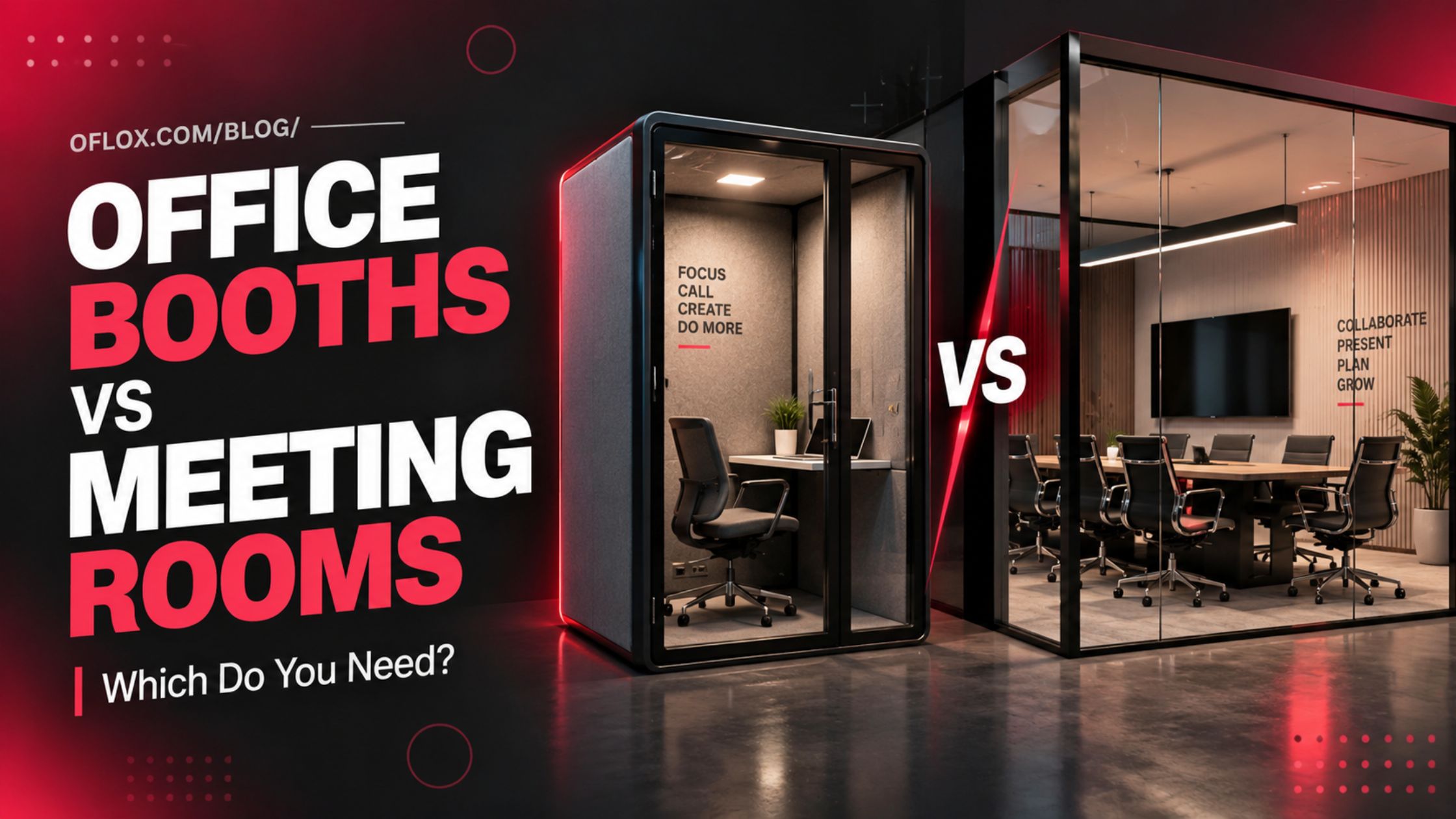
Whether you are a business owner, office manager, workplace designer, facility manager, startup founder, HR professional, or organisation planning a modern workspace, understanding the difference between office booths and meeting rooms can help you use available office space more effectively.
Let’s explore it together.
Table of Contents
What Is an Office Booth?
An office booth is a compact enclosed workspace designed to create privacy within a larger office.
Booths come in different sizes. Some are designed for one person, while larger models can accommodate several people for small meetings or collaborative work.
Single-person phone booths are particularly useful for video calls, private conversations and tasks that require concentration. Instead of booking an entire meeting room, an employee can step into a booth for a 20-minute call and return to their desk afterwards.
Because many office booths are modular or freestanding, they can also be added to an existing workplace without constructing a permanent room.
This makes them useful in offices where space needs may change over time.
When Does an Office Booth Make Sense?
Office booths work best for activities that require privacy but do not need a large amount of space.
Video calls are an obvious example.
In an open office, even a short call can become distracting for nearby colleagues. The person on the call may also find it difficult to hear clearly when several conversations are happening around them.
A booth creates a separate environment for the call while leaving larger meeting spaces available.
They can also be useful for focused individual work. An employee who needs an hour without interruptions may prefer moving into a booth rather than trying to concentrate at an open workstation.
Privacy is another consideration. Conversations involving clients, internal matters or personal information may not be appropriate at an open desk.
For these everyday situations, a compact booth can be more practical than a conventional meeting room.
Where Meeting Rooms Still Work Better
Meeting rooms serve a different purpose.
When several people need to sit around a table, share a screen, review physical materials or have a longer discussion, a full meeting room is usually more comfortable.
The larger space gives people room to move and makes it easier to accommodate presentation equipment, whiteboards and other collaboration tools.
Meeting rooms are also better suited to client presentations and formal discussions where the setting itself matters.
A booth designed for one or two people would obviously not replace a boardroom or a room used for larger team meetings.
The challenge is making sure meeting rooms are actually available for these activities rather than being filled throughout the day by individual calls.
Office Booths Can Take Pressure Off Meeting Rooms
One of the strongest reasons to introduce office booths is to improve how existing meeting rooms are used.
Consider an office with four meeting rooms.
If two of them are regularly occupied by individual employees taking online calls, half of the company’s meeting capacity has effectively disappeared.
Adding several phone booths can give employees another place for individual calls and focused work. JEB’s KoPlus Midi Studio Booth, for example, provides an enclosed workspace with room for one chair and one desk, making it suitable for individual work and virtual meetings.
Larger booth configurations are also available where businesses need space for more than one person.
By matching the size of the space to the activity, companies can make better use of their overall office footprint.
Think About How Much Space You Have
Floor space is often one of the biggest constraints when planning an office.
A traditional meeting room requires walls, circulation space, furniture and usually a relatively permanent location within the floor plan.
An office booth has a smaller footprint.
This can make booths particularly useful in offices where there is not enough room to construct several additional meeting rooms.
They can also fill awkward or underused areas of the floor plan. A section of an open office that is too small for another meeting room may still be suitable for an individual booth.
However, placement needs some thought.
Booths should be easy to access without blocking walkways or making busy areas feel cramped. They should also be positioned where people can enter and leave without creating new distractions for nearby workstations.
Consider How Long People Will Use the Space
The length of a meeting matters too.
A compact booth may be perfectly comfortable for a 30-minute video call but less suitable for a two-hour team workshop.
For longer meetings, people usually need more room to move, spread out documents and change their seating position.
This is where meeting rooms have a clear advantage.
Office planners should therefore look at actual meeting behaviour rather than simply counting the number of meetings on the calendar.
How many are individual calls? How many involve two people? How often do six or more people genuinely need to meet in person?
The answers can help determine the right balance between booths and meeting rooms.
Acoustic Privacy Matters for Both
A space can look private without providing meaningful acoustic privacy.
This is especially important in open offices.
If an employee steps into a booth for a confidential conversation but everyone outside can hear what is being said, the booth is not doing its job properly.
The same problem can occur with meeting rooms.
When choosing either solution, look at how the enclosure manages sound. The walls, door, seals, ventilation and overall construction can influence how much sound travels in and out.
Internal acoustics also matter. Excessive sound reflection can make calls uncomfortable even when the booth is physically separated from the rest of the office.
For this reason, acoustic performance should be considered alongside size, appearance and furniture.
Flexibility Is Another Difference
Traditional meeting rooms become part of the architecture of an office.
That can be useful when the organisation has stable space requirements. But workplaces change. Teams grow, departments move and hybrid working can alter how frequently people come into the office.
Freestanding office booths offer more flexibility because they do not necessarily require the same level of permanent construction.
Depending on the system and office design, booths can potentially be relocated or incorporated into a new layout when workplace requirements change.
This can be valuable for companies that expect their office to evolve.
A permanent meeting room still makes sense where there is consistent demand for a larger enclosed space. The point is to avoid using permanent construction for every privacy need.
Do You Need Office Booths or Meeting Rooms?
For many workplaces, the answer is both.
Meeting rooms remain important for team discussions, client meetings, presentations and longer collaborative sessions.
Office booths solve a different set of problems. They give individuals somewhere to take calls, join virtual meetings or work privately without occupying a room designed for a larger group.
The right balance depends on how your employees actually work.
If meeting rooms are constantly booked by one person, adding phone booths may free up valuable capacity. If most meetings involve several people working together for long periods, additional meeting rooms may be more useful.
Look at room booking data if it is available. Speak to employees about where they currently take calls and where they go when they need privacy. You may find that the problem is not a lack of meeting space at all.
It may simply be that the office has too few types of spaces.
A workplace that offers both meeting rooms and smaller enclosed booths gives employees more choice. More importantly, it allows each space to be used for the purpose it was actually designed for.
Conclusion:)
Office booths and meeting rooms are not simply two different types of office spaces; they are designed to support different workplace activities and help employees work more comfortably, privately, and efficiently.
Office booths can provide a practical space for video calls, private conversations, virtual meetings, and focused individual work without occupying a larger meeting room. On the other hand, traditional meeting rooms remain important for team discussions, client meetings, presentations, and longer collaborative sessions where more space and equipment are required.
“A productive workplace is not about having more meeting spaces; it is about having the right space for every type of work.”
Whether you manage a startup, corporate office, hybrid workplace, agency, or growing business, combining office booths with traditional meeting rooms can help you use available space more effectively while giving employees greater flexibility and choice.
Read also:)
- What Is Code Splitting? Complete Guide with Examples!
- What Is Mera Photo AI? A Complete Guide for Beginners!
- What Is a Staging Website? A Complete Beginner’s Guide!
Hope you liked this article about Office Booths vs Meeting Rooms: Which Do You Need? If you have any questions or suggestions related to office booths, meeting rooms, or modern workplace planning, please feel free to comment below.