This article provides a complete guide on What Is AVO (Authority & Visibility Optimization), including its meaning, importance, working process, key components, benefits, AI authority, visibility measurement, its relationship with SEO and GEO/AEO, practical applications, and the future of AI-driven search.
For years, businesses have relied on Search Engine Optimization (SEO) to improve their online visibility, rank higher on Google, attract organic traffic, and reach potential customers. However, the way people search for information and discover brands is rapidly changing.
This is where Authority & Visibility Optimization (AVO) becomes important. AVO is a strategic discipline focused on improving how AI systems understand, evaluate, and recommend a brand. Instead of focusing only on webpage rankings, it introduces another important question: Will AI recommend the brand when potential customers ask?
Today, platforms such as ChatGPT, Gemini, and Perplexity can provide direct, synthesized answers rather than simply presenting users with a traditional list of search results. This shift means businesses are increasingly competing not only for search rankings but also for authority, AI visibility, and recommendations.
Whether you’re a business owner, digital marketer, SEO professional, content creator, startup founder, or marketing professional, this beginner-friendly guide will help you understand AVO and its role in the evolving AI Search ecosystem.
Let’s explore it together.
Table of Contents
What is AVO?
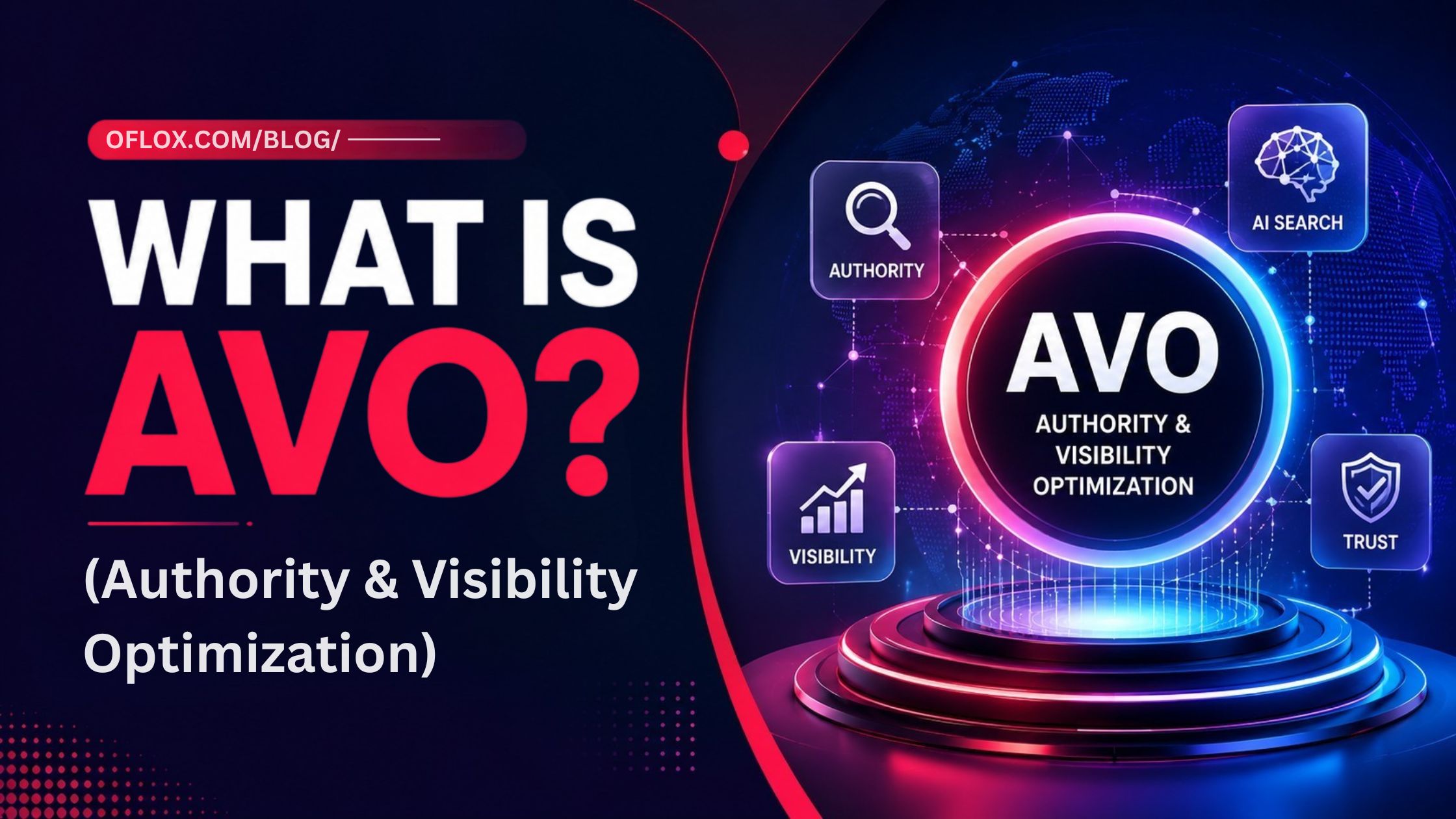
Authority & Visibility Optimization (AVO) is a strategic discipline that helps organizations improve how AI systems understand, evaluate, and recommend their brand.
It does not replace SEO, nor does it compete with established optimization practices. Instead, AVO addresses a challenge that became significantly more important with the rise of AI-powered search: ensuring that a brand is not only discoverable but also considered trustworthy enough to appear in AI-generated recommendations.
A simple comparison clarifies the distinction.
| Traditional SEO | Authority & Visibility Optimization |
| Focuses on webpages | Focuses on brands |
| Optimizes for rankings | Optimizes for recommendations |
| Measures search performance | Measures AI authority and visibility |
| The primary objective is discoverability | The primary objective is AI-mediated discoverability and recommendation |
SEO answers one important question:
“Can customers find us?”AVO introduces another:
“Will AI recommend us when customers ask?”Both questions matter. They simply solve different problems.
Benefits of Authority & Visibility Optimization
For businesses preparing for AI-driven discovery, AVO introduces several potential strategic benefits.
- Better Understanding of AI Readiness: Businesses can evaluate whether their digital presence provides sufficient authority signals for AI systems to understand their brand.
- Identification of Authority Gaps: Instead of guessing why competitors receive greater AI visibility, organizations can identify areas where their own authority signals may be weaker.
- Competitive Benchmarking: AVO can provide another way to compare digital visibility against competitors beyond conventional keyword rankings.
- AI Visibility Monitoring: Brands can evaluate whether and how prominently they appear in AI-generated answers.
- Complements Existing SEO: AVO does not require businesses to abandon their existing SEO investment. Instead, it adds an authority and recommendation-readiness layer to traditional discoverability.
- Long-Term AI Search Preparation: As AI assistants become increasingly involved in product research and brand discovery, understanding AI visibility can help businesses prepare for changing customer journeys.
Why Traditional SEO Doesn’t Fully Solve AI Search
One of the biggest misconceptions about AI Search is the belief that it works just like Google, with a chatbot interface.
It doesn’t.
Search engines are designed to retrieve information. AI systems are designed to synthesize information.
That distinction changes how brands earn visibility.
A search engine may rank your webpage because it is relevant to a query. An AI model, however, must decide whether your brand is credible enough to include in its response after considering information from multiple sources.
In other words, visibility is no longer determined solely by how well a webpage is optimized.
It is increasingly influenced by how consistently a brand demonstrates authority across the digital ecosystem.
This is the problem AVO was designed to solve.
AVO Complements SEO Rather Than Replacing It
Whenever a new marketing discipline appears, the first question is usually whether it replaces the previous one.
The answer is no.
SEO remains one of the foundations of digital marketing. Without technically accessible websites, structured content, and strong search visibility, AI systems have fewer reliable signals to understand your business.
AVO builds on that foundation by focusing on a different layer of optimization.
Rather than asking how to improve rankings, it asks how to improve the authority signals AI relies on when deciding which brands deserve to be recommended.
The relationship between these disciplines can be viewed like this:
| Marketing Layer | Primary Role |
| SEO | Makes information discoverable |
| AVO | Builds authority and recommendation readiness |
| GEO / AEO | Optimizes content for AI-generated responses |
Instead of competing, these disciplines reinforce one another.
Turning AVO Into a Measurable Discipline
Marketing frameworks become valuable only when they can be measured.
SEO has keyword rankings, backlinks, crawlability, and organic traffic. Paid advertising has impressions, clicks, and return on ad spend.
AVO follows the same principle.
According to the research, the discipline is supported by three interconnected components:
- Authority Score (AS) measures how prepared a brand is to be understood and trusted by AI systems.
- OMG Protocol provides a structured methodology for strengthening authority over time.
- Visibility Score (VS) measures how frequently and how prominently a brand appears across AI-generated answers.
Together, these components transform AVO from a conceptual framework into a practical discipline that organizations can continuously evaluate and improve.
Today, businesses can operationalize this approach using platforms such as AVO by Avonetiq, which implements the research framework in a practical environment. Instead of relying solely on search rankings, organizations can assess AI readiness, identify authority gaps, benchmark against competitors, and monitor how their visibility evolves across AI platforms.
The value of these measurements is not simply to generate another score. They provide actionable insight into why AI recommends certain brands while overlooking others.
Why This Matters Now
Every major shift in digital marketing has introduced a new optimization discipline.
- The growth of search engines led to SEO.
- The rise of social media created entirely new strategies for social engagement.
- Today, AI Search is creating another transition.
As more buying journeys begin with conversations rather than search queries, businesses need to understand not only whether they can be found, but also whether they can be confidently recommended.
That is the role AVO was created to fulfill.
The Future of AI Search and Brand Visibility
AI is rapidly becoming another interface between people and online information.
Users increasingly expect to ask detailed questions and receive direct, personalized answers rather than manually opening and comparing many webpages.
That does not mean websites or search engines are disappearing.
It means the path between information and decision-making is changing.
In the coming years, marketers may increasingly track metrics beyond conventional organic rankings, including:
AI mentions, brand visibility, recommendation frequency, authority signals, citation presence, competitive AI visibility, and recommendation readiness.
Businesses that understand this transition early can start building strategies that account for both traditional search visibility and emerging AI-mediated discovery.
Conclusion:)
The future of online visibility is unlikely to be defined by Google rankings alone.
SEO remains an essential foundation of digital marketing, but AI-generated answers are introducing an additional layer between users, information, and brands.
As AI becomes more involved in research and purchasing decisions, businesses need to consider not only whether customers can find them, but also whether AI systems can clearly understand, evaluate, and potentially recommend them.
That is the central idea behind Authority & Visibility Optimization (AVO).
By combining traditional SEO foundations with GEO/AEO practices and a structured approach to authority and AI visibility, businesses can build a more complete strategy for the evolving search ecosystem.
The supplied AVO framework ultimately positions Authority & Visibility Optimization as a way for organizations to measure, improve, and manage their presence as AI becomes an increasingly important interface between users and digital information.
The next era of digital marketing may not be only about ranking first—it may also be about becoming a brand AI considers worth recommending.
Read also:)
- What Is Digital Signature Certificate? A-to-Z Guide for Beginners!
- What Is SIP Trunking? A Complete Beginner’s Guide!
- How to Make Blurry Pictures Clear App Free: A Complete Guide!
As AI Search continues to evolve, businesses that start understanding their authority and visibility today may be better prepared for how customers discover brands tomorrow.