This detailed guide explains everything you need to know about What Is Cloud Telephony, including its meaning, history, working process, features, benefits, challenges, business applications, popular platforms, expert tips, common mistakes, future trends, and much more.
In today’s fast-moving digital world, businesses need more than just a traditional phone system—they need a smarter, faster, and more flexible way to communicate with customers. Whether it’s handling sales inquiries, providing customer support, managing remote teams, or tracking business calls, modern organizations require a communication solution that is reliable, scalable, and accessible from anywhere. This is where Cloud Telephony plays a crucial role.
Unlike conventional telephone systems that rely on expensive PBX hardware and fixed phone lines, Cloud Telephony uses cloud technology and internet connectivity to manage business communication. It allows organizations to make and receive calls, set up IVR menus, record conversations, route calls intelligently, integrate with CRM software, and monitor performance through a centralized online dashboard—all without maintaining complex on-premise infrastructure.
From startups and SMEs to large enterprises, healthcare providers, educational institutions, banks, and e-commerce businesses, Cloud Telephony has become an essential tool for improving customer experience while reducing operational costs. With advanced capabilities such as virtual numbers, AI-powered call routing, real-time analytics, voice recording, omnichannel communication, and remote accessibility, businesses can streamline operations and deliver faster, more personalized support.
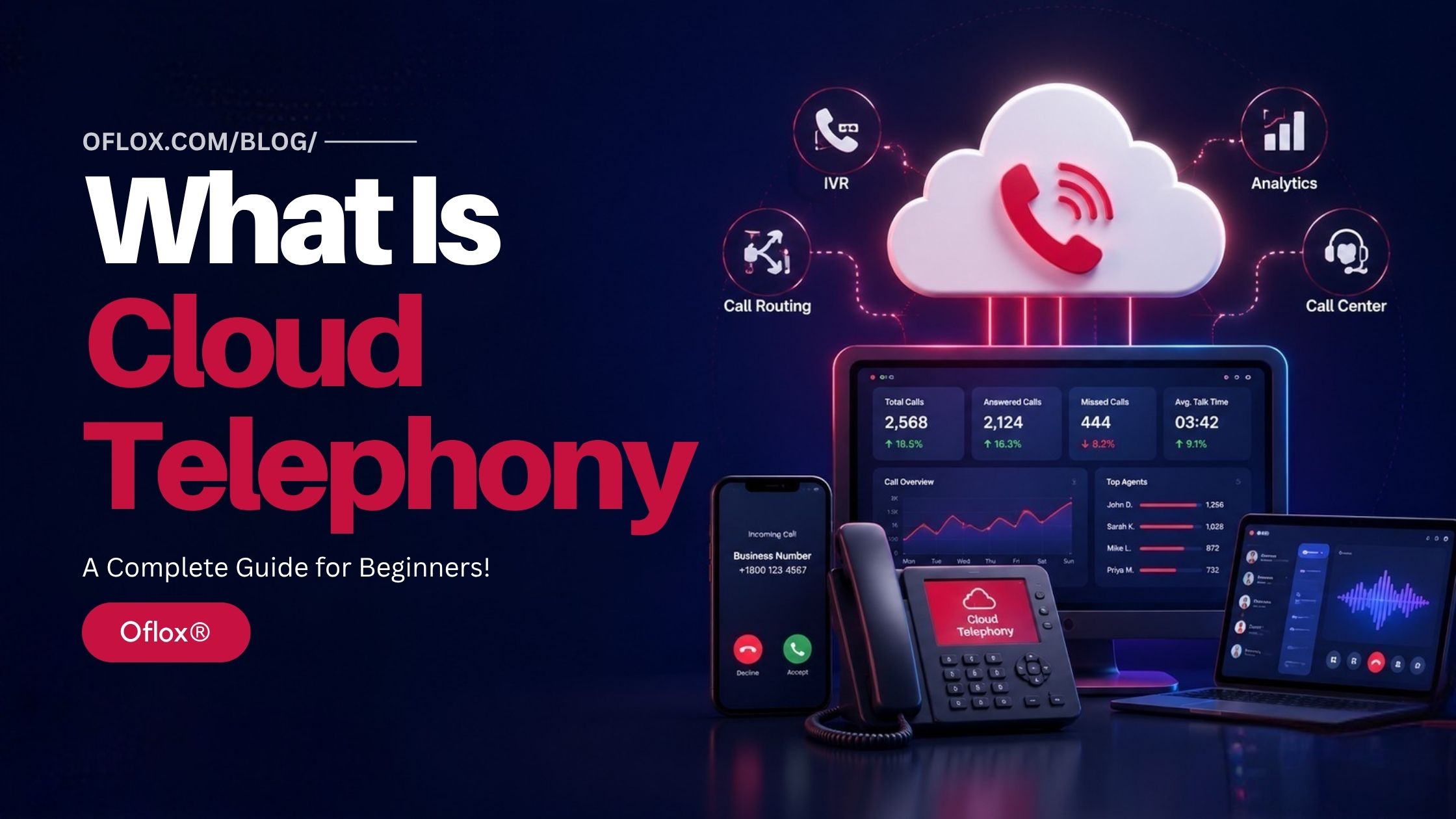
As cloud computing and artificial intelligence continue to transform business communication, Cloud Telephony is becoming the foundation of modern customer engagement. Organizations that adopt cloud-based communication systems today are better equipped to improve productivity, support hybrid workforces, and stay competitive in an increasingly digital marketplace.
Let’s explore it together.
Table of Contents
What Is Cloud Telephony?
Cloud Telephony is a cloud-based communication technology that allows businesses to handle phone calls using internet-connected cloud servers instead of traditional telephone infrastructure.
Instead of installing expensive PBX machines, physical phone lines, and telecom equipment, organizations simply subscribe to a Cloud Telephony provider that hosts the entire communication system in secure data centers.
Employees can make or receive business calls using:
- Desktop applications
- Mobile apps
- Web browsers
- IP Phones
- Softphones
- CRM platforms
All call processing happens in the cloud.
This means businesses can communicate from anywhere without being tied to a physical office.
Cloud Telephony in Simple Words
Think of Cloud Telephony like Google Drive for business phone systems.
Instead of storing files on your own computer, Google Drive stores them in the cloud.
Similarly,
Instead of managing phone systems inside your office, Cloud Telephony manages everything on secure cloud servers.
You simply connect through the internet and start communicating.
Traditional Phone System vs Cloud Telephony
| Traditional Phone System | Cloud Telephony |
|---|---|
| Physical PBX required | No physical PBX |
| Expensive installation | Quick cloud setup |
| Office-only access | Work from anywhere |
| High maintenance | Provider manages everything |
| Limited scalability | Easily scalable |
| Hardware upgrades required | Automatic updates |
| Costly expansion | Add users instantly |
| Fixed phone lines | Internet-based communication |
History and Evolution of Cloud Telephony
Business communication has changed dramatically over the last few decades.
Understanding this evolution helps explain why Cloud Telephony has become the preferred communication solution for modern organizations.
1. Traditional Landline Era (Before 1990)
Businesses depended entirely on:
- Copper telephone lines
- Manual switchboards
- Physical PBX systems
- On-premise telephone equipment
Although reliable, these systems were expensive, difficult to maintain, and lacked flexibility.
2. Digital PBX Systems (1990–2005)
Organizations started using digital PBX systems that offered:
- Internal extensions
- Call transfer
- Conference calling
- Voicemail
- Auto attendants
However, installation and maintenance costs remained high.
3. VoIP Revolution (2005–2015)
With the growth of broadband internet, businesses began adopting Voice over Internet Protocol (VoIP), allowing voice calls over IP networks instead of traditional phone lines.
VoIP reduced communication costs and introduced greater flexibility.
4. Rise of Cloud Telephony (2015–2025)
Cloud computing transformed business communication.
Instead of maintaining on-site PBX hardware, organizations shifted to hosted communication platforms offering:
- Cloud PBX
- IVR
- Virtual numbers
- CRM integration
- AI-powered call routing
- Analytics dashboards
- Call recording
- Remote accessibility
This significantly reduced infrastructure costs while improving scalability.
5. AI-Powered Cloud Telephony (2026 & Beyond)
Modern Cloud Telephony platforms are now integrating advanced AI capabilities, including:
- AI Voice Agents
- Voice Biometrics
- Real-time transcription
- Sentiment analysis
- Predictive call routing
- Automated quality monitoring
- Generative AI call summaries
- Multilingual virtual assistants
These innovations are making customer communication faster, smarter, and more personalized.
Major Reasons Cloud Telephony Is Important
Cloud Telephony is no longer just a convenience—it has become a strategic business tool that improves customer experience, operational efficiency, and team productivity.
Here are some key reasons why it matters.
1. Enables Remote Work
Employees can answer business calls from any location using:
- Smartphones
- Laptops
- Tablets
- Web browsers
This supports hybrid and remote work environments.
2. Reduces Infrastructure Costs
Businesses no longer need to purchase:
- PBX hardware
- Telephone switches
- Dedicated servers
- Multiple office phone lines
The cloud provider manages the infrastructure, reducing capital expenditure.
3. Improves Customer Experience
Advanced features such as:
- Intelligent IVR
- Call routing
- Queue management
- Faster agent connections
help customers reach the right department quickly.
4. Supports Business Growth
As businesses expand, they can easily:
- Add new users
- Create virtual numbers
- Open new branches
- Manage distributed teams
without replacing existing infrastructure.
5. Enhances Business Continuity
Cloud-based systems continue operating even if an office faces:
- Power outages
- Hardware failures
- Natural disasters
- Network disruptions (with failover options)
ensuring uninterrupted communication.
6. Provides Actionable Insights
Cloud Telephony platforms offer detailed analytics such as:
- Call volume
- Missed calls
- Agent performance
- Customer wait time
- Average handling time
- Call outcomes
These insights help improve customer service and operational efficiency.
7. Simplifies System Management
Providers handle:
- Software updates
- Security patches
- Infrastructure maintenance
- System monitoring
allowing businesses to focus on their core operations.
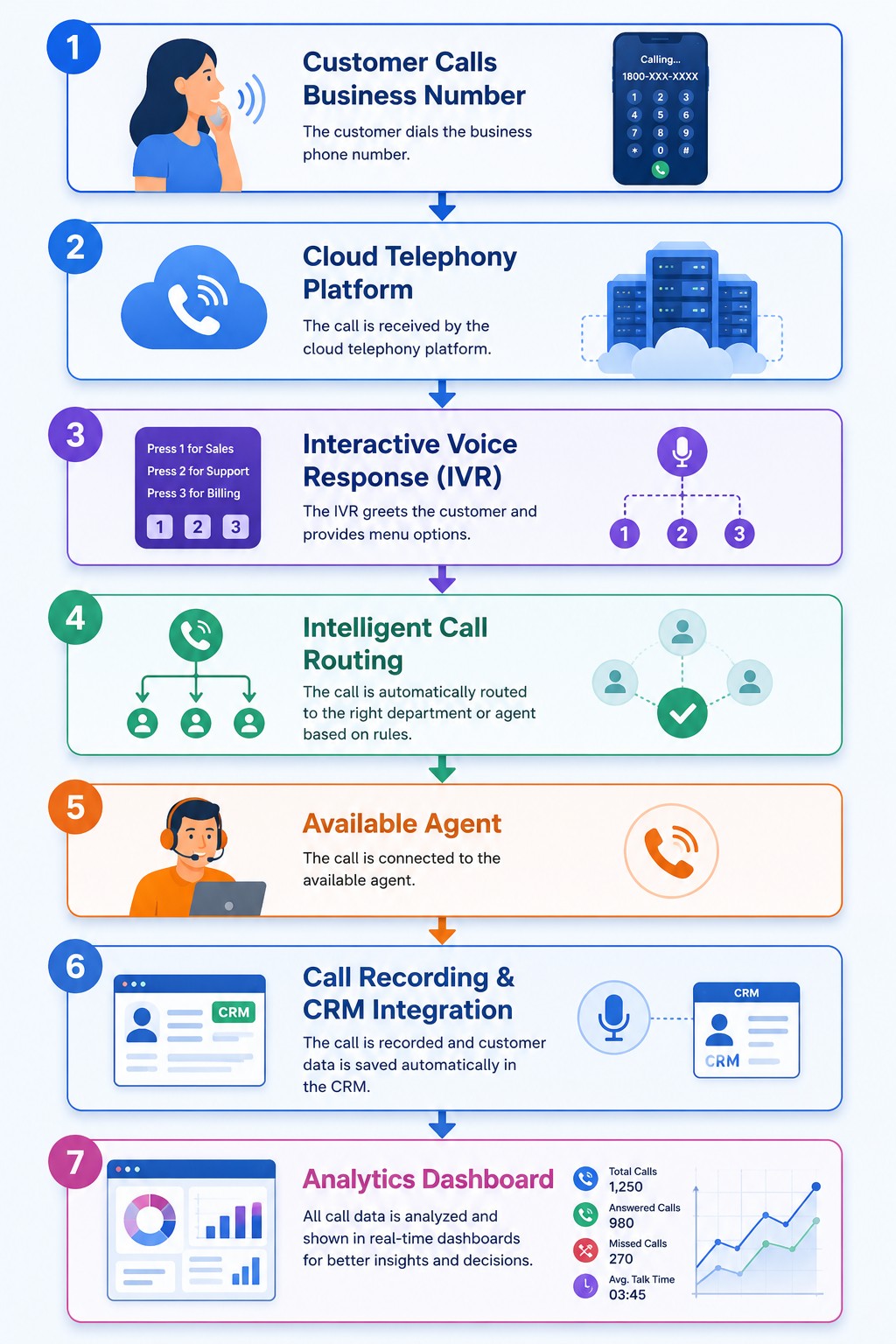
How Does Cloud Telephony Work?
Although Cloud Telephony appears simple to users, several technologies work together behind the scenes to deliver seamless communication.
Below is the typical workflow.
1. Customer Initiates a Call
A customer dials the company’s:
- Toll-Free Number
- Virtual Number
- Business Phone Number
The call is directed to the Cloud Telephony provider’s secure cloud servers.
2. Cloud Platform Receives the Call
Instead of reaching a physical PBX, the call is received by the cloud infrastructure, where intelligent software manages the communication process.
3. IVR Menu Is Played
The system may greet the caller with an automated Interactive Voice Response (IVR), such as:
- Press 1 for Sales
- Press 2 for Customer Support
- Press 3 for Billing
- Press 4 for Technical Assistance
The caller selects the appropriate option.
4. Intelligent Call Routing
Based on predefined rules, the platform routes the call according to factors like:
- Department selection
- Agent availability
- Business hours
- Language preference
- Customer priority
- Geographic location
This ensures the caller reaches the most suitable representative.
5. Agent Receives the Call
The assigned agent answers the call using:
- Mobile phone
- Laptop
- Desktop softphone
- IP phone
- Web browser
No traditional office phone line is required.
6. Call Features Operate Automatically
During the conversation, the platform can automatically enable features such as:
- Call recording
- Live monitoring
- CRM screen pop-ups
- Real-time analytics
- AI transcription
- Sentiment analysis
- Call tagging
7. Call Data Is Stored Securely
Once the call ends, the system stores valuable information, including:
- Call duration
- Recording
- Agent details
- Customer information
- Call outcome
- Performance metrics
Managers can later review reports through an online dashboard.
Cloud Telephony Workflow
Core Components of a Cloud Telephony System
A Cloud Telephony solution consists of multiple technologies working together to provide seamless business communication. Understanding these components helps businesses choose the right platform and configure it effectively.
1. Cloud PBX (Private Branch Exchange)
Cloud PBX is the heart of a Cloud Telephony system.
Instead of installing a physical PBX machine in your office, the PBX software is hosted on secure cloud servers.
It manages:
- Incoming calls
- Outgoing calls
- Internal extensions
- Call transfers
- Voicemail
- Conference calls
Benefits:
- No hardware maintenance
- Easy scalability
- Lower operational costs
- Automatic software updates
2. Virtual Phone Numbers
Virtual numbers are business phone numbers that are not tied to a specific SIM card or landline.
They can route calls to:
- Mobile phones
- Office phones
- Remote agents
- Call centers
Common Types:
- Toll-Free Numbers (1800)
- Local Numbers
- National Numbers
- International Numbers
3. Interactive Voice Response (IVR)
IVR is an automated phone menu that guides callers to the appropriate department.
Example:
Welcome to ABC Company

Press 1 → Sales

Press 2 → Customer Support

Press 3 → Billing

Press 4 → Technical Assistance
Benefits include:
- Faster call handling
- Reduced manual transfers
- Better customer experience
- Lower workload for agents
4. Automatic Call Distribution (ACD)
ACD intelligently distributes incoming calls among available agents based on predefined rules.
Routing methods may include:
- Round Robin
- Least Busy Agent
- Skill-Based Routing
- Priority Routing
- VIP Customer Routing
5. Call Recording
Every customer conversation can be securely recorded for:
- Quality monitoring
- Employee training
- Compliance
- Dispute resolution
- Customer feedback analysis
6. CRM Integration
Cloud Telephony integrates with CRM software to display customer information automatically during incoming calls.
Popular integrations include:
- Salesforce
- HubSpot
- Zoho CRM
- Freshsales
- Microsoft Dynamics
This helps agents provide personalized customer service.
7. Analytics Dashboard
Managers receive real-time business insights such as:
- Call volume
- Missed calls
- Agent productivity
- Customer wait time
- Average handling time
- First Call Resolution (FCR)
- Call abandonment rate
These reports help optimize business performance.
Key Features of Cloud Telephony
Modern Cloud Telephony platforms offer far more than basic calling. They provide intelligent communication tools that improve productivity, customer experience, and operational efficiency.
Essential Features:
| Feature | Description |
|---|---|
| IVR | Automated call menus |
| Call Routing | Routes calls to the right department or agent |
| Virtual Numbers | Business phone numbers without physical lines |
| Toll-Free Numbers | Free calling for customers |
| Call Recording | Records conversations securely |
| Voicemail | Stores unanswered calls |
| Call Analytics | Tracks performance metrics |
| CRM Integration | Connects customer data with calls |
| Click-to-Call | Call directly from CRM or browser |
| Call Forwarding | Redirect calls to another number |
| Conference Calling | Multiple participants in one call |
| Business Hours Routing | Different routing based on office timings |
| AI Voice Assistant | Automates customer conversations |
| Live Call Monitoring | Supervisors monitor ongoing calls |
| Whisper Coaching | Guide agents without customers hearing |
| Call Barging | Supervisor joins live calls |
| Multi-Level IVR | Advanced call flow navigation |
| API Integration | Connect with business applications |
| Number Masking | Protect customer privacy |
| Omnichannel Support | Voice, SMS, WhatsApp, Email integration |
Types of Cloud Telephony
Different businesses have different communication requirements. Cloud Telephony platforms offer several deployment models.
1. Hosted PBX
The provider manages the entire phone system in the cloud.
| Best For: | Advantages: |
| Small businesses | Affordable |
| Startups | Easy setup |
| SMEs | No hardware |
| Low maintenance |
2. Cloud Contact Center
Designed specifically for customer support operations.
| Includes: | Best For: |
| IVR | BPOs |
| Call queues | Support teams |
| Analytics | Enterprises |
| CRM integration | |
| Workforce management | |
| AI assistance |
3. Omnichannel Communication Platform
Supports multiple communication channels, including:
- Voice Calls
- SMS
- Live Chat
- Social Media
Best For:
Businesses seeking a unified customer communication platform.4. AI-Powered Cloud Telephony
The latest generation of platforms includes:
- AI Voice Bots
- Real-Time Translation
- AI Call Summaries
- Voice Biometrics
- Sentiment Analysis
- Smart Call Routing
- Predictive Analytics
Major Benefits of Cloud Telephony
Cloud Telephony provides significant advantages over traditional phone systems.
1. Lower Operational Costs
Businesses save money by eliminating:
- PBX hardware
- Telephone wiring
- Maintenance contracts
- Hardware upgrades
2. Work From Anywhere
Employees can answer business calls using:
- Smartphones
- Laptops
- Tablets
- Browsers
This supports remote and hybrid work models.
3. Faster Business Expansion
Adding:
- New employees
- Departments
- Branches
- Phone numbers
takes only a few minutes.
4. Better Customer Experience
Features like:
- IVR
- Smart Routing
- Shorter Wait Times
- Personalized Support
increase customer satisfaction.
5. Business Continuity
Even if an office closes temporarily due to power outages or natural disasters, cloud systems continue operating from remote locations.
6. Increased Employee Productivity
Employees spend less time transferring calls manually and more time solving customer problems.
7. Advanced Analytics
Managers gain valuable insights into:
- Agent performance
- Customer behavior
- Call trends
- Operational efficiency
8. Strong Security
Most enterprise platforms provide:
- Data encryption
- Secure cloud infrastructure
- Role-based access
- Compliance certifications
- Backup systems
Challenges of Cloud Telephony
Although Cloud Telephony offers numerous benefits, businesses should also understand its limitations.
| Challenge | Solution |
|---|---|
| Internet dependency | Use reliable broadband with backup connections |
| Network latency | Optimize network quality |
| Initial employee training | Conduct onboarding sessions |
| Data privacy concerns | Choose certified providers |
| Integration complexity | Use API-ready platforms |
| Vendor lock-in | Select scalable providers with open APIs |
| Call quality issues | Ensure sufficient bandwidth and QoS settings |
10+ Popular Cloud Telephony Platforms
Several trusted providers offer Cloud Telephony solutions with varying features and pricing.
| Platform | Best For | Key Features |
|---|---|---|
| Exotel | Businesses in India | IVR, Virtual Numbers, APIs |
| Knowlarity | Enterprises | Smart Routing, CRM Integration |
| MyOperator | SMEs | Toll-Free Numbers, Call Tracking |
| Ozonetel | Contact Centers | AI Calling, Omnichannel Support |
| Freshcaller | Customer Support | Cloud Contact Center |
| RingCentral | Global Businesses | Unified Communications |
| Aircall | Sales Teams | CRM Integrations |
| Dialpad | AI Communication | AI Voice Intelligence |
| 8×8 | Enterprises | Global Calling & Analytics |
| Zoom Phone | Hybrid Work | Cloud PBX & Meetings |
Industry-Wise Applications of Cloud Telephony
Cloud Telephony is widely used across industries to improve communication, automate customer interactions, and enhance service quality.
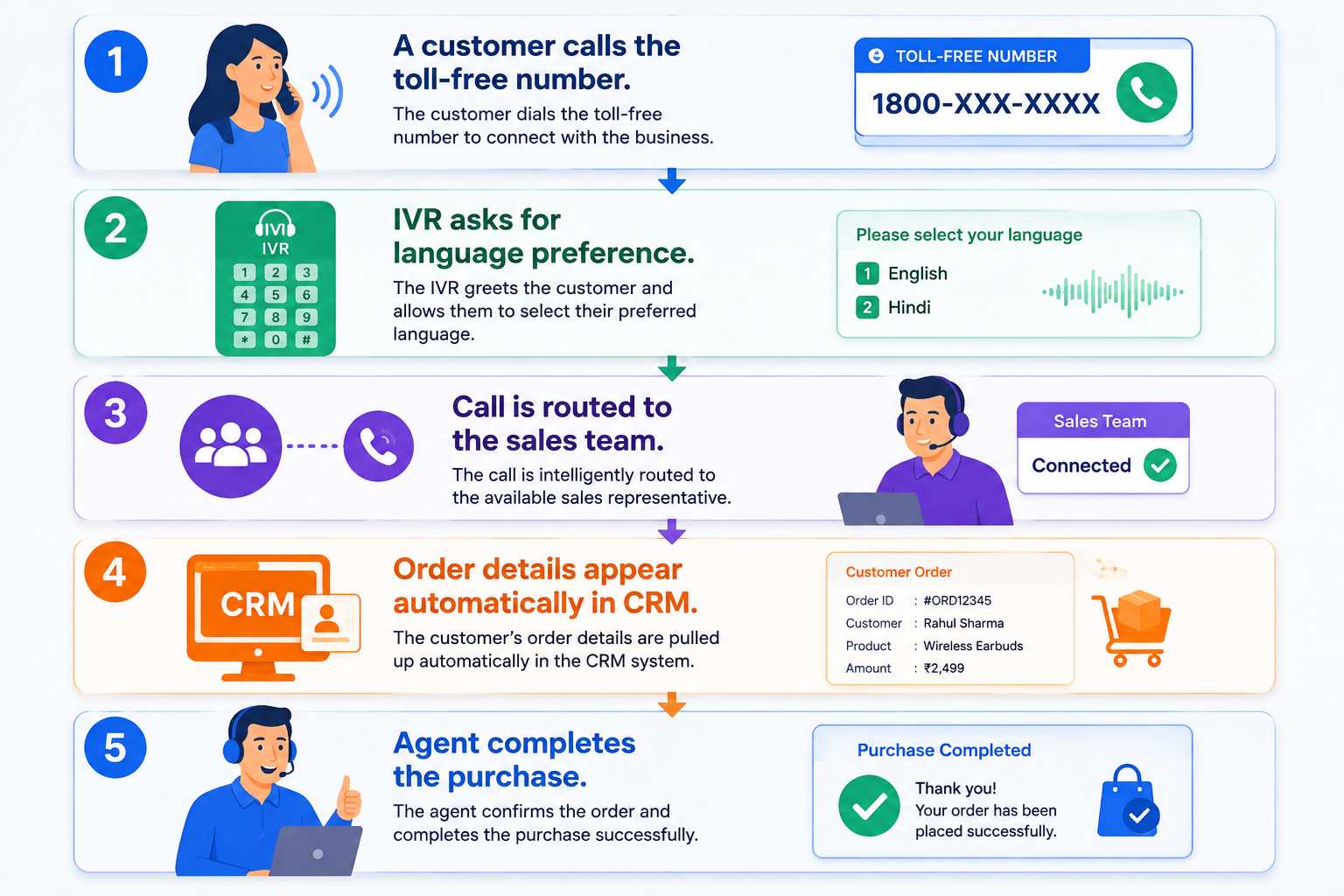
1. E-Commerce
Uses include:
- Order confirmation
- Delivery updates
- Customer support
- Return management
- Payment reminders
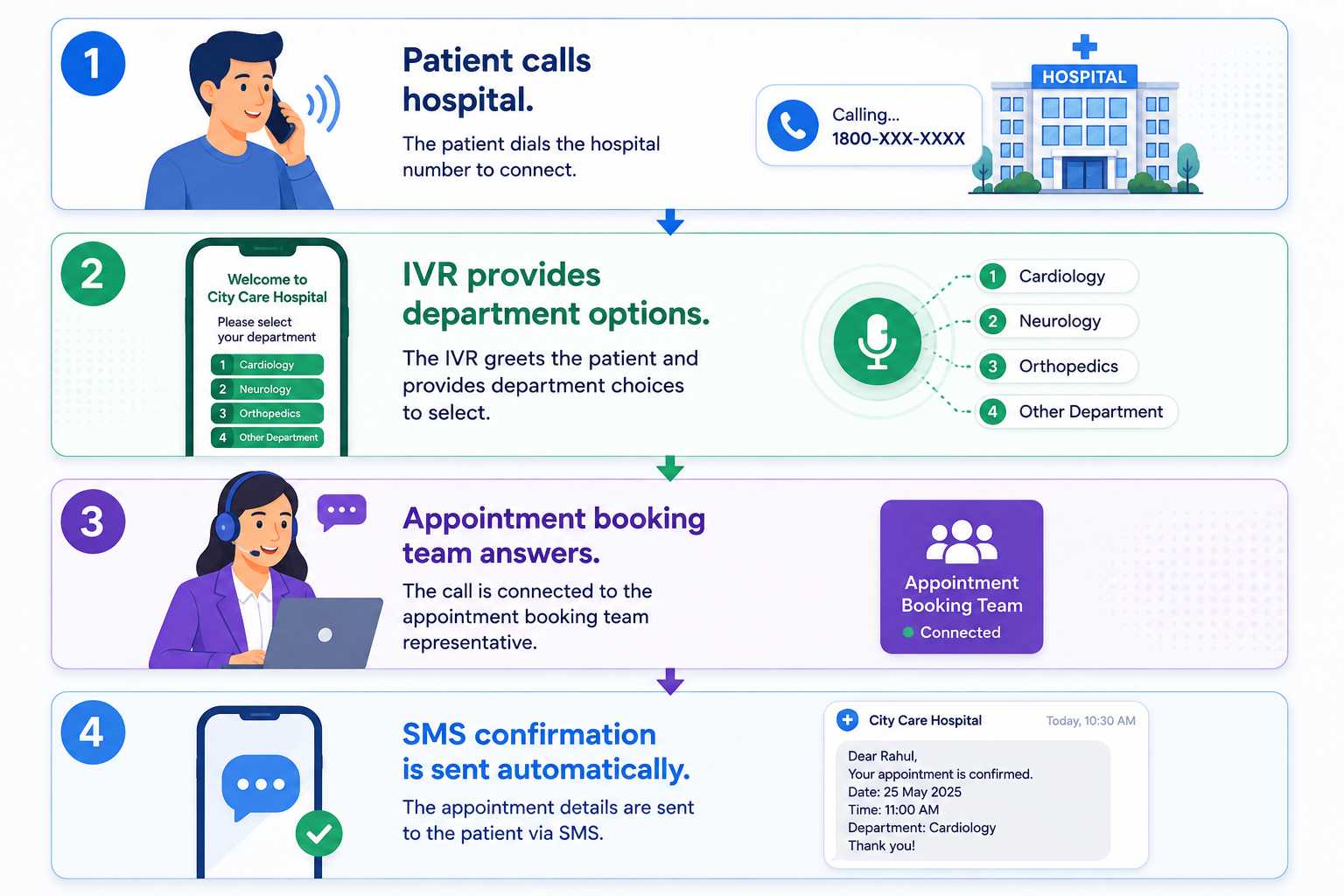
2. Healthcare
Applications:
- Appointment booking
- Doctor consultation scheduling
- Emergency helplines
- Patient follow-ups
- Prescription reminders
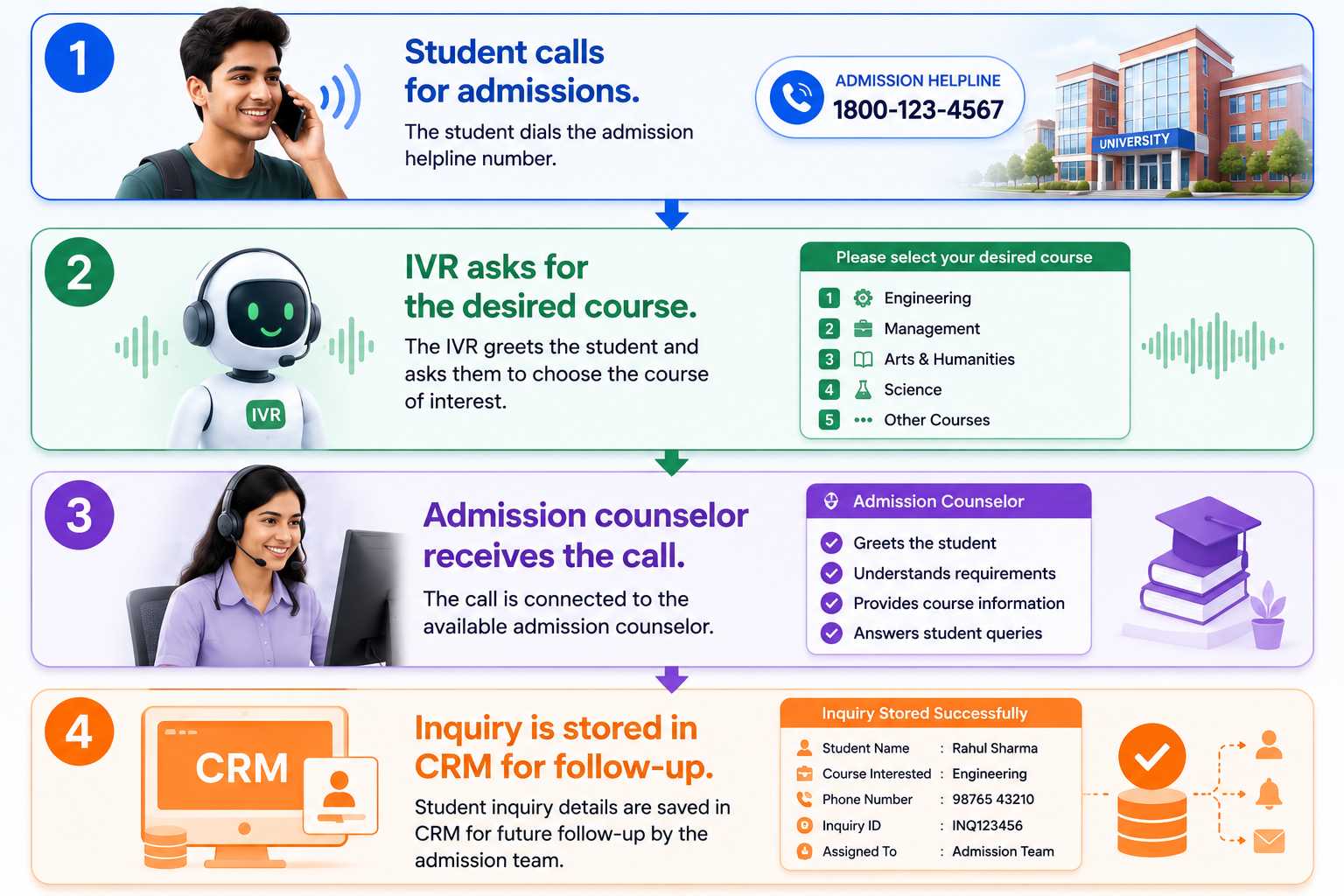
3. Education
Used for:
- Admission inquiries
- Student support
- Fee reminders
- Parent communication
- Attendance notifications
4. Banking & Finance
Supports:
- OTP verification
- Loan assistance
- Fraud alerts
- Customer verification
- Balance inquiries
5. Real Estate
Useful for:
- Lead management
- Property inquiries
- Site visit scheduling
- Agent call routing
- Follow-up campaigns
6. Travel & Hospitality
Handles:
- Booking confirmations
- Customer inquiries
- Reservation changes
- Travel assistance
- Feedback collection
7. Logistics
Supports:
- Shipment tracking
- Driver communication
- Delivery verification
- Customer notifications
- Complaint handling
8. Government Services
Used for:
- Citizen helplines
- Emergency response
- Public awareness campaigns
- Complaint management
- Information hotlines
Real-World Examples of Cloud Telephony
1. Online Shopping Company
2. Hospital Appointment System
3. Educational Institute
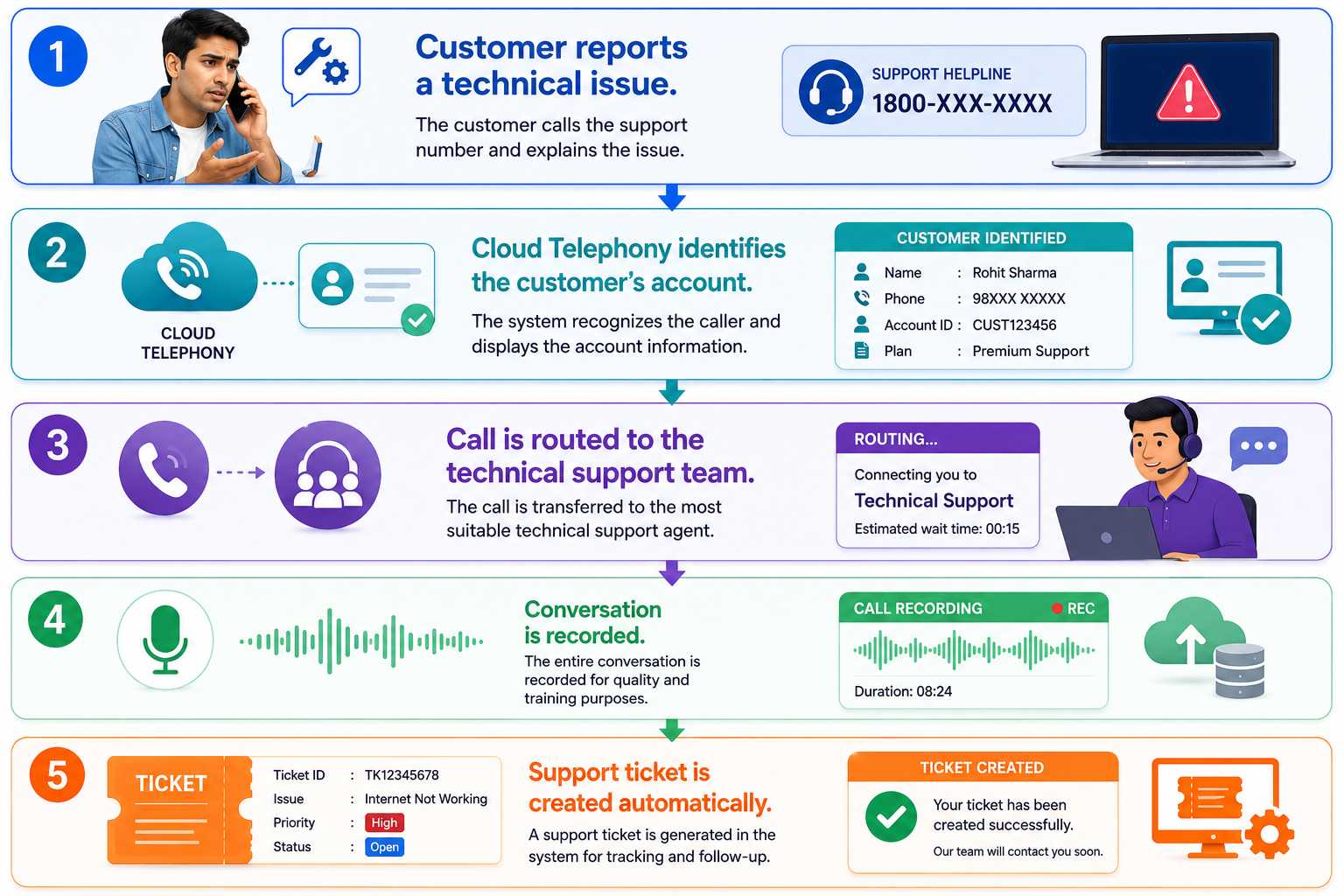
4. Customer Support Center
Traditional PBX vs Cloud Telephony Comparison
| Feature | Traditional PBX | Cloud Telephony |
|---|---|---|
| Initial Cost | High | Low |
| Hardware | Required | Not Required |
| Installation Time | Weeks | Hours |
| Remote Access | Limited | Yes |
| Maintenance | Business Responsibility | Provider Responsibility |
| Scalability | Difficult | Easy |
| Automatic Updates | No | Yes |
| Disaster Recovery | Limited | Strong |
| CRM Integration | Limited | Extensive |
| AI Features | Rare | Widely Available |
Cloud Telephony at a Glance
| Category | Cloud Telephony |
|---|---|
| Technology | Cloud Computing + VoIP |
| Internet Required | Yes |
| Hardware Required | Minimal |
| Scalability | Excellent |
| Best For | Businesses of All Sizes |
| Deployment | Cloud-Based |
| Remote Access | Supported |
| AI Support | Available |
| CRM Integration | Extensive |
| Security | Enterprise Grade |
Expert Tips for Successfully Implementing Cloud Telephony
Here are some expert recommendations to help you get the best results.
1. Clearly Define Your Business Requirements
Before selecting a provider, identify:
- Number of agents
- Expected daily call volume
- IVR requirements
- CRM integration needs
- Remote workforce requirements
- Reporting expectations
Choosing a solution based on actual business needs prevents unnecessary costs.
2. Select a Reliable Cloud Telephony Provider
Compare providers based on:
- Uptime SLA (99.9% or higher)
- Data security
- Customer support
- API availability
- Pricing transparency
- Scalability
- Compliance certifications
- Integration ecosystem
A reliable provider ensures long-term stability.
3. Use a Professional IVR Structure
A well-designed IVR reduces customer frustration.
Keep menus:
- Short
- Clear
- Easy to understand
- Limited to essential options
Avoid creating too many menu levels.
4. Integrate with CRM
Connecting Cloud Telephony with CRM enables:
- Automatic customer identification
- Faster issue resolution
- Personalized conversations
- Better sales tracking
- Improved customer experience
CRM integration significantly increases agent productivity.
5. Monitor Call Analytics Regularly
Review key metrics such as:
- Average Handling Time (AHT)
- First Call Resolution (FCR)
- Call Abandonment Rate
- Customer Satisfaction (CSAT)
- Agent Productivity
- Peak Call Hours
Data-driven decisions help improve operational efficiency.
6. Train Employees
Even the best communication system requires trained users.
Conduct regular sessions on:
- Call handling
- CRM usage
- Customer communication
- Compliance
- System features
Well-trained agents deliver better customer experiences.
7. Optimize Internet Connectivity
Since Cloud Telephony depends on internet connectivity:
- Use high-speed broadband
- Configure Quality of Service (QoS)
- Keep backup internet connections
- Monitor network latency
Reliable internet ensures excellent call quality.
8. Secure Your Communication
Protect business conversations by enabling:
- Multi-factor authentication (MFA)
- Role-based access control
- End-to-end encryption (where supported)
- Strong password policies
- Regular security audits
Security should always be a priority.
Common Cloud Telephony Mistakes to Avoid
Many organizations invest in Cloud Telephony but fail to utilize its full potential due to avoidable mistakes.
- Choosing Based Only on Price: The cheapest solution may lack Reliability, Security, Customer support, and scalability. Always evaluate overall value instead of price alone.
- Ignoring CRM Integration: Without CRM integration Agents manually search customer information, Response time increases, and Customer experience suffers.
- Complicated IVR Menus: Customers dislike long automated menus. Keep IVR navigation Simple, Logical, and Customer-friendly.
- Poor Internet Infrastructure: Low-quality internet leads to dropped calls, Voice delays, and Poor audio quality. Invest in reliable connectivity.
- Not Monitoring Analytics: Ignoring reports means missing opportunities to improve Customer satisfaction, Agent productivity, Sales conversions, and Operational efficiency.
- Lack of Employee Training: Employees who don’t understand the system often misuse features, reducing productivity and service quality.
- Underestimating Security: Weak passwords and unrestricted access increase cybersecurity risks. Follow security best practices from day one.
- Failing to Plan for Growth: Choose a solution that can easily support More users, Additional locations, Higher call volumes, and New business units. Future scalability is essential.
FAQs:)
A. Cloud Telephony is a cloud-based communication system that enables businesses to make, receive, manage, and automate phone calls over the internet without requiring traditional PBX hardware.
A. Not exactly. VoIP is the technology used to transmit voice over the internet, while Cloud Telephony is a complete business communication solution built on top of VoIP with features such as IVR, call routing, analytics, CRM integration, and automation.
A. Yes. Since the service operates through cloud infrastructure, a stable internet connection is essential for reliable call quality.
A. Absolutely. It eliminates expensive hardware costs and offers affordable subscription plans, making it ideal for startups and small businesses.
A. Yes. Employees can answer business calls from smartphones, laptops, tablets, IP phones, or web browsers from virtually anywhere with internet access.
A. Reputable providers implement strong security measures such as encryption, secure data centers, role-based access control, backups, and compliance standards. Businesses should also enforce good password and access policies.
A. Almost every industry, including Healthcare, Education, Banking, E-commerce, Logistics, Travel, Real Estate, Government, Manufacturing, and Customer Support.
A. Yes. Most leading platforms integrate with popular CRM solutions, allowing automatic customer information display, call logging, and workflow automation.
Conclusion:)
Cloud Telephony has transformed business communication by replacing expensive and complex traditional phone systems with flexible, internet-based cloud solutions. Organizations of all sizes—from startups and small businesses to large enterprises—can now manage calls, automate customer interactions, support remote teams, and gain valuable insights without investing in costly on-premise infrastructure.
As digital transformation continues to accelerate, Cloud Telephony is becoming more intelligent through AI-powered voice assistants, predictive call routing, real-time analytics, and seamless CRM integrations. These innovations help businesses improve customer experience, increase employee productivity, reduce operational costs, and scale communication effortlessly.
Whether you want to strengthen your customer support, streamline sales operations, or enable a distributed workforce, adopting a reliable Cloud Telephony platform can provide a significant competitive advantage in today’s fast-changing business environment.
Businesses that embrace modern cloud communication today will be better prepared for the AI-driven customer engagement landscape of tomorrow.
“Great customer communication isn’t measured by the number of calls you answer—it’s measured by how effortlessly you solve customer problems. Cloud Telephony makes that possible.” — Mr Rahman
Read also:)
- What Is Voice Biometrics? A Complete Beginner’s Guide!
- How to Get Toll Free Number in India: A Step-by-Step Guide!
- What Is Ticketing System? A Complete Guide for Beginners!
Have you implemented Cloud Telephony in your business, or are you planning to switch from a traditional phone system? Share your experience or questions in the comments below—we’d love to hear your thoughts!