This article provides a complete guide on What Is Voice Biometrics, including its meaning, importance, history, working process, types, key features, benefits, challenges, popular tools, real-world applications, expert tips, common mistakes, frequently asked questions, and future trends.
Passwords can be forgotten, PINs can be stolen, and OTPs can sometimes be intercepted. As cyber threats continue to evolve, businesses and organizations are rapidly adopting smarter and more secure authentication methods. One of the most innovative technologies leading this transformation is Voice Biometrics.
Voice Biometrics verifies a person’s identity by analyzing the unique characteristics of their voice instead of relying on traditional passwords or security questions. Just as every fingerprint is unique, every individual has a distinct voice pattern created by the shape of their vocal tract, speaking style, pitch, tone, rhythm, and hundreds of other vocal characteristics. This makes voice-based authentication both convenient and highly secure.
Today, Voice Biometrics is widely used across banking, healthcare, telecommunications, government services, customer support centers, fintech, and AI-powered applications. It enables users to access accounts, authorize transactions, and verify their identity simply by speaking naturally. With advancements in Artificial Intelligence (AI), Machine Learning (ML), and deepfake detection technologies, Voice Biometrics is becoming faster, more accurate, and more resistant to fraud than ever before.
As organizations move toward passwordless authentication and enhanced digital security, Voice Biometrics is playing a crucial role in protecting sensitive information while improving customer experience. Whether it is authenticating a customer during a banking call or securing access to enterprise applications, this technology is reshaping the future of digital identity verification.
Whether you’re a student, developer, cybersecurity professional, business owner, or simply interested in modern authentication technologies, this beginner-friendly guide will help you understand Voice Biometrics from the ground up.
Let’s explore it together.
Table of Contents
What Is Voice Biometrics?
Voice Biometrics is a biometric authentication technology that verifies or identifies a person by analyzing the unique characteristics of their voice. Instead of asking users to enter passwords, PINs, or security questions, the system compares the speaker’s voice with a previously enrolled voiceprint to confirm their identity.
A voiceprint is a digital mathematical representation of a person’s vocal characteristics. It is not an audio recording but a secure biometric template generated using advanced signal processing and artificial intelligence.
The technology examines hundreds of vocal attributes, including:
- Voice frequency
- Pitch
- Tone
- Pronunciation
- Speaking rhythm
- Accent
- Vocal tract shape
- Speaking speed
- Resonance
- Micro-patterns unique to every speaker
These characteristics remain relatively stable over time, allowing systems to accurately identify individuals even when they use different devices or speak from different locations.
Unlike passwords that can be guessed or stolen, a person’s natural voice is significantly harder to duplicate accurately, especially when modern AI-based anti-spoofing technologies are used.
Major Reasons Voice Biometrics Is Important
As cyber threats continue to grow, Voice Biometrics provides a reliable and convenient way to protect digital identities and reduce fraud.
- Eliminates Password Fatigue: Users no longer need to remember multiple passwords.
- Faster Authentication: Identity verification often takes only a few seconds.
- Reduces Fraud: Unique voice characteristics make impersonation much more difficult.
- Better Customer Experience: Customers enjoy faster support without lengthy security questions.
- Supports Remote Verification: Authentication works over phone calls, mobile apps, and online services.
- Improves Business Efficiency: Customer service representatives spend less time verifying identities.
- Works Hands-Free: Users simply speak naturally without touching any device.
- Enhances AI Applications: Voice Biometrics integrates seamlessly with AI assistants and conversational AI platforms.
- Scalable Authentication: Organizations can verify millions of users without issuing physical tokens.
- Future-Proof Security: It supports multi-factor authentication strategies required by modern cybersecurity frameworks.
History and Evolution of Voice Biometrics
Voice recognition research has existed for several decades, but commercial adoption accelerated only after advances in artificial intelligence and machine learning.
- 1960s: Researchers began experimenting with speech recognition systems.
- 1970s: Scientists developed early speaker recognition techniques.
- 1980s: Signal processing algorithms improved voice comparison accuracy.
- 1990s: Banks and government agencies started testing voice authentication.
- 2000s: Call centers adopted Voice Biometrics for customer verification.
- 2010s: Cloud computing and deep learning dramatically improved recognition accuracy.
- 2020–2024: AI-based voice authentication became mainstream across banking, fintech, healthcare, telecom, and enterprise security.
- 2025–2026: Modern Voice Biometrics systems now combine Artificial Intelligence, Machine Learning, Deep Neural Networks, Anti-spoofing Detection, Deepfake Detection, Behavioral Biometrics, Continuous Authentication, and Real-Time Risk Analysis. These innovations significantly improve security while delivering a smoother user experience.
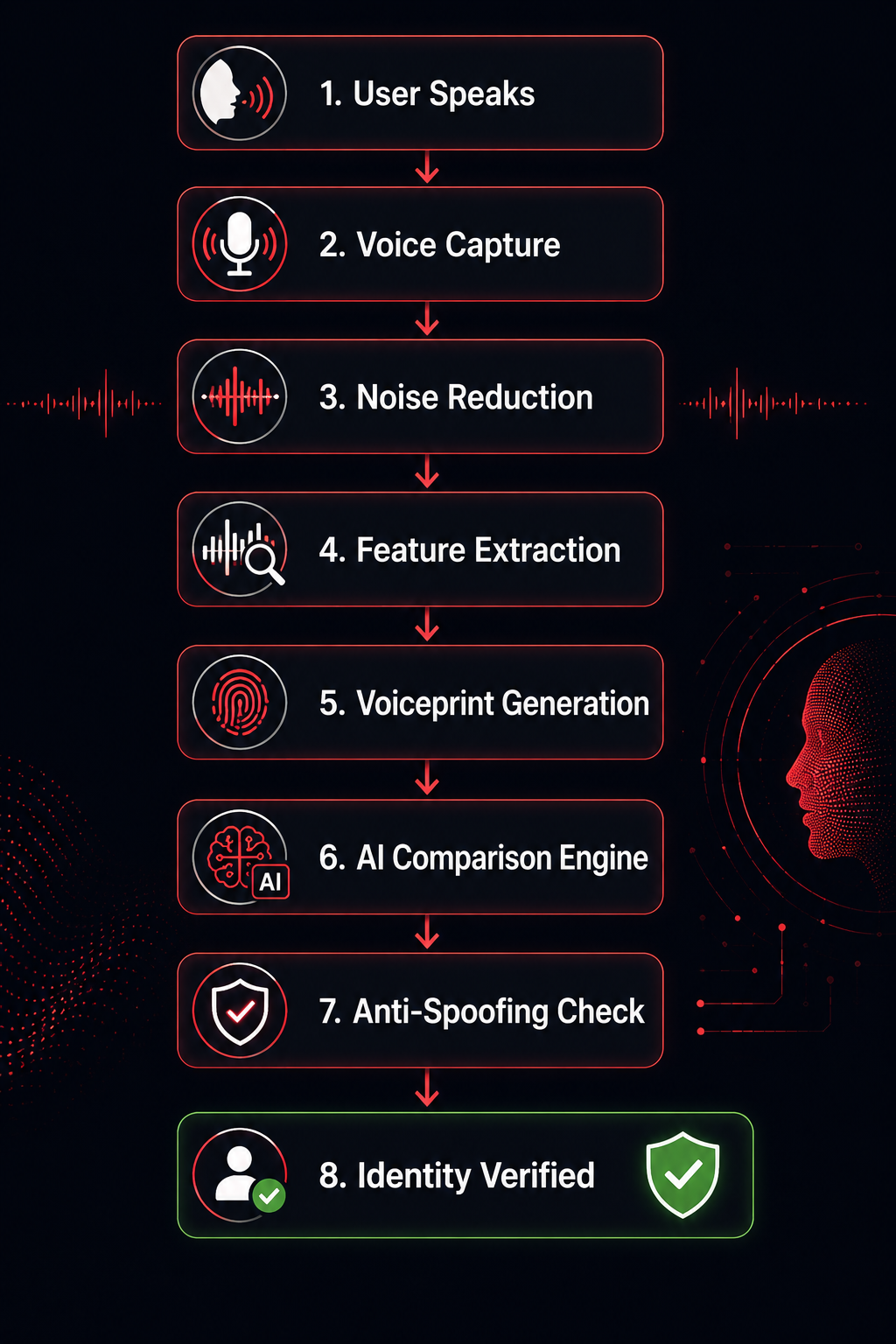
How Does Voice Biometrics Work?
Voice Biometrics follows a structured process to securely authenticate users. Instead of storing audio recordings, the system creates a mathematical representation called a voiceprint.
The overall process consists of several stages.
1. User Enrollment
The user speaks one or more predefined or natural phrases.
Example:
“My voice is my password.”
or
“Hello, this is Rahul.”
The system records only enough speech to create a biometric template.
2. Voice Capture
When authentication is required, the microphone captures the user’s speech.
This may happen through:
- Mobile app
- Phone call
- Website
- Smart speaker
- ATM
- Banking application
- Customer support IVR
3. Audio Processing
Background noise is reduced using digital signal processing techniques.
The system separates useful speech from environmental sounds.
4. Feature Extraction
The AI engine extracts hundreds of unique vocal characteristics such as:
- Pitch
- Frequency
- Formants
- Rhythm
- Speaking speed
- Vocal tract characteristics
- Spectral features
- Pronunciation style
- Intonation
- Voice energy
These features create a unique digital signature.
5. Voiceprint Generation
The extracted features are converted into a secure mathematical model called a voiceprint.
Important:
A voiceprint is not an audio recording.It is encrypted biometric data.
6. Voice Comparison
The new voice sample is compared with the enrolled voiceprint.
AI calculates how closely the two voiceprints match.
7. Anti-Spoofing Detection
Modern systems check whether the voice comes from:
- A real human
- Audio recording
- AI-generated deepfake
- Voice cloning software
- Synthetic speech
- Replay attack
If suspicious activity is detected, authentication is rejected.
8. Identity Verification
If the similarity score exceeds the required threshold, access is granted.
Otherwise, authentication fails or additional verification methods are requested.
Voice Biometrics Workflow
Types of Voice Biometrics
Voice Biometrics can be categorized into different types based on how the system captures and verifies a user’s voice during authentication.
1. Active Voice Biometrics (Text-Dependent)
Active Voice Biometrics requires users to speak a predefined phrase or password during authentication.
For example:
“My voice is my password.”
The system compares the spoken phrase with the enrolled voiceprint to verify identity.
| Advantages | Limitations |
| Very accurate | Users must remember the required phrase. |
| Easy to implement | Less flexible than passive authentication. |
| Fast authentication | |
| Suitable for banking and mobile apps |
Common Use Cases:
- Mobile banking
- Digital wallets
- Employee login
- Secure enterprise systems
2. Passive Voice Biometrics (Text-Independent)
Passive Voice Biometrics authenticates users while they speak naturally. No fixed phrase is required.
For example, a customer calling a bank may simply say:
“I want to check my account balance.”
The system verifies the speaker in the background without interrupting the conversation.
| Advantages | Limitations |
| Natural user experience | Requires more advanced AI models |
| No passwords | Performance may be affected by poor audio quality |
| Difficult for fraudsters to predict | |
| Faster customer support |
Common Use Cases:
- Call centers
- Customer support
- Telecom
- Insurance
- Government helplines
Active vs Passive Voice Biometrics
| Feature | Active | Passive |
|---|---|---|
| Fixed phrase required | Yes | No |
| Natural conversation | No | Yes |
| User experience | Good | Excellent |
| Security | High | Very High |
| AI complexity | Moderate | Advanced |
| Best for | Apps & Banking | Call Centers & Enterprises |
Key Features of Voice Biometrics
Modern Voice Biometrics solutions include numerous intelligent features that improve both security and user experience.
- Unique Voiceprint Creation: Every enrolled user receives a secure digital voiceprint that represents hundreds of unique vocal characteristics.
- AI-Powered Authentication: Machine learning algorithms continuously improve recognition accuracy and reduce false matches.
- Real-Time Verification: Identity can be confirmed within a few seconds during a live conversation.
- Anti-SSpoofing Protection: Advanced systems detect Voice cloning, Replay attacks, Deepfake voices, AI-generated speech, and Synthetic audio.
- Noise Reduction: Modern algorithms remove background noise before analyzing speech. This improves authentication even in noisy environments.
- Multi-Language Support: Most enterprise platforms support multiple languages and accents.
- Continuous Authentication: Instead of verifying users only once, some systems continuously monitor voice throughout the conversation.
- Cloud Deployment: Organizations can deploy Voice Biometrics through cloud-based APIs without expensive hardware.
- Multi-Factor Authentication Integration: Voice Biometrics easily integrates with Face Recognition, Fingerprint Authentication, OTP Verification, Password Authentication, and Smart Cards.
- Fraud Detection: AI identifies suspicious behavioral patterns and blocks high-risk authentication attempts.
Major Benefits of Voice Biometrics
Organizations worldwide are rapidly adopting Voice Biometrics because it offers both convenience and security.
- Better Security: Passwords can be stolen. Voices are significantly harder to duplicate accurately.
- Faster Login Process: Users authenticate simply by speaking. No typing is required.
- Improved Customer Experience: Customers avoid lengthy identity verification questions.
- Reduced Operational Costs: Call centers spend less time on manual verification. This improves agent productivity.
- Lower Fraud Rates: Voice Biometrics helps prevent Identity theft, Account takeover, Social engineering, Call center fraud, and Deepfake attacks.
- Higher Customer Satisfaction: Quick authentication leads to shorter waiting times.
- Better Accessibility: People with physical disabilities can authenticate hands-free.
- Supports Remote Work: Employees can securely verify themselves from anywhere.
- Regulatory Compliance: Many industries require strong authentication. Voice Biometrics supports compliance initiatives.
- Scalable Enterprise Security: Large organizations can authenticate millions of customers daily.
Challenges and Limitations of Voice Biometrics
Although Voice Biometrics is highly effective, it is not perfect. Businesses should understand its limitations before implementation.
- Background Noise: Poor-quality audio can reduce recognition accuracy.
- Illness or Voice Changes: Severe cold, throat infections, or surgery may temporarily affect authentication.
- Deepfake Technology: AI-generated voices are becoming increasingly realistic. Modern anti-spoofing systems are essential.
- Privacy Concerns: Organizations must securely store biometric templates and comply with privacy regulations.
- Accent Variations: Strong regional accents may require additional AI training.
- Internet Dependency: Cloud-based authentication may require a stable internet connection.
- Initial Enrollment: Users must first enroll their voice before authentication becomes possible.
- Environmental Conditions: Echoes, traffic noise, and poor microphones can impact performance.
Popular Voice Biometrics Tools and Platforms
Several leading technology providers offer enterprise-grade Voice Biometrics solutions.
| Tool | Best For | Key Features |
|---|---|---|
| Microsoft Azure AI Speech | Enterprises | Speaker verification, cloud APIs |
| Amazon Connect Voice ID | Contact Centers | Real-time caller authentication |
| Google Cloud Speech AI | Developers | AI speech recognition & integrations |
| Nuance Gatekeeper | Banking & Healthcare | Fraud detection, voice authentication |
| Verint Voice Biometrics | Call Centers | Passive authentication |
| Pindrop Security | Financial Institutions | Fraud detection & caller verification |
| NICE CXone | Customer Experience | Voice authentication for contact centers |
| Phonexia Voice Biometrics | Government & Enterprise | Speaker identification & investigation |
Real-World Examples of Voice Biometrics
Voice Biometrics has become an essential security technology across many industries. Let’s look at some practical examples.
- Banking: A customer calls customer support. Instead of answering multiple security questions, they simply speak naturally. Within seconds, the bank verifies their identity. The benefits are faster service, Better security, and Lower fraud.
- Telecom Companies: Mobile operators authenticate subscribers before allowing SIM-related requests. This prevents SIM swap fraud.
- Healthcare: Patients verify their identity before accessing sensitive medical information over the phone.
- Insurance: Insurance companies authenticate policyholders before discussing claim details.
- Government Services: Citizens securely access public services using voice authentication.
- Smart Home Devices: Voice assistants verify authorized users before executing sensitive commands. For example Unlocking smart locks, making payments, and accessing personal calendars.
- Enterprise Login: Employees authenticate into secure systems using only their voice.
- Call Centers: Passive Voice Biometrics verifies customers while the conversation continues naturally. No interruptions. No passwords.
Industry-Wise Applications of Voice Biometrics
As organizations embrace digital transformation, Voice Biometrics has become a trusted authentication solution for a wide range of industry-specific applications.
1. Banking & Financial Services
Voice Biometrics helps banks enhance customer security while reducing authentication time.
Common applications include:
- Phone banking authentication
- Secure fund transfers
- Credit card verification
- Fraud detection
- Digital banking login
2. Healthcare
Healthcare organizations use Voice Biometrics to protect sensitive patient information.
Applications include:
- Patient identity verification
- Telemedicine authentication
- Prescription verification
- Medical record access
- Appointment confirmation
3. Telecommunications
Telecom providers use voice authentication to reduce fraud and improve customer service.
Applications include:
- SIM replacement requests
- Customer verification
- Account recovery
- Subscription management
- Fraud prevention
4. Insurance
Insurance companies rely on Voice Biometrics for faster policyholder verification.
Applications include:
- Claims processing
- Policy access
- Customer support
- Fraud investigation
5. Government
Government agencies increasingly adopt Voice Biometrics for secure digital citizen services.
Applications include:
- Pension verification
- Citizen helplines
- Tax support
- Public service authentication
- Social welfare programs
6. E-Commerce
Online businesses improve customer trust using voice-based verification.
Applications include:
- High-value order confirmation
- Account recovery
- Payment approval
- Customer support
7. Enterprise Security
Large organizations use Voice Biometrics to strengthen internal security.
Applications include:
- Employee authentication
- VPN access
- Secure meetings
- Confidential system login
- Executive identity verification
8. Education
Educational institutions use Voice Biometrics for remote learning and examinations.
Applications include:
- Student identity verification
- Online exams
- Digital classroom access
- Attendance systems
Voice Biometrics vs Traditional Authentication
| Feature | Voice Biometrics | Passwords | OTP | PIN |
|---|---|---|---|---|
| Easy to Remember | Yes | No | Yes | No |
| Can Be Stolen | Very Difficult | Yes | Possible | Yes |
| Hands-Free | Yes | No | No | No |
| Fast Authentication | Yes | Moderate | Moderate | Fast |
| User Convenience | Excellent | Average | Good | Average |
| AI Fraud Detection | Yes | No | No | No |
| Supports Continuous Verification | Yes | No | No | No |
Expert Tips for Successfully Implementing Voice Biometrics
Following expert recommendations can help businesses build a Voice Biometrics system that is secure, scalable, and prepared for evolving cyber threats.
- Use Multi-Factor Authentication (MFA): Do not rely solely on Voice Biometrics for highly sensitive transactions. Combine it with OTP verification, Fingerprint authentication, Face recognition, Device authentication, and Behavioral biometrics.
- Choose AI-Powered Platforms: Select solutions that offer Deep learning, Anti-spoofing detection, Continuous authentication, Real-time fraud analysis, and Cloud scalability.
- Enroll High-Quality Voice Samples: Encourage users to record their voice in a quiet environment during enrollment to create a more accurate voiceprint.
- Enable Anti-Spoofing Protection: Modern cybercriminals can use replay attacks or AI-generated voices. Always activate liveness detection and anti-spoofing features.
- Encrypt Voiceprints: Never store raw audio files. Voiceprints should be encrypted and protected using industry-standard security practices.
- Monitor Authentication Performance: Regularly review False Acceptance Rate (FAR), False Rejection Rate (FRR), Authentication speed, and Fraud attempts. Continuous monitoring helps optimize accuracy.
- Keep AI Models Updated: Voice AI models should be updated regularly to recognize new fraud techniques, including deepfake voice attacks.
- Educate Users: Explain how Voice Biometrics works and reassure users that the system stores encrypted voiceprints—not ordinary voice recordings.
- Test in Real-World Conditions: Evaluate the solution under different conditions, such as Background noise, Mobile networks, Various microphones, Multiple accents, and Different languages.
- Follow Privacy Regulations: Ensure compliance with applicable privacy and data protection laws. Obtain user consent before collecting biometric data and maintain transparent data handling practices.
Common Voice Biometrics Mistakes
Many implementation failures occur because organizations overlook basic best practices. Avoid these common mistakes:
- Depending Only on Voice Authentication: For high-risk actions such as large financial transfers, use additional verification methods alongside Voice Biometrics.
- Ignoring Deepfake Risks: Failing to implement anti-spoofing technology leaves systems vulnerable to AI-generated voices.
- Poor Enrollment Quality: Recording voice samples in noisy environments reduces future authentication accuracy.
- Storing Raw Audio Files: Voice recordings should not replace secure, encrypted voiceprints.
- Skipping Regular System Updates: Outdated AI models may struggle to detect emerging attack techniques.
- Not Testing Across Different Devices: Users authenticate from smartphones, landlines, laptops, and tablets. Ensure consistent performance across all devices.
- Ignoring Regional Accents: Train models using diverse speech samples to improve accuracy for multilingual and regional users.
- Lack of User Awareness: Inform users about the benefits and privacy safeguards to build trust and encourage adoption.
- Weak Data Security: Protect biometric templates using encryption, strict access controls, and regular security audits.
- Failing to Measure Performance: Track authentication success rates, user experience, and fraud prevention metrics to continuously improve the system.
Future Trends of Voice Biometrics
The future of Voice Biometrics is being shaped by advancements in AI, machine learning, and digital identity technologies, opening new possibilities for secure authentication.
- AI-Powered Continuous Authentication: Systems will continuously verify users during conversations instead of authenticating only once.
- Stronger Deepfake Detection: AI models will become increasingly capable of identifying synthetic and cloned voices in real time.
- Passwordless Authentication: Voice Biometrics will play a significant role in replacing traditional passwords across digital services.
- Zero Trust Security Integration: Organizations will combine Voice Biometrics with Zero Trust frameworks for stronger identity verification.
- Edge AI Processing: Authentication will increasingly happen directly on devices, improving speed, privacy, and reducing cloud dependency.
- Smart Banking Experiences: Banks will use Voice Biometrics for secure transactions, personalized services, and fraud prevention.
- AI Contact Centers: Customer support systems will verify callers automatically without interrupting conversations.
- IoT and Smart Home Security: Voice authentication will secure smart locks, connected vehicles, and home automation systems.
- Multimodal Biometrics: Future systems will combine Voice, Face, Fingerprint, Behavioral biometrics, and Device intelligence. This layered approach will significantly enhance security.
- Personalized AI Assistants: AI assistants will recognize authorized users through Voice Biometrics, enabling secure and personalized interactions.
FAQs:)
A. Voice Biometrics is a technology that verifies or identifies a person using the unique characteristics of their voice instead of passwords or PINs.
A. Yes. Modern systems use AI, encrypted voiceprints, anti-spoofing technology, and liveness detection to provide strong security. However, no authentication method is completely risk-free, so many organizations combine it with multi-factor authentication for sensitive actions.
A. No. A voiceprint is an encrypted mathematical representation of vocal characteristics, not an audio recording.
A. Advanced systems are designed to detect replay attacks and many AI-generated or cloned voices. However, attackers continue to improve their techniques, making regular updates and anti-spoofing measures essential.
A. Temporary conditions such as a cold or sore throat can slightly affect recognition. Modern AI systems are designed to tolerate normal voice variations, but severe changes may require additional verification.
A. For convenience and resistance to password theft, it offers clear advantages. However, the strongest security often comes from combining Voice Biometrics with other authentication methods.
A. Speech recognition converts spoken words into text. Voice Biometrics identifies who is speaking.
A. Yes. Most enterprise solutions include advanced noise reduction technologies, although extremely noisy conditions can still affect performance.
A. The future includes passwordless authentication, AI-powered fraud detection, multimodal biometrics, and deeper integration with smart devices and digital identity platforms.
Conclusion:)
Voice Biometrics is transforming how people and organizations verify identity in the digital world. Analyzing the unique characteristics of an individual’s voice, it offers a fast, convenient, and increasingly secure alternative to traditional passwords and PINs.
From banking and healthcare to telecom, government services, and AI-powered customer support, Voice Biometrics is improving both security and user experience. As artificial intelligence continues to evolve, modern systems are becoming more accurate, better at detecting fraud, and more resilient against emerging threats such as voice cloning and deepfake attacks.
Although no authentication method is perfect, combining Voice Biometrics with strong encryption, anti-spoofing technologies, and multi-factor authentication creates a robust security strategy for modern digital services. Organizations that adopt these best practices will be better prepared to protect users while delivering seamless and efficient authentication experiences.
As we move toward a passwordless future, Voice Biometrics is set to become one of the most important technologies in digital identity and cybersecurity.
“Your voice is more than a way to communicate—it is a unique digital identity that can help secure the future of authentication.” — Mr Rahman
Read also:)
- How to Get Toll Free Number in India: A Step-by-Step Guide!
- What Is Ticketing System? A Complete Guide for Beginners!
- What Is AI Guardrail? A Complete Beginner’s Guide!
Have you ever used Voice Biometrics to access a banking app, contact customer support, or unlock a smart device? Share your experience or questions in the comments below—we’d love to hear from you!