This article provides a detailed guide on What is MLOps and LLMOps. Today, businesses are rapidly adopting Artificial Intelligence (AI), Machine Learning (ML), and Generative AI technologies to automate operations, improve customer experience, and increase productivity.
As AI systems become larger and more complex, companies need proper processes to manage AI models efficiently. This is where MLOps and LLMOps become extremely important. These systems help organizations deploy, monitor, update, secure, and scale AI models in real-world environments.
Whether you are a beginner, developer, startup founder, digital marketer, or AI engineer, understanding MLOps and LLMOps can help you build modern AI-powered systems more effectively.
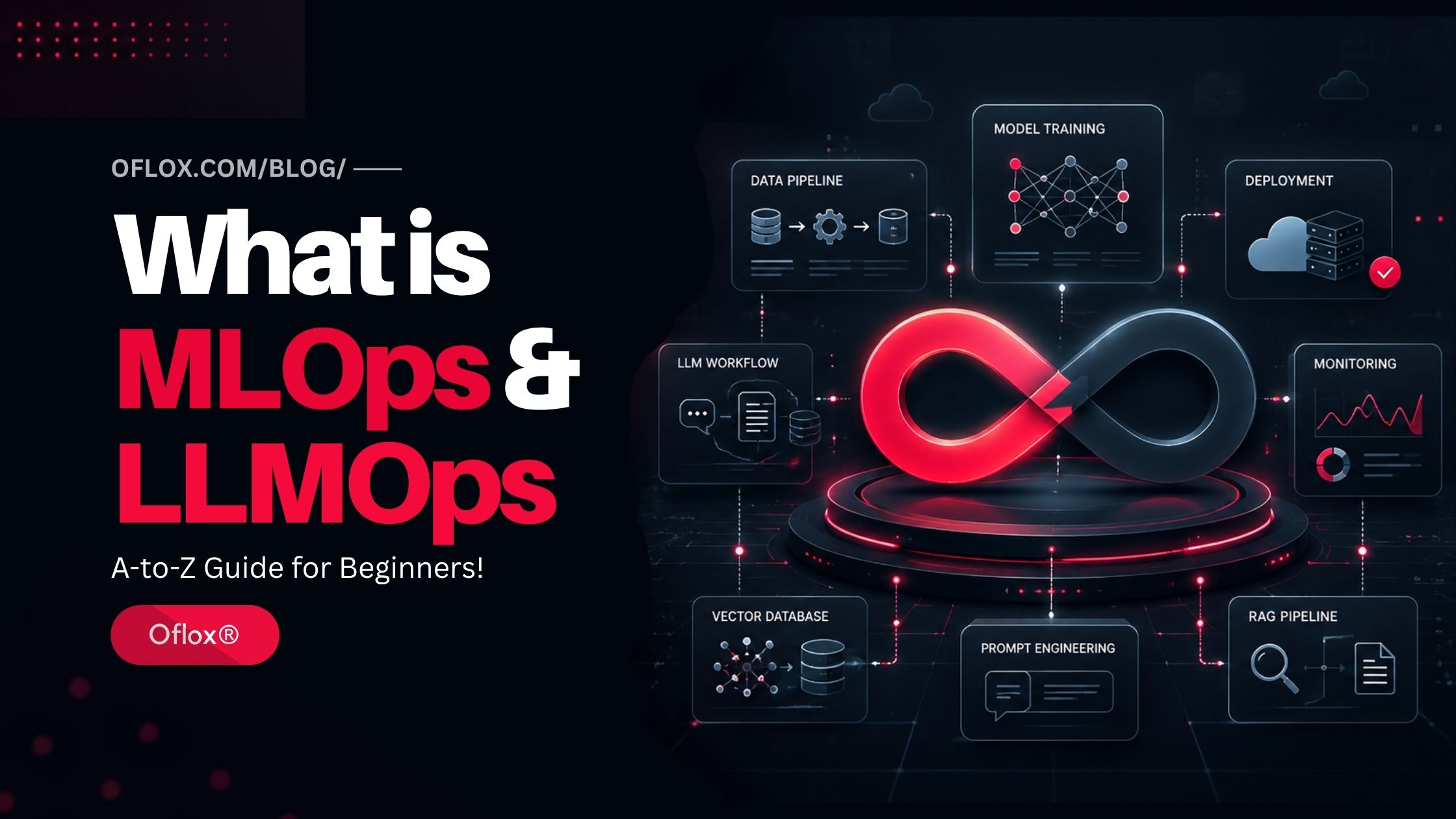
In this detailed guide, we will explore definitions, workflows, tools, architecture, examples, benefits, challenges, future trends, and best practices related to MLOps and LLMOps.
Let’s explore it together!
Table of Contents
What is MLOps?
MLOps stands for Machine Learning Operations.
MLOps is the process of managing and automating machine learning models from development to production.
It is a combination of:
- Machine Learning (ML)
- DevOps
- Data Engineering
- Automation
- Cloud Infrastructure
MLOps helps businesses automate the complete lifecycle of machine learning models.
This includes:
- Data collection
- Model training
- Testing
- Deployment
- Monitoring
- Updating
- Scaling
In simple words, MLOps helps companies run AI models smoothly in real-world applications.
What is LLMOps?
LLMOps stands for Large Language Model Operations.
LLMOps is the process of managing, deploying, monitoring, optimizing, and securing large language models in production environments.
It is a specialized version of MLOps designed specifically for Large Language Models (LLMs) like:
- OpenAI GPT models
- Google Gemini
- Anthropic Claude
- Meta Llama
- Mistral AI Mistral
LLMOps focuses on:
- Prompt management
- Vector databases
- Retrieval-Augmented Generation (RAG)
- AI guardrails
- Hallucination monitoring
- Fine-tuning
- AI governance
- Cost optimization
Difference Between MLOps and LLMOps
| Feature | MLOps | LLMOps |
|---|---|---|
| Full Form | Machine Learning Operations | Large Language Model Operations |
| Focus | ML models | Large Language Models |
| Data Type | Structured & unstructured | Mostly text and embeddings |
| Use Cases | Prediction systems | Chatbots & AI assistants |
| Monitoring | Accuracy & drift | Hallucination & response quality |
| Infrastructure | ML pipelines | GPU-heavy AI infrastructure |
| Prompt Engineering | Limited | Very important |
| Vector Databases | Rarely used | Commonly used |
| Fine-Tuning | Traditional ML tuning | LLM fine-tuning |
History and Evolution
The history and evolution of MLOps and LLMOps show how AI operations transformed from manual processes into scalable, automated, and production-ready ecosystems.
1. Early AI Systems
Earlier AI systems were manually managed. Developers trained models and deployed them manually.
Problems included:
- Slow deployment
- No automation
- Difficult scaling
- Poor monitoring
2. Rise of MLOps
As AI adoption increased, companies needed automation similar to DevOps.
This led to MLOps.
Major cloud providers started offering ML platforms:
- Amazon SageMaker
- Google Vertex AI
- Microsoft Azure ML
3. Rise of LLMOps
After the growth of Generative AI and ChatGPT-like systems, traditional MLOps became insufficient.
Businesses needed systems for:
- Prompt versioning
- RAG pipelines
- AI safety
- Token management
- Hallucination reduction
This created the demand for LLMOps.
Why MLOps and LLMOps Are Important
As businesses increasingly depend on Artificial Intelligence, MLOps and LLMOps help manage AI models smoothly, reduce operational issues, and improve overall performance.
- Faster AI Deployment: Businesses can launch AI products quickly.
- Better Automation: Automation reduces manual effort.
- Scalability: Systems can handle millions of users.
- Continuous Monitoring: AI models are continuously checked for errors.
- Cost Optimization: Helps reduce cloud and GPU expenses.
- Improved Security: Protects AI systems from misuse and attacks.
How MLOps Works
The MLOps workflow usually follows these steps:
- Data Collection: Businesses collect data from Websites, Apps, Sensors, APIs, or Databases.
- Data Processing: Data is cleaned and transformed.
- Model Training: AI models learn patterns from data.
- Model Testing: Performance is checked using metrics.
- Deployment: The model is deployed to servers or cloud infrastructure.
- Monitoring: The model is monitored continuously.
- Retraining: Models are updated with new data.
How LLMOps Works
LLMOps workflows are more advanced.
- Data Preparation: Text data is collected and structured.
- Embedding Generation: Text is converted into vector embeddings.
- Vector Database Storage: Embeddings are stored in vector databases. Popular vector databases include: Pinecone, Weaviate, Chroma, and FAISS.
- Prompt Engineering: Prompts are designed carefully for better outputs.
- Retrieval-Augmented Generation (RAG): Relevant data is retrieved before AI generates responses.
- Model Inference: The LLM generates answers.
- Monitoring & Evaluation: AI responses are checked for: Hallucinations, Toxicity, Bias, or Accuracy.
Core Components of MLOps
The main components of MLOps work together to simplify machine learning development and deployment.
- Data Pipelines: Move and process data automatically.
- Model Registry: Stores trained models.
- CI/CD Pipelines: Automates testing and deployment.
- Monitoring Systems: Track AI performance.
- Cloud Infrastructure: Provides scalable computing resources.
Core Components of LLMOps
The main components of LLMOps work together to improve AI performance, security, and response quality.
- Prompt Management: Organizes AI prompts.
- Vector Databases: Store embeddings for semantic search.
- RAG Systems: Improve answer accuracy using external knowledge.
- AI Guardrails: Prevent harmful outputs.
- GPU Infrastructure: Handles large-scale inference.
MLOps Lifecycle
The MLOps lifecycle helps automate and monitor AI model workflows.
| Stage | Description |
|---|---|
| Data Collection | Gathering datasets |
| Data Preparation | Cleaning and formatting |
| Model Training | Training ML models |
| Validation | Testing performance |
| Deployment | Releasing to production |
| Monitoring | Tracking model behavior |
| Retraining | Updating models |
LLMOps Lifecycle
The LLMOps lifecycle helps manage large language models efficiently.
| Stage | Description |
|---|---|
| Data Ingestion | Collecting text data |
| Embedding Creation | Generating embeddings |
| Vector Storage | Saving embeddings |
| Prompt Engineering | Designing prompts |
| RAG Integration | Connecting external knowledge |
| Inference | AI response generation |
| Evaluation | Checking quality |
| Optimization | Improving cost & speed |
5+ Popular MLOps Tools
The following MLOps tools are widely used for AI model deployment and monitoring.
- MLflow: Used for experiment tracking, Model registry, and Deployment.
- Kubeflow: Popular Kubernetes-based MLOps platform.
- TensorFlow Extended (TFX): Used for production ML pipelines.
- Apache Airflow: Workflow orchestration tool.
- Amazon SageMaker: Cloud-based ML development platform.
- DataRobot: Enterprise AI platform for automated machine learning operations.
- Domino Data Lab: Collaborative MLOps platform for data science teams.
5+ Popular LLMOps Tools
Many businesses use these LLMOps tools to build scalable and reliable Generative AI systems.
- LangChain: Framework for building LLM applications.
- LlamaIndex: Helps connect LLMs with external data.
- Weights & Biases: AI monitoring and experiment tracking.
- Pinecone: Vector database platform.
- Hugging Face: Open-source AI model ecosystem.
- Haystack: Framework for building RAG and AI search applications.
- FlowiseAI: Visual drag-and-drop builder for LLM workflows and AI agents.
Features of Good MLOps and LLMOps Systems
Good MLOps and LLMOps systems include features that improve AI automation, scalability, monitoring, and security.
- Automation: Reduces manual work.
- Scalability: Supports large workloads.
- Security: Protects AI systems.
- Monitoring: Tracks performance continuously.
- Collaboration: Teams can work together efficiently.
- Version Control: Tracks models and prompts.
- Cost Optimization: Reduces cloud expenses.
Benefits of MLOps and LLMOps
MLOps and LLMOps provide many benefits that improve AI performance, automation, and scalability.
- Faster Development: AI products launch quickly.
- Better Accuracy: Continuous monitoring improves results.
- Reduced Downtime: Automation minimizes failures.
- Easier Collaboration: Data scientists and developers work together smoothly.
- Improved Customer Experience: AI systems become more reliable.
Real-World Examples
Real-world examples help us understand how MLOps and LLMOps are used in modern AI-powered businesses and applications.
- Netflix Recommendation System: Netflix uses MLOps to manage recommendation models for millions of users.
- ChatGPT: OpenAI uses advanced LLMOps systems for Prompt optimization, AI safety, Scaling, and Monitoring.
- Amazon Product Recommendations: Amazon uses MLOps for personalized recommendations.
- AI Customer Support Bots: Many companies use LLMOps for AI chat assistants. Examples include Banking bots, E-commerce support, and Healthcare assistants.
Challenges in MLOps and LLMOps
MLOps and LLMOps come with several challenges related to scalability, monitoring, security, and AI management.
- High Infrastructure Cost: LLMs require expensive GPUs.
- Data Quality Issues: Poor data reduces AI performance.
- Hallucinations: LLMs sometimes generate incorrect information.
- Security Risks: AI systems may leak sensitive data.
- Compliance Problems: Businesses must follow data privacy laws.
- Monitoring Complexity: Tracking AI quality is difficult.
MLOps vs DevOps vs LLMOps
Comparing DevOps, MLOps, and LLMOps makes it easier to understand how modern AI infrastructure works.
| Feature | DevOps | MLOps | LLMOps |
|---|---|---|---|
| Focus | Software | ML models | Large Language Models |
| Data Dependency | Low | High | Very High |
| Prompt Engineering | No | Limited | Critical |
| Vector Databases | No | Rare | Common |
| AI Monitoring | No | Yes | Advanced |
| Hallucination Control | No | No | Yes |
Best Practices for Businesses
These best practices can improve AI performance, automation, monitoring, and overall operational efficiency.
- Use High-Quality Data: Good data improves AI results.
- Monitor AI Continuously: Always track performance.
- Implement AI Security: Protect against prompt injection and data leaks.
- Use Version Control: Track prompts and models carefully.
- Optimize Costs: Use efficient cloud infrastructure.
- Start Small: Begin with pilot AI projects.
Common Mistakes Beginners Make
Avoiding common MLOps and LLMOps mistakes can improve AI performance and operational efficiency.
- Ignoring Data Quality: Bad data creates poor AI models.
- No Monitoring: Many beginners deploy models without tracking performance.
- Overusing Large Models: Large models are expensive.
- Weak Prompt Engineering: Poor prompts reduce AI quality.
- Ignoring Security: Sensitive business data may leak.
Expert Tips for Better MLOps and LLMOps
Following expert MLOps and LLMOps tips helps organizations build smarter and more reliable AI workflows.
- Automate Everything Possible: Automation improves scalability.
- Use Smaller Models When Needed: Smaller models reduce cost.
- Implement Human Review: Human oversight improves AI safety.
- Use RAG Instead of Full Fine-Tuning: RAG is often cheaper and faster.
- Monitor Token Usage: Helps reduce AI API costs.
AI Security Best Practices
Following strong AI security practices is essential for building safe and reliable machine learning and Generative AI systems.
- Protect APIs: Use authentication and rate limiting.
- Prevent Prompt Injection: Validate user inputs carefully.
- Encrypt Sensitive Data: Protect customer information.
- Use Access Controls: Restrict AI system permissions.
- Audit AI Outputs: Monitor harmful responses.
Future Trends of MLOps and LLMOps
The future of MLOps and LLMOps is expected to bring smarter automation, faster AI deployment, and more advanced Generative AI systems.
- AI Agents: AI agents will automate complex tasks independently.
- Multi-Agent Systems: Multiple AI systems will collaborate together.
- Edge AI: AI models will run on mobile devices locally.
- Smaller Efficient Models: Compact AI models will become more popular.
- Autonomous AI Infrastructure: AI systems will manage themselves automatically.
- AI Governance: Governments may introduce stricter AI regulations.
Real-World Use Cases of MLOps and LLMOps
Real-world use cases help explain how businesses apply MLOps and LLMOps in modern AI-powered applications and services.
| Industry | Use Case |
|---|---|
| Healthcare | AI diagnosis systems |
| Banking | Fraud detection |
| E-commerce | Product recommendations |
| Education | AI tutoring |
| Marketing | AI content generation |
| Customer Support | AI chatbots |
| Cyber Security | Threat detection |
Pros & Cons of MLOps and LLMOps
The advantages and disadvantages of MLOps and LLMOps show both the power and complexity of modern AI systems.
| Pros | Cons |
|---|---|
| Faster deployment | High infrastructure cost |
| Better automation | Complex setup |
| Continuous improvement | Requires skilled teams |
| Scalable AI systems | Security risks |
| Improved monitoring | GPU dependency |
FAQs:)
A. MLOps is the process of managing machine learning models efficiently in production.
A. LLMOps manages large language models like GPT and Gemini.
A. Yes, LLMOps is considered a specialized branch of MLOps.
A. It helps businesses manage AI chatbots, generative AI, and large AI systems effectively.
A. Popular tools include LangChain, Pinecone, LlamaIndex, and Hugging Face.
A. Yes, MLOps and LLMOps are among the fastest-growing AI careers.
A. Yes, beginners can start with Python, cloud platforms, and AI basics.
A. Common languages include Python, JavaScript, and SQL.
Conclusion:)
MLOps and LLMOps are transforming how businesses build, deploy, and manage Artificial Intelligence systems. From recommendation engines to advanced AI chatbots, these technologies help organizations automate workflows, improve scalability, reduce operational issues, and deliver better customer experiences.
As AI adoption continues to grow in India and globally, learning MLOps and LLMOps can open massive opportunities for developers, startups, marketers, and businesses. Whether you are building AI products, automating operations, or launching Generative AI applications, understanding these systems will become increasingly important in the future.
“MLOps and LLMOps are becoming the backbone of scalable AI businesses in the modern digital world.” – Mr Rahman, CEO Oflox®
Read also:)
- What is AI Agent and How It Works: A-to-Z Guide for Beginners!
- What is Credential Stuffing: A-to-Z Guide for Beginners!
- What is Cash Flow Management: A-to-Z Guide for Beginners!
Have you tried using MLOps or LLMOps for your AI projects or business workflows? Share your experience or ask your questions in the comments below — we’d love to hear from you!