This article provides a complete guide on What Is Parallel Programming, including its meaning, importance, history, working process, types, key features, benefits, challenges, popular tools, real-world applications, expert tips, common mistakes, frequently asked questions, and future trends.
Modern computers are expected to perform complex calculations, process massive datasets, run AI models, render graphics, and handle multiple operations quickly. However, processing every task one after another can become slow and inefficient, especially when dealing with large or computationally intensive workloads.
This is where Parallel Programming becomes useful. It divides a large computational problem into smaller tasks that can be executed simultaneously using multiple CPU cores, processors, GPUs, or computing systems. By allowing several operations to run at the same time, parallel programming can significantly improve performance and make better use of modern hardware.
Today, Parallel Programming plays an important role in Artificial Intelligence, Machine Learning, cloud computing, scientific research, gaming, big data analytics, financial modelling, and high-performance computing. As multi-core processors and powerful GPUs become increasingly common, understanding parallel programming is becoming more valuable for modern developers.
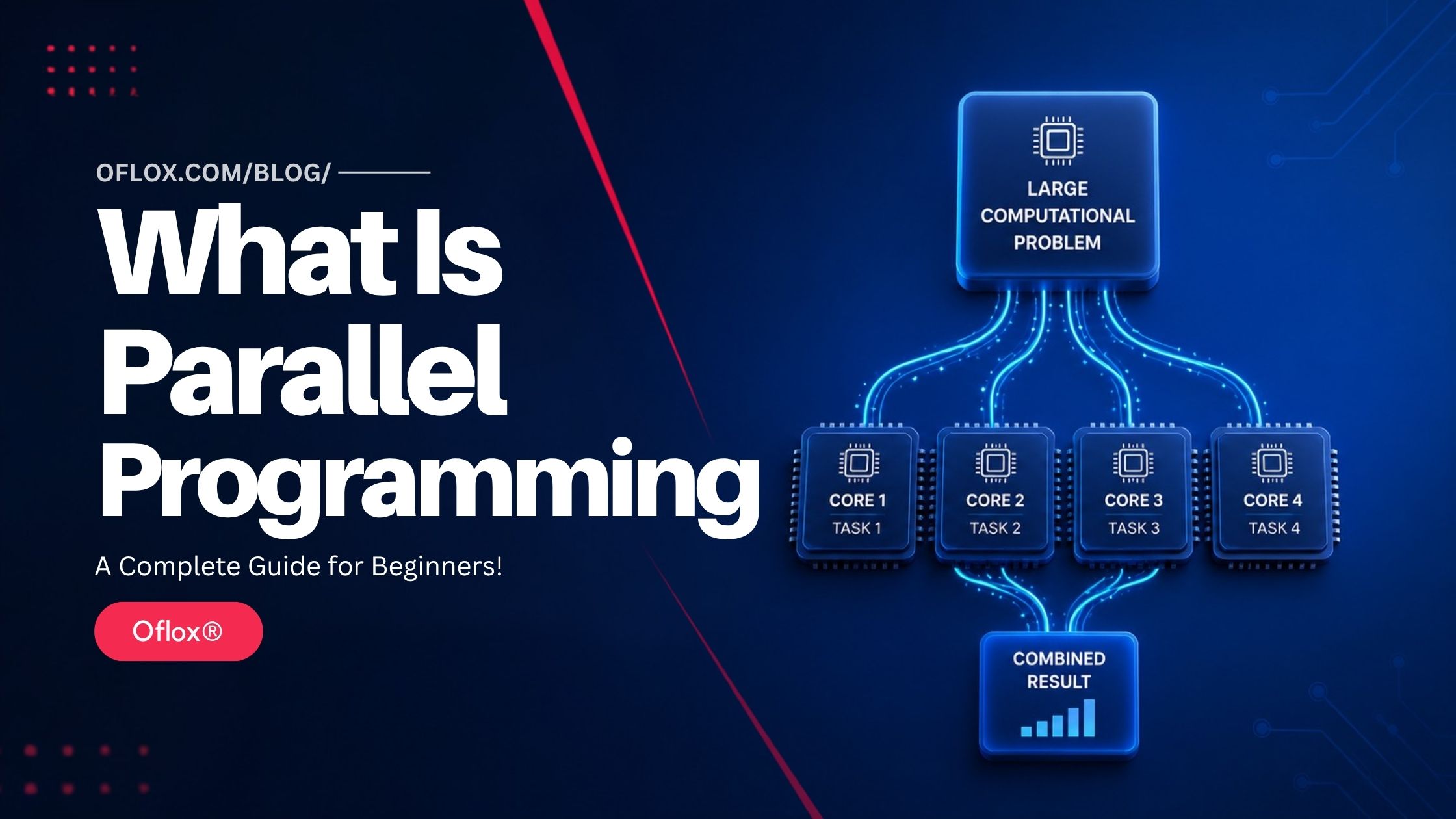
Whether you’re a student, beginner, developer, software engineer, or technology professional, this beginner-friendly guide will help you understand Parallel Programming from the ground up.
Let’s explore it together.
Table of Contents
What Is Parallel Programming?
Parallel Programming is a software development technique in which a computational problem is divided into multiple smaller tasks that are executed simultaneously using multiple processing resources.
These processing resources may include:
- Multiple CPU cores
- Multiple processors
- Graphics Processing Units (GPUs)
- Multiple computers
- Cloud servers
- Distributed computing nodes
The primary objective is to reduce execution time and improve computational performance.
Consider a program that needs to process 1 million images.
In traditional sequential programming, the program might process images one after another:
Image 1 → Image 2 → Image 3 → Image 4 → ...However, in parallel programming, the workload can be divided between multiple processing units:
- Processor 1 → Images 1–250,000
- Processor 2 → Images 250,001–500,000
- Processor 3 → Images 500,001–750,000
- Processor 4 → Images 750,001–1,000,000
All four processors can work simultaneously.
As a result, the overall processing time may be significantly reduced.
Why Is Parallel Programming Important?
Parallel programming has become increasingly important because simply increasing processor clock speed is no longer enough to meet modern computing demands.
Modern processors commonly contain multiple CPU cores, while GPUs may contain thousands of smaller processing units designed for highly parallel workloads.
Software must be designed appropriately to take advantage of these resources.
Here are some major reasons Parallel Programming is important:
1. Faster Processing
The biggest advantage of parallel programming is improved processing speed.
Large workloads can be divided into smaller independent tasks and processed simultaneously.
This can dramatically reduce execution time for suitable applications.
2. Better Use of Multi-Core CPUs
Modern laptops, smartphones, servers, and desktop computers contain multi-core processors.
For example, a processor may contain:
- 4 cores
- 8 cores
- 16 cores
- 32 cores
- 64+ cores
Parallel programming allows software to distribute computational work across these cores instead of relying heavily on a single core.
3. Handling Large Datasets
Modern organizations generate enormous quantities of information.
Parallel computing helps process large datasets used in:
- Data analytics
- Machine Learning
- Artificial Intelligence
- Scientific research
- Financial modelling
- Search engines
- Recommendation systems
Without parallel processing, some large-scale computations could take significantly longer.
4. Artificial Intelligence and Machine Learning
Modern AI development heavily relies on parallel computing.
Training neural networks requires enormous numbers of mathematical operations.
GPUs and specialized AI accelerators execute many operations simultaneously, helping developers train sophisticated models more efficiently.
5. Scientific Research
Scientists use parallel computing for computationally intensive simulations involving areas such as:
- Climate modelling
- Molecular research
- Physics simulations
- Astronomy
- Genomics
- Weather forecasting
Supercomputers can contain thousands or even millions of processing elements working together.
6. Better Scalability
Parallel programs can often be scaled by adding additional computational resources.
For example, an application may initially use 8 CPU cores but later be deployed on servers containing dozens of cores.
Distributed parallel systems can potentially scale across multiple machines as well.
History and Evolution of Parallel Programming
The idea of performing computations simultaneously is not new.
Its development has evolved alongside computer hardware.
1. 1950s–1960s: Early Parallel Computing
Early researchers began exploring ways to execute multiple calculations simultaneously.
Large scientific and military computing systems experimented with parallel processing architectures.
2. 1970s: Multiprocessor Systems
Computers containing multiple processors became more practical.
Researchers started developing algorithms capable of distributing computational workloads between processors.
3. 1980s: Supercomputing Growth
Supercomputers became increasingly important for scientific research.
Parallel architectures were used for complex calculations involving:
- Weather forecasting
- Nuclear simulations
- Aerospace engineering
- Scientific modelling
4. 1990s: Distributed Computing
Computer networks became faster and more accessible.
Developers began connecting multiple computers together to solve large computational problems.
Technologies such as Message Passing Interface (MPI) became important for distributed parallel computing.
5. 2000s: Multi-Core Processors
Processor manufacturers increasingly shifted toward multi-core architectures.
Instead of continuously increasing clock speeds, manufacturers added multiple processing cores to CPUs.
Parallel programming consequently became relevant to mainstream software development.
6. 2010s: GPU Computing and AI
Graphics Processing Units became widely used for general-purpose parallel computation.
Technologies such as CUDA helped developers use GPUs for workloads beyond graphics.
GPU computing became particularly important for:
- Deep Learning
- Computer vision
- Scientific computing
- Cryptocurrency-related computation
- Data processing
7. 2020s–2026: AI Accelerators and Massive Parallelism
Modern computing systems increasingly combine:
- CPUs
- GPUs
- TPUs
- NPUs
- AI accelerators
- Cloud clusters
Parallel programming is therefore becoming a core technology behind high-performance and AI-focused computing.
How Does Parallel Programming Work?
Parallel programming works by identifying a large computational problem, breaking it into smaller units, executing suitable units simultaneously, coordinating their work, and combining the results.
Here is the basic process:
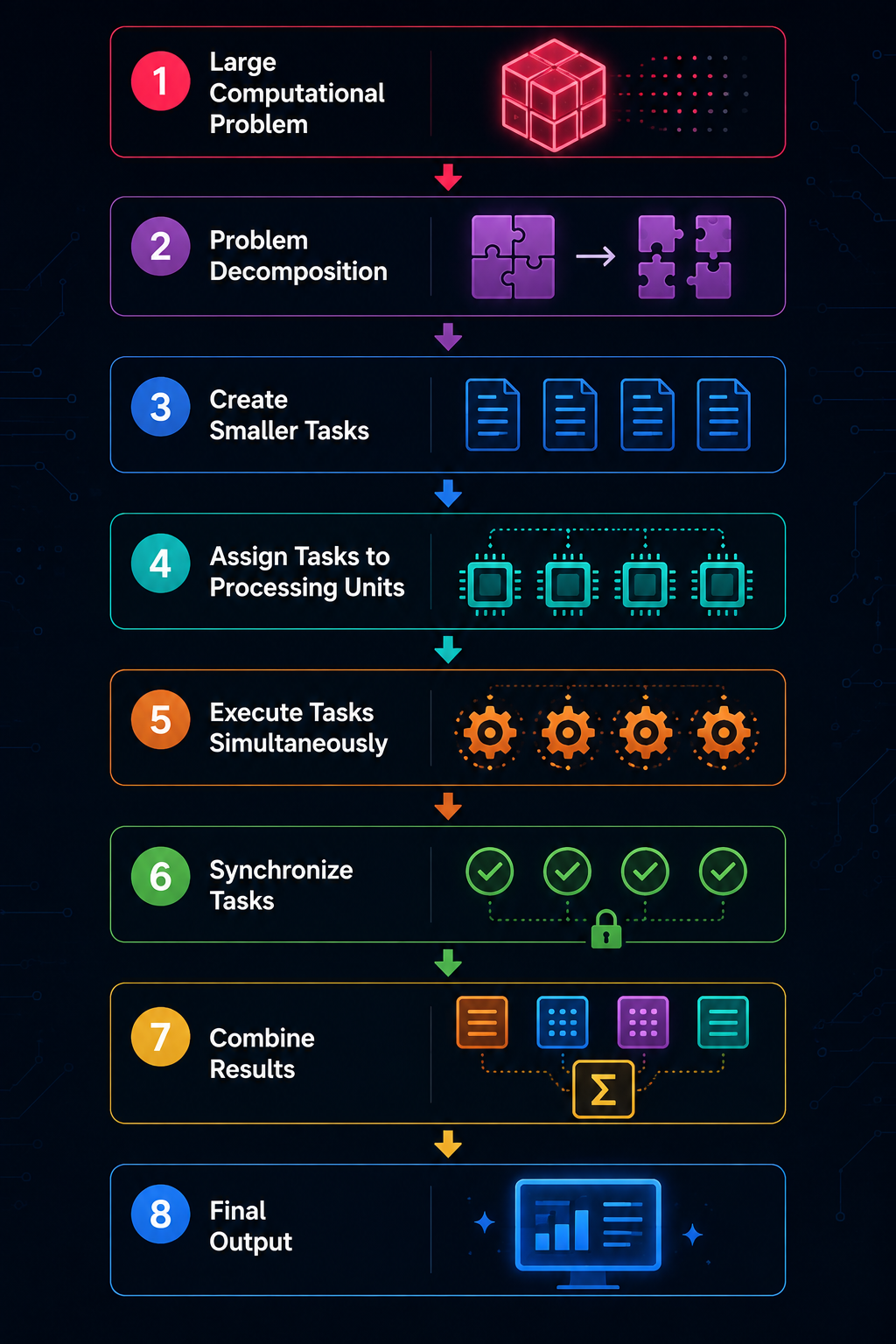
Let us understand each step.
Step-by-Step Working Process of Parallel Programming
Here’s the complete working process of Parallel Programming explained in simple steps.
1. Identify the Problem
First, developers determine whether a problem can benefit from parallel execution.
Not every algorithm can be effectively parallelized.
Tasks with many independent calculations are usually better candidates.
2. Divide the Problem
The large problem is divided into smaller tasks.
This process is commonly called decomposition.
For example:
Suppose a program needs to analyse 10 million records.The records might be divided into 10 groups of 1 million records each.
3. Assign Tasks
The smaller tasks are assigned to available processing resources.
These may include:
- CPU cores
- Threads
- GPUs
- Servers
- Cluster nodes
A scheduler or runtime environment may manage task allocation automatically.
4. Execute Tasks Simultaneously
Different processing units perform their assigned computations simultaneously.
For example:
- Core 1 → Task A
- Core 2 → Task B
- Core 3 → Task C
- Core 4 → Task D
This simultaneous execution is where much of the potential performance improvement comes from.
5. Communication Between Tasks
Some tasks may need to exchange information.
For example, one task may calculate data required by another task.
Communication can happen through:
- Shared memory
- Message passing
- Network communication
- Shared variables
- Queues
Efficient communication is extremely important because excessive communication can reduce performance.
6. Synchronization
Tasks may need to wait for each other at certain points.
This is called synchronization.
Common synchronization mechanisms include:
- Locks
- Mutexes
- Semaphores
- Barriers
- Atomic operations
Proper synchronization helps prevent inconsistent or corrupted results.
7. Combine Results
Once parallel tasks finish their work, their outputs may be combined.
For example:
Four processors calculate:
- Processor 1 → Result A
- Processor 2 → Result B
- Processor 3 → Result C
- Processor 4 → Result D
The program then combines them:
A + B + C + D → Final ResultParallel Programming vs Sequential Programming
Understanding the difference between sequential and parallel programming is essential.
| Factor | Sequential Programming | Parallel Programming |
|---|---|---|
| Execution | One operation at a time | Multiple operations simultaneously |
| Processing Resources | Usually one primary execution flow | Multiple cores/processors |
| Complexity | Relatively simpler | More complex |
| Performance | Limited for large workloads | Potentially much faster |
| Synchronization | Usually less complicated | Often required |
| Debugging | Easier | More challenging |
| Best For | Small/simple workloads | Large computational workloads |
| Hardware Usage | May underuse multi-core hardware | Better multi-core utilization |
Parallel programming does not automatically make every application faster.
The performance improvement depends on how much of the workload can actually be executed in parallel.
Parallel Programming vs Concurrent Programming
Parallelism and concurrency are related but different concepts.
1. Concurrency
Concurrency means multiple tasks make progress during overlapping periods.
They do not necessarily execute at exactly the same instant.
A single CPU core can switch rapidly between tasks and create concurrent behaviour.
2. Parallelism
Parallelism means multiple computations are actually being executed simultaneously using multiple processing resources.
A simple way to remember this is:
Concurrency = Dealing with multiple tasks togetherParallelism = Executing multiple tasks at the same timeA system can be concurrent without being truly parallel.
Major Types of Parallel Programming
Parallel programming can be implemented using several models.
1. Data Parallelism
Data parallelism involves applying the same operation to different parts of a dataset simultaneously.
Example:
A program needs to resize 10,000 images.The images can be divided among multiple processors.
- Core 1 → Images 1–2,500
- Core 2 → Images 2,501–5,000
- Core 3 → Images 5,001–7,500
- Core 4 → Images 7,501–10,000
Each core performs essentially the same operation on different data.
Data parallelism is widely used in:
- Machine Learning
- Image processing
- Scientific computing
- Matrix operations
2. Task Parallelism
Task parallelism means different processors perform different tasks simultaneously.
For example:
- Processor 1 → Image processing
- Processor 2 → Database query
- Processor 3 → Data validation
- Processor 4 → Report generation
Different tasks may operate on the same or different data.
3. Shared Memory Parallelism
In shared-memory systems, multiple processors or threads access a common memory space.
Threads can communicate through shared variables.
Common technologies include:
- OpenMP
- POSIX Threads
- C++ threading libraries
Shared-memory parallelism is commonly used on multi-core computers.
4. Distributed Memory Parallelism
In distributed-memory systems, each processor or computer has its own memory.
Computers communicate by sending messages over a network.
MPI is a popular technology for this model.
It is widely used in:
- Supercomputers
- High-performance computing clusters
- Scientific research
5. Hybrid Parallelism
Hybrid systems combine multiple parallel programming models.
For example:
MPI + OpenMPMPI may manage communication between computers, while OpenMP manages parallel execution across CPU cores within each computer.
This approach is common in modern supercomputing environments.
6. GPU Parallelism
GPUs contain large numbers of processing units capable of performing many calculations simultaneously.
GPU parallelism is particularly effective for highly repetitive mathematical operations.
Applications include:
- Deep Learning
- Computer vision
- 3D rendering
- Video processing
- Scientific simulations
Key Features of Parallel Programming
Here are some important characteristics of parallel programming.
- Simultaneous Execution: Multiple computations can execute at the same time.
- Workload Distribution: Large workloads are divided across multiple processing resources.
- Scalability: Applications may potentially use additional processors to handle larger workloads.
- Synchronization: Parallel tasks can coordinate their operations when dependencies exist.
- Resource Utilization: Parallel software can make better use of modern multi-core processors.
- Communication: Parallel tasks can exchange information through memory or message-passing mechanisms.
- Performance Optimization: Parallel programming aims to reduce execution time for computationally demanding workloads.
Benefits of Parallel Programming
Parallel programming offers several important advantages.
- Reduced Execution Time: Dividing suitable workloads among multiple processors can substantially reduce processing time.
- Higher Performance: Computationally intensive software can process more operations within a given period.
- Better Hardware Utilization: Modern processors contain multiple cores. Parallel applications can use these resources more efficiently.
- Large-Scale Data Processing: Parallel systems can process massive datasets more efficiently. This is especially useful for Big Data, AI, Machine Learning, Analytics.
- Complex Problem Solving: Some scientific and engineering problems involve billions or trillions of calculations. Parallel computing makes these workloads more practical.
- Improved Scalability: Parallel applications may scale vertically using more CPU cores or horizontally across multiple machines, depending on their architecture.
- Faster AI Training: Machine Learning models often involve massive matrix operations. Parallel GPUs and accelerators can dramatically accelerate suitable training workloads.
Challenges of Parallel Programming
Despite its benefits, parallel programming introduces several challenges.
1. Increased Programming Complexity
Parallel programs are generally more difficult to design than sequential programs.
Developers must consider:
- Task dependencies
- Communication
- Synchronization
- Data sharing
- Resource allocation
2. Race Conditions
A race condition occurs when multiple threads access shared data simultaneously and the program’s result depends on execution timing.
For example:
Two threads attempt to update the same account balance simultaneously.Without proper synchronization, incorrect results may occur.
3. Deadlocks
A deadlock happens when multiple tasks wait indefinitely for resources held by each other.
For example:
Thread A waits for Thread Bwhile
Thread B waits for Thread ANeither can continue.
4. Synchronization Overhead
Synchronization mechanisms such as locks and barriers consume processing time.
Too much synchronization can reduce the benefits of parallel execution.
5. Communication Overhead
In distributed systems, processors need to exchange information over networks.
Frequent communication can create delays.
6. Load Imbalance
If tasks are not distributed properly, some processors may remain idle while others continue working.
This reduces overall efficiency.
7. Difficult Debugging
Parallel bugs may appear only under particular timing conditions.
This makes problems such as race conditions difficult to reproduce and debug.
Popular Parallel Programming Languages
Parallel programming can be implemented using many programming languages.
| Language | Common Parallel Capabilities | Common Use |
|---|---|---|
| C | OpenMP, MPI, Pthreads | HPC and system software |
| C++ | Threads, OpenMP, MPI | Games, simulations, HPC |
| Python | multiprocessing, concurrent.futures, frameworks | AI and data processing |
| Java | Threads, Fork/Join, parallel streams | Enterprise applications |
| C# | Task Parallel Library | .NET applications |
| Julia | Native parallel/distributed features | Scientific computing |
| Fortran | OpenMP, MPI | Scientific and HPC workloads |
| Rust | Threads and concurrency libraries | High-performance systems |
The best language depends on application requirements, ecosystem, hardware, and performance targets.
Popular Tools and Technologies for Parallel Programming
Here’s a look at the popular tools and technologies that make Parallel Programming easier and more efficient.
1. OpenMP
OpenMP is an API commonly used for shared-memory parallel programming in languages such as C, C++, and Fortran.
It allows developers to add parallel behaviour using compiler directives.
2. MPI
Message Passing Interface (MPI) is a standard widely used for distributed-memory parallel programming.
It enables processes running on different machines or processors to communicate by exchanging messages.
3. CUDA
CUDA is a parallel computing platform and programming model developed by NVIDIA.
It enables developers to use compatible NVIDIA GPUs for general-purpose computing.
CUDA is widely used in:
- AI
- Deep Learning
- Scientific computing
- Computer vision
4. OpenCL
OpenCL provides a framework for parallel programming across different types of processors and accelerators.
These may include:
- CPUs
- GPUs
- Other computing devices
5. Python multiprocessing
Python provides a built-in multiprocessing module that allows developers to execute work across multiple processes.
This can be useful for CPU-bound tasks.
6. Apache Spark
Apache Spark is a distributed data processing framework.
It can process large datasets across clusters of computers and is commonly used in large-scale analytics and data engineering.
Real-World Applications of Parallel Programming
Parallel programming powers many technologies people use every day.
1. Artificial Intelligence
AI systems require huge amounts of mathematical computation.
Parallel GPUs accelerate tasks such as:
- Neural network training
- Matrix multiplication
- Model inference
- Image recognition
2. Weather Forecasting
Weather forecasting involves processing massive quantities of atmospheric information.
Supercomputers divide calculations across large numbers of processing units to simulate weather patterns.
3. Video Rendering
Video editing and 3D rendering applications can divide frames or rendering calculations across CPU cores and GPUs.
This can significantly reduce rendering time.
4. Healthcare Research
Parallel computing supports research involving:
- Medical imaging
- Genomic analysis
- Drug discovery
- Molecular simulations
Large datasets can be analysed more efficiently using distributed systems and accelerators.
5. Financial Services
Financial institutions use parallel computing for:
- Risk modelling
- Fraud detection
- Portfolio simulations
- Market analytics
- Pricing models
Many calculations can be performed simultaneously.
6. Gaming
Modern video games perform numerous operations simultaneously, including:
- Graphics rendering
- Physics calculations
- AI behaviour
- Audio processing
- Networking
Multi-core CPUs and GPUs help manage these workloads.
7. Search Engines
Search engines process enormous quantities of webpages and user requests.
Distributed and parallel computing help perform indexing, ranking, data processing, and query-related operations at scale.
8. Big Data Analytics
Organizations may need to analyse billions of records.
Distributed processing technologies can divide these datasets across multiple machines.
Example of Parallel Programming
Suppose an e-commerce company needs to analyse 100 million customer transactions.
Instead of processing every transaction on one processor, the dataset can be divided.
For example:
- Server 1 → Transactions 1–25 million
- Server 2 → Transactions 25–50 million
- Server 3 → Transactions 50–75 million
- Server 4 → Transactions 75–100 million
Each server processes its portion simultaneously.
After processing finishes, the results are combined into a final analytics report.
This approach can reduce processing time compared with purely sequential execution, provided communication and coordination overhead remain manageable.
Understanding Speedup in Parallel Programming
Parallel programming performance is often measured using speedup.
A simplified formula is:
Speedup = Sequential Execution Time ÷ Parallel Execution TimeFor example:
- Sequential execution time = 100 seconds
- Parallel execution time = 25 seconds
Therefore:
Speedup = 100 ÷ 25 = 4×However, doubling the number of processors does not necessarily double performance.
Communication, synchronization, memory bandwidth, and sequential parts of the program can limit speedup.
What Is Amdahl’s Law?
Amdahl’s Law explains an important limitation of parallel computing.
It states that the maximum performance improvement of a program is limited by the portion that must still run sequentially.
Imagine:
- 90% of a program can run in parallel.
- 10% must run sequentially.
Even if enormous parallel computing resources are available, the sequential 10% limits the maximum overall speedup.
Therefore, developers should identify and optimize both parallel and sequential bottlenecks.
Expert Tips for Successful Parallel Programming
Here are some practical recommendations for developers.
- Identify Parallelizable Workloads: Do not parallelize everything automatically. Find tasks that can execute independently.
- Minimize Shared Data: Excessive shared data increases synchronization complexity. Where possible, design tasks to operate independently.
- Reduce Communication: In distributed computing, frequent network communication can become expensive. Try to process more information locally before exchanging results.
- Avoid Excessive Locks: Too many locks can reduce performance and increase the possibility of deadlocks.
- Balance the Workload: Distribute computational work evenly across processors.
- Measure Before Optimizing: Use profiling tools to identify actual bottlenecks. Do not assume parallelism will automatically improve performance.
- Start Simple: Begin with a correct sequential implementation when practical. Then identify performance-critical sections that can benefit from parallelization.
- Test Under Different Conditions: Parallel bugs can depend on timing and workload. Test applications using different Data sizes, Core counts, Hardware configurations, and Concurrency levels.
Common Parallel Programming Mistakes
Here are some common Parallel Programming mistakes developers should avoid for better performance and reliability.
- Parallelizing Very Small Tasks: Creating and managing threads or processes has overhead. For tiny workloads, parallel execution may actually be slower.
- Ignoring Race Conditions: Unsynchronized shared data can produce unpredictable results.
- Excessive Synchronization: Too many locks and barriers can eliminate performance gains.
- Poor Workload Distribution: One processor may receive significantly more work than another.
- Assuming More Cores Always Mean More Speed: Performance is limited by factors including Sequential code, Memory bandwidth, Communication overhead, Synchronization, and Hardware architecture.
- Ignoring Memory Usage: Parallel processes may require additional memory. Large-scale parallelism can therefore create memory pressure.
- Not Profiling Performance: Optimization should be based on measurements rather than assumptions.
Future Trends of Parallel Programming: 2026 and Beyond
Parallel computing will become even more important as computing workloads continue growing.
1. AI-Driven Parallel Computing
Artificial Intelligence workloads will continue pushing demand for highly parallel hardware.
Developers will increasingly optimize software for accelerators designed specifically for AI workloads.
2. Heterogeneous Computing
Future systems will increasingly combine different processor types.
For example:
CPU + GPU + NPU + Specialized AcceleratorApplications will distribute workloads to the hardware best suited for each operation.
3. Exascale Computing
Exascale computing systems are capable of performing extremely large numbers of calculations per second.
These systems depend heavily on massive parallelism.
They are expected to support research in areas including climate science, energy, materials, medicine, and physics.
4. Cloud-Based Parallel Computing
Developers no longer need to own supercomputers to access large-scale computing resources.
Cloud platforms make it possible to provision:
- Multi-core servers
- GPU clusters
- Distributed computing environments
- AI accelerators
This makes parallel computing accessible to more organizations.
5. Quantum-Classical Workflows
Quantum computing will not simply replace classical parallel computing.
Instead, future systems may combine quantum processors with traditional CPUs, GPUs, and HPC infrastructure for specialized workloads.
6. Better Parallel Programming Frameworks
Programming frameworks will continue becoming more developer-friendly.
Higher-level abstractions can reduce the complexity of managing:
- Threads
- Scheduling
- Synchronization
- Data distribution
- Hardware accelerators
7. Energy-Efficient Parallel Computing
Performance is no longer the only objective.
Energy efficiency is becoming increasingly important, particularly for data centres, AI infrastructure, and supercomputers.
Future parallel systems will focus on achieving more computation per unit of energy.
FAQs:)
A. Parallel Programming is a programming technique where a computational problem is divided into smaller tasks that can be executed simultaneously using multiple processing resources.
A. It is primarily used to improve performance, reduce execution time, process large datasets, and make better use of multi-core or distributed computing resources.
A. Processing thousands of independent images simultaneously across multiple CPU cores or GPU processing units is a common example.
A. Yes. Python supports parallel and distributed workloads through tools such as multiprocessing, concurrent.futures, and external frameworks. The best approach depends on whether the workload is CPU-bound, I/O-bound, GPU-based, or distributed.
A. Sequential programming performs operations primarily one after another, while parallel programming executes suitable operations simultaneously using multiple computing resources.
A. Not always. Multiple threads can execute concurrently without actually executing simultaneously, particularly on a single CPU core. True parallel execution requires multiple processing resources executing work at the same time.
A. Common models include data parallelism, task parallelism, shared-memory parallelism, distributed-memory parallelism, hybrid parallelism, and GPU parallelism.
A. MPI stands for Message Passing Interface. It is a standard used for communication between processes, particularly in distributed-memory parallel computing.
A. CUDA is NVIDIA’s parallel computing platform and programming model that allows compatible GPUs to perform general-purpose computational workloads.
A. Basic parallel programming concepts are relatively straightforward, but building highly efficient and reliable parallel applications can be challenging because developers must understand synchronization, memory, communication, workload distribution, and hardware architecture.
A. No. Small workloads or applications with many dependencies may gain little benefit and can sometimes become slower because of thread creation, communication, synchronization, or scheduling overhead.
A. Parallel computing is widely used in AI, healthcare, finance, gaming, scientific research, engineering, cybersecurity, cloud computing, big data, telecommunications, and media processing.
Conclusion:)
Parallel Programming has become one of the foundational techniques behind modern high-performance computing.
Instead of forcing a computer to complete every operation sequentially, parallel programming divides suitable computational workloads into smaller tasks and executes them simultaneously using multiple CPU cores, processors, GPUs, servers, or computing nodes.
This approach helps developers process larger datasets, accelerate scientific calculations, train AI models, render complex graphics, perform financial simulations, and build computational systems capable of handling demanding workloads.
However, effective parallel programming requires more than simply adding threads or processors. Developers must carefully manage task decomposition, communication, synchronization, memory access, load balancing, and sequential bottlenecks.
As computing moves further toward multi-core processors, GPUs, AI accelerators, cloud clusters, and heterogeneous architectures, understanding parallel programming will become increasingly valuable for developers and technology professionals.
For beginners, the best approach is to first understand sequential programming, threads, processes, CPU architecture, and memory management. From there, technologies such as OpenMP, MPI, GPU computing, and distributed processing can be explored step by step.
Ultimately, Parallel Programming is not simply about using more processors—it is about intelligently organizing computational work so multiple resources can solve problems efficiently together.
“Parallel programming turns computing power into teamwork—dividing complex problems into smaller tasks and solving them together at greater speed.” — Mr Rahman
Read also:)
- What Is Digital Signature Certificate? A-to-Z Guide for Beginners!
- What Is Voice Biometrics? A Complete Beginner’s Guide!
- What Is SIP Trunking? A Complete Beginner’s Guide!
We hope this guide on What Is Parallel Programming helped you understand the concept and its real-world importance. If you have any questions or thoughts, feel free to share them in the comments below.