This article provides a complete guide on What Is Jamstack Development, including its meaning, importance, history, architecture, working process, key features, benefits, challenges, popular tools, real-world examples, expert tips, common mistakes, FAQs, and future trends.
Modern websites are expected to be fast, secure, scalable, SEO-friendly, and easy to maintain. However, traditional web development often depends on servers and databases to generate pages whenever a user visits a website. As websites grow and receive more traffic, this approach can sometimes increase server load, infrastructure complexity, and maintenance requirements.
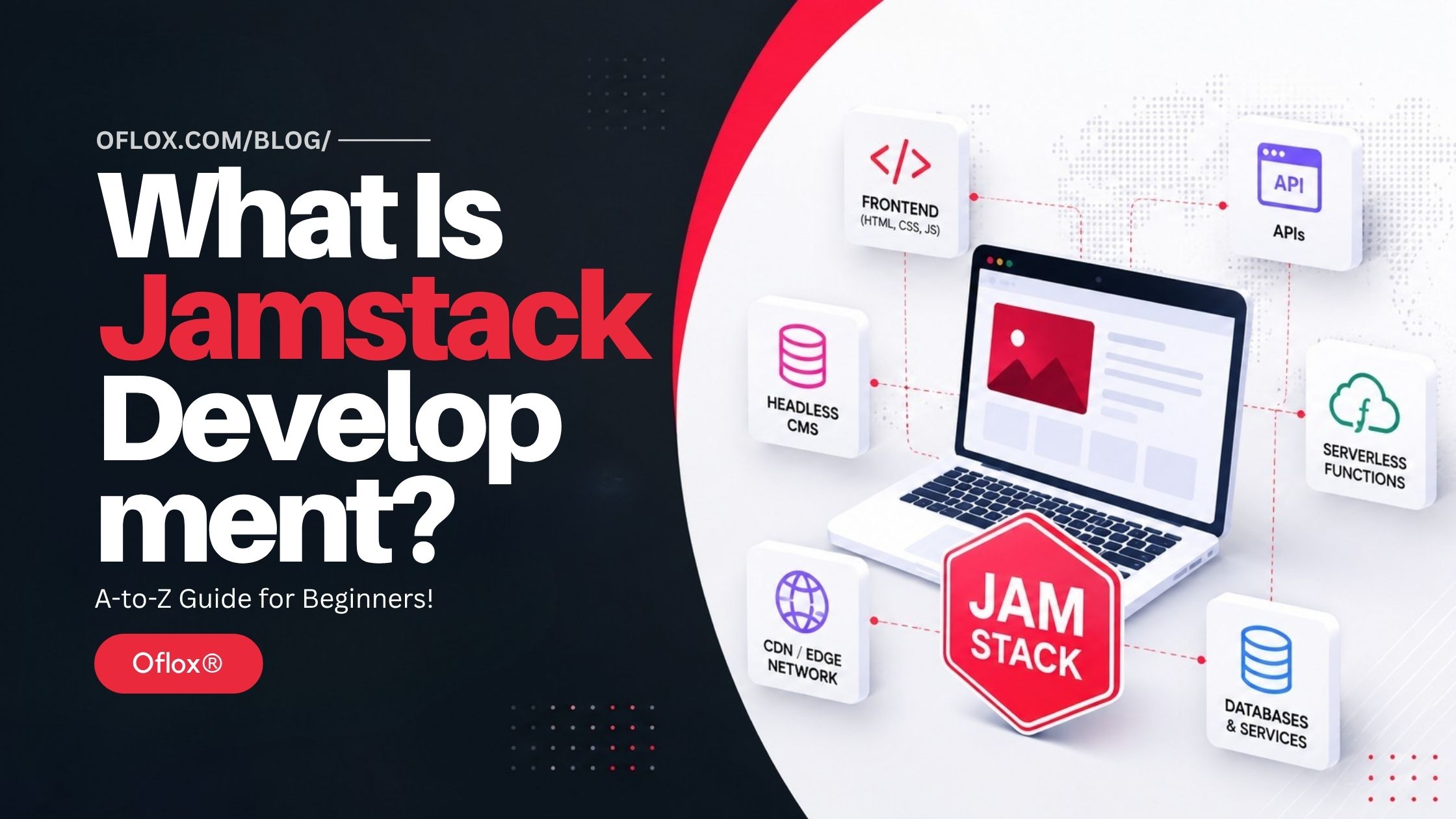
This is where Jamstack Development becomes useful. It is a modern web development approach that separates the frontend experience from backend systems and uses pre-built pages, APIs, serverless functions, headless CMS platforms, and CDN or edge infrastructure to build and deliver websites efficiently.
Instead of generating every webpage from scratch for every visitor, Jamstack can prepare much of the content in advance and distribute it through a global network. Dynamic features such as login, payments, search, forms, databases, and personalised content can then be handled through APIs and backend services when required.
Today, Jamstack Development is widely relevant for business websites, SaaS platforms, blogs, e-commerce stores, documentation websites, landing pages, portfolios, and other modern web applications. Its flexible architecture also works well with technologies such as headless CMS, serverless computing, cloud platforms, and modern frontend frameworks.
So, whether you are a beginner learning modern web development or a professional looking for a faster and more flexible website architecture, understanding Jamstack can help you make better development decisions.
Let’s explore it together.
Table of Contents
What Is Jamstack Development?
Jamstack Development is a modern web development architecture that separates the frontend experience from backend data and business logic while using pre-built pages, APIs, and globally distributed infrastructure to deliver fast and scalable websites and applications.
The term was originally written as JAMstack, where:
- J – JavaScript
- A – APIs
- M – Markup
The original idea focused heavily on JavaScript, reusable APIs, and pre-built markup. However, Jamstack has evolved considerably.
Today, it should not be understood as a requirement to use those three technologies in one specific way. Instead, it represents a broader architectural approach based on concepts such as decoupling, pre-rendering, API-driven services, automated deployments, and distributed delivery.
Netlify’s updated definition describes Jamstack as an architectural approach that decouples the web experience layer from data and business logic to improve areas such as flexibility, scalability, performance, and maintainability.
Simple Example:
Imagine that you operate a company website containing:
- Home page
- About page
- Service pages
- Blog
- Contact form
- Customer login
- Product information
In a traditional dynamic architecture, the server may communicate with a database and generate HTML when visitors request pages.
With Jamstack, many public pages can be generated before visitors request them.
These ready-made pages can then be distributed across a CDN.
When dynamic functionality is required, such as login, payments, search, or form submission, the frontend can communicate with specialised APIs or backend services.
This means the website does not necessarily need one large application server handling everything.
What Does JAM in Jamstack Mean?
Originally, JAM represented three important components.
| Component | Meaning | Purpose |
|---|---|---|
| J | JavaScript | Adds dynamic and interactive functionality |
| A | APIs | Connect the frontend with services and data |
| M | Markup | Provides pre-built HTML content |
However, modern Jamstack development is not limited to JavaScript.
A Jamstack project can involve different programming languages, frameworks, build systems, content platforms, databases, APIs, edge infrastructure, and cloud services.
Therefore, Jamstack is an architecture rather than a particular programming language or framework.
History of Jamstack Development
The concepts behind Jamstack existed before the term itself.
Static websites were common during the early days of the Internet. Developers created HTML files and uploaded them directly to servers.
As websites became more complicated, developers increasingly adopted server-side technologies and database-driven content management systems.
Platforms such as WordPress made dynamic website management significantly easier.
However, traditional architectures also introduced challenges related to:
- Server management
- Database performance
- Security
- Caching
- Traffic spikes
- Scaling
- Deployment complexity
Meanwhile, several important technologies were improving.
Developers gained access to better static site generators, Git-based workflows, cloud platforms, APIs, JavaScript frameworks, CDNs, and automated deployment systems.
In 2015, Netlify co-founders Mathias Biilmann and Chris Bach coined the term Jamstack to describe the emerging approach of separating frontend experiences from backend systems.
Originally called JAMstack, the term eventually became simply Jamstack, reflecting the fact that the architecture had expanded beyond the literal JavaScript-APIs-Markup interpretation.
The modern definition focuses more strongly on decoupling the frontend experience from backend business logic.
Why Is Jamstack Development Important?
The importance of Jamstack comes from the changing requirements of modern websites.
A website today may need to serve visitors from multiple countries, integrate with several APIs, deliver content quickly, rank in search engines, support frequent deployments, remain secure, and handle unexpected traffic.
Traditional monolithic systems can achieve these objectives, but they may require more infrastructure and server management.
Jamstack offers another approach.
By pre-building content where practical and distributing it through CDN or edge infrastructure, developers can reduce the amount of server-side processing required for normal page requests.
It also allows different parts of an application to operate independently.
For example:
- Frontend → Astro
- Content → Headless CMS
- Payments → Payment API
- Authentication → Authentication provider
- Search → Search API
- Deployment → Edge/CDN platform
Instead of building every capability inside one application, developers can select specialised services for individual requirements.
This is closely related to the wider movement towards composable web architecture.
How Does Jamstack Development Work?
Jamstack Development follows a modern workflow where websites are pre-built, deployed through global infrastructure, and connected with APIs for dynamic functionality.
1. Developers Create the Frontend
The development team first creates the frontend experience.
It may use technologies such as:
- HTML
- CSS
- JavaScript
- TypeScript
- React
- Vue
- Astro
- Next.js
- Nuxt
- Svelte
The frontend controls what visitors see and how they interact with the website.
2. Content Is Stored Separately
Content does not necessarily need to be stored inside the frontend application.
Developers may use:
- Markdown
- JSON
- Git repository
- Headless CMS
- Content API
- Database
For example, a company could store hundreds of articles inside a headless CMS.
The frontend can retrieve this information through an API during the build process or, when appropriate, at runtime.
Contentful describes this separation as allowing content and presentation to operate independently, helping developers and content teams work on their respective responsibilities.
3. The Website Is Built
When developers push changes or content is published, an automated build process can start.
The selected framework or static site generator processes:
- Templates
- Content
- Components
- Images
- CSS
- JavaScript
- API data
It then generates optimised website files.
Instead of waiting for a visitor before generating the page, many pages already exist before the visitor arrives.
This process is commonly called pre-rendering or pre-building.
4. Files Are Deployed Globally
The generated website files are deployed to a CDN or edge network.
Copies of website assets can be distributed geographically.
When someone opens the website, content can therefore be delivered from infrastructure located relatively close to that visitor instead of depending entirely on one distant origin server.
This can significantly reduce latency.
5. Dynamic Features Use APIs
Jamstack does not mean websites must be completely static.
Modern Jamstack applications can include highly dynamic features.
For example:
- Login
- Registration
- Search
- Payments
- Shopping carts
- Comments
- Forms
- Personalised dashboards
- Product inventory
- Booking systems
These features can communicate with APIs or serverless functions.
A simplified example is:
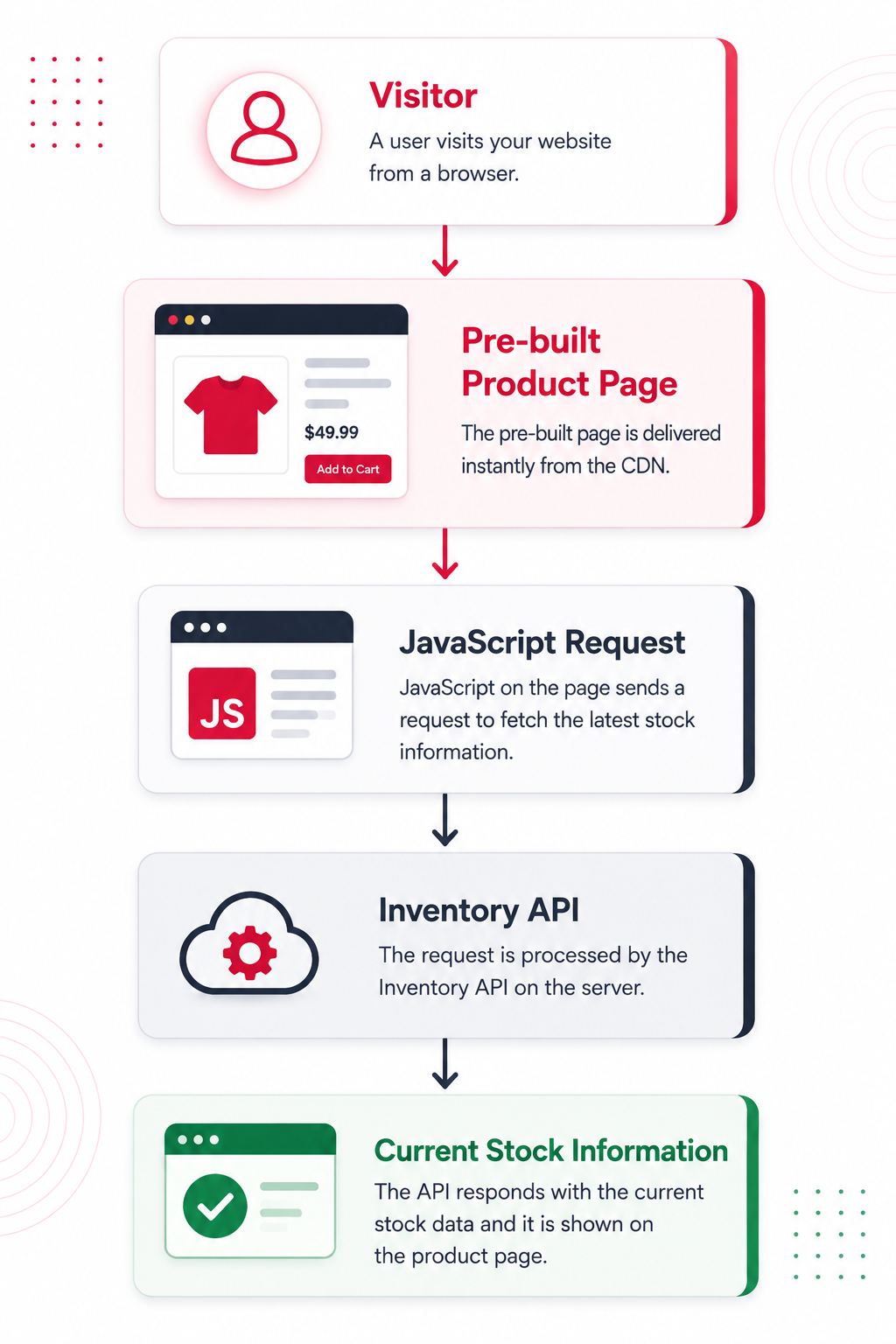
The page can remain highly optimised while still displaying updated information.
6. New Changes Trigger Another Deployment
Suppose a developer changes the website header.
They push the change to Git.
The deployment system can automatically:
- Detect the update.
- Run the build.
- Generate updated files.
- Run tests.
- Deploy the new version.
- Replace the previous production version.
This creates an efficient Git-based CI/CD workflow.
Major Features of Jamstack Development
Jamstack includes several architectural characteristics.
- Decoupled Architecture: Frontend presentation is separated from backend systems. This means developers can modify one layer without necessarily rebuilding the entire technology stack.
- Pre-rendering: Pages that do not require per-request generation can be created ahead of time. This reduces unnecessary runtime computation.
- API-First Integrations: Jamstack applications frequently use APIs for dynamic functionality. Examples include Payment APIs, Search APIs, Authentication APIs, Email APIs, Maps APIs, CMS APIs, and Database APIs.
- CDN and Edge Delivery: Pre-built files can be distributed through global networks. This helps websites deliver content efficiently to geographically distributed visitors.
- Git-Based Workflow: Git commonly acts as the central source of truth for application code. Developers can create branches, review changes, test deployments, and maintain version history.
- Automated Builds and Deployments: Changes can automatically trigger: Git Push → Build → Test → Deploy. This reduces repetitive deployment work.
- Serverless Functions: Developers can execute backend logic without managing a traditional always-running application server. For example, a serverless function could process Contact forms, Payments, Authentication callbacks, Email notifications, and Database queries.
- Headless CMS Support: Jamstack works particularly well with headless content management systems. A headless CMS focuses on managing content while providing that content through APIs. The frontend remains independent.
Major Benefits of Jamstack Development
Jamstack has become popular because its architecture can provide several practical advantages.
1. Better Website Performance
One of its biggest advantages is speed.
If a page has already been generated, the infrastructure does not need to repeatedly:
Receive Request → Run Application → Query Database → Build HTML → Return PageInstead, the process may be closer to:
Receive Request → Deliver Pre-built PageNetlify highlights pre-rendering and global delivery as central Jamstack performance advantages.
2. Improved Scalability
Imagine a product announcement suddenly generates 500,000 visitors.
A traditional application may need additional database and application-server resources.
Static assets delivered through distributed infrastructure can often handle traffic spikes more efficiently because individual requests require less computation.
Dynamic APIs still need appropriate scaling strategies, but much of the public frontend can remain inexpensive to serve.
3. Reduced Attack Surface
Traditional websites may expose:
- Application servers
- Databases
- CMS administration systems
- Plugins
- Server-side runtime environments
A pre-built public frontend can reduce some of these directly exposed components.
This does not make Jamstack automatically secure. APIs, dependencies, authentication, deployment credentials, and frontend code still require proper security controls.
However, decoupling can reduce certain categories of server-side attack surface.
4. Better Developer Experience
Modern workflows allow developers to:
- Work locally
- Use Git
- Review pull requests
- Create preview deployments
- Automate testing
- Roll back releases
- Use reusable components
This can improve collaboration between development teams.
5. Easier Technology Selection
A company does not necessarily have to use one vendor for everything.
It can select:
- Frontend: Astro
- CMS: Sanity
- Search: specialised search provider
- Payments: payment gateway
- Authentication: dedicated identity platform
- Hosting: CDN/edge platform
This provides greater architectural flexibility.
6. Potentially Lower Infrastructure Costs
Static content is generally inexpensive to distribute compared with continuously executing server-side applications for every request.
However, costs depend heavily on:
- Build frequency
- Bandwidth
- Serverless execution
- API requests
- Database usage
- Image transformation
- Third-party services
Therefore, Jamstack is not automatically cheaper in every situation.
7. SEO Advantages
Jamstack can be highly suitable for SEO when implemented properly.
Pre-rendered pages can provide search engines with complete HTML containing:
- Page title
- Meta description
- Headings
- Content
- Internal links
- Structured data
- Canonical tags
Combined with good Core Web Vitals, image optimisation, crawlable navigation, and proper technical SEO, this creates a strong foundation for organic visibility.
Jamstack vs Traditional Web Development
| Factor | Traditional Architecture | Jamstack Architecture |
|---|---|---|
| Page Generation | Frequently generated on request | Often pre-rendered |
| Frontend & Backend | Often tightly connected | Usually decoupled |
| Database | Commonly directly integrated | Often accessed through APIs |
| Hosting | Application/web server | CDN/edge-oriented |
| Scaling | May require server scaling | Static frontend scales easily |
| Deployment | Server deployment | Build + automated deployment |
| CMS | Often traditional CMS | Frequently headless CMS |
| Security Surface | Larger in many architectures | Can be reduced |
| Dynamic Features | Server-side application | APIs/functions/backend services |
Neither architecture is universally superior.
The correct choice depends on the project.
Popular Jamstack Development Tools
Modern Jamstack projects can use many different technologies.
1. Frontend Frameworks and Static Site Generators
Popular options include:
- Astro: Astro is particularly suitable for content-heavy websites and supports component-based development with strong static-generation capabilities.
- Next.js: Next.js provides several rendering strategies and can be used for static generation, hybrid rendering, and modern React applications.
- Nuxt: Nuxt provides similar capabilities for the Vue ecosystem.
- Gatsby: Gatsby played an important role in popularising modern static-site and Jamstack workflows.
- Hugo: Hugo is known for extremely fast static-site generation and is popular for documentation, blogs, and content websites.
- Eleventy: Eleventy, commonly called 11ty, provides a flexible static site generation approach without requiring a large client-side framework.
2. Headless CMS Platforms
Popular choices include:
- Contentful
- Sanity
- Strapi
- Storyblok
- DatoCMS
- Directus
Sanity, for example, provides API-first structured content that can be consumed by frameworks including Next.js, Astro, SvelteKit and Nuxt.
3. Deployment Platforms
Common options include:
- Netlify
- Vercel
- Cloudflare
- AWS
- Azure
- Google Cloud
The ideal choice depends on framework requirements, traffic, geographic audience, serverless requirements, and budget.
4. Version Control
Git remains one of the most important parts of modern Jamstack workflows.
Popular Git hosting services include GitHub, GitLab, and Bitbucket.
Real-World Examples of Jamstack Development
Jamstack can be used for much more than simple static blogs.
1. Business Website
A digital agency could create its service website using Astro.
Service pages and blog articles could be generated during deployment and distributed through a CDN.
A contact form could use a serverless function.
Result:
Fast public website + dynamic lead generation functionality.2. E-commerce Website
Consider an online store.
The architecture could be:
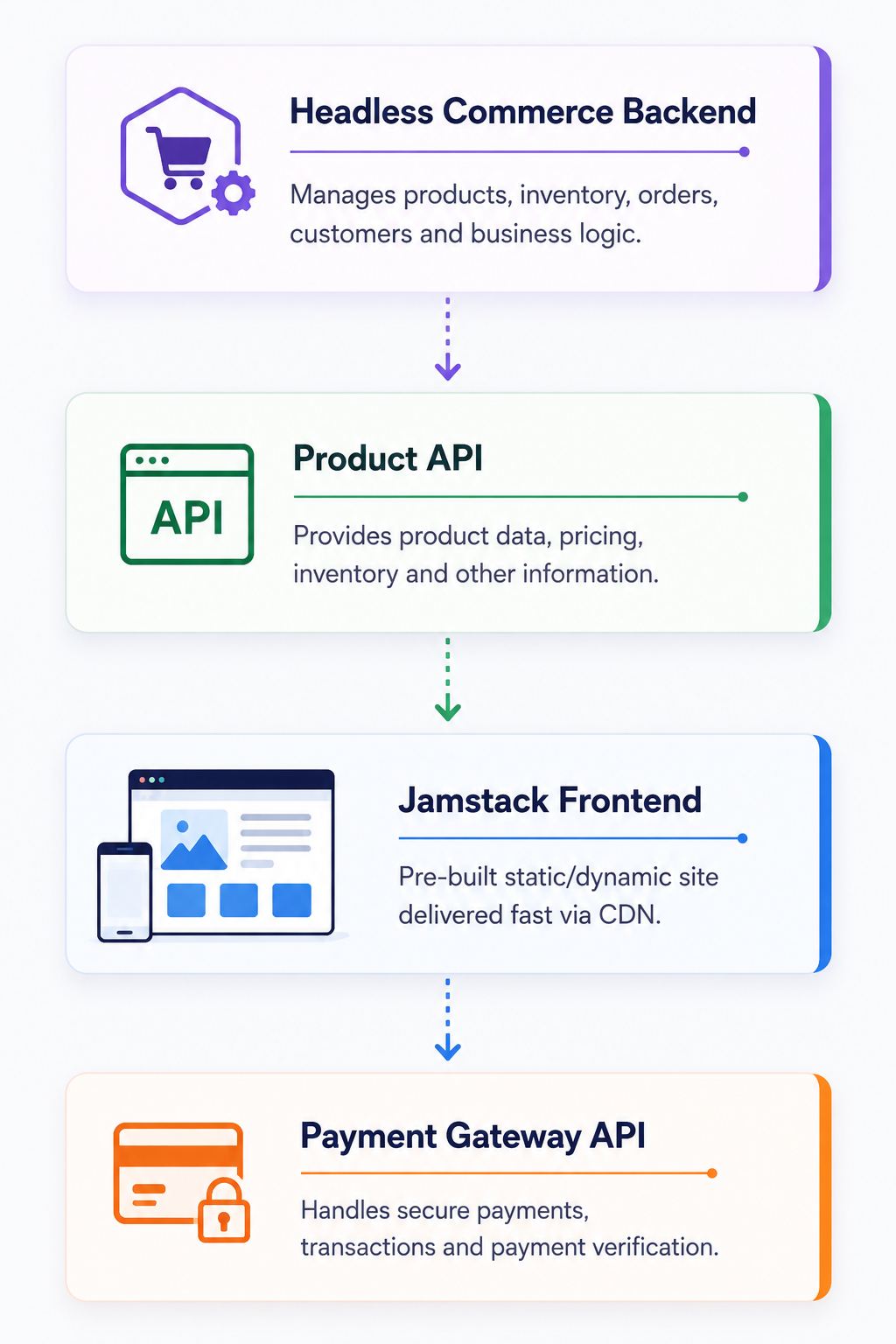
Product and category pages could be pre-rendered while inventory, checkout, account information, and payment processes remain dynamic.
3. News Website
A news organisation may have thousands of articles.
Journalists publish content using a headless CMS.
The publishing event triggers an update.
Journalist → CMS → Build/Webhook → Updated Page → CDNThis allows editorial teams to manage content while developers independently control the frontend.
4. SaaS Marketing Website
A SaaS company could pre-render:
- Homepage
- Pricing
- Features
- Documentation
- Blog
- Landing pages
The actual SaaS dashboard may remain a dynamic application.
Jamstack therefore does not have to control the entire product.
5. Documentation Portal
Jamstack is particularly suitable for documentation websites because documentation content changes less frequently than application data.
Markdown files can be stored in Git and converted into static pages automatically.
Challenges of Jamstack Development
Despite its advantages, Jamstack also introduces challenges.
1. Large Build Times
If a website contains hundreds of thousands of pages, rebuilding everything after every update can become inefficient.
Modern frameworks address this through techniques such as:
- Incremental builds
- On-demand generation
- Partial rebuilds
- Caching
- Hybrid rendering
2. API Dependency
A heavily composable website may depend on many external services.
If an important API becomes unavailable, parts of the website may stop functioning.
Developers therefore need proper:
- Error handling
- Caching
- Monitoring
- Fallbacks
- Retry logic
3. Architecture Complexity
Jamstack can simplify infrastructure while simultaneously increasing service coordination.
A project might include five or ten independent platforms.
Managing credentials, API contracts, billing, observability, and vendor relationships can become complicated.
4. Dynamic Applications Need Additional Planning
A brochure website is relatively straightforward.
A real-time banking dashboard is different.
Applications requiring highly personalised, constantly changing, transactional, or real-time data may need significant runtime infrastructure.
Jamstack can still form part of the architecture, but not every page should automatically be static.
5. Vendor Lock-In
Heavy dependence on proprietary functions or platform-specific features can make future migration difficult.
Whenever possible, developers should understand which parts of their application are portable.
Expert Tips for Implementing Jamstack Development
If you are planning a Jamstack project, the following practices can help you create a more reliable architecture.
1. Choose Jamstack for the Right Reason
Do not use Jamstack simply because it is considered modern.
First analyse:
- Website requirements
- Content frequency
- Dynamic functionality
- Traffic
- Development resources
- Budget
- SEO requirements
Architecture should solve business problems.
2. Pre-render What Makes Sense
Not everything needs to be static.
A good modern architecture may combine:
- Static generation
- Server-side rendering
- Client-side rendering
- Edge rendering
- API requests
Use the right rendering method for each page.
3. Optimise Images
Large images can destroy the performance advantage of an otherwise fast website.
Use:
- WebP/AVIF
- Responsive images
- Lazy loading
- Proper dimensions
- Image CDN where appropriate
4. Protect API Keys
Never expose private API keys in frontend JavaScript.
Use environment variables and secure server-side or serverless functions where secrets are required.
5. Monitor Third-Party Services
If your application depends on APIs, monitor their availability and performance.
6. Keep Accessibility in Mind
Performance alone does not create a good website.
Use semantic HTML, keyboard-friendly interfaces, appropriate contrast, descriptive alt text, and accessible forms.
Common Jamstack Development Mistakes
Beginners often misunderstand Jamstack and make avoidable mistakes.
1. Thinking Jamstack Means a Static Website
Jamstack websites can be dynamic.
APIs and serverless functions can provide complex functionality.
2. Using Too Much Client-Side JavaScript
Pre-rendering a website and then shipping several megabytes of unnecessary JavaScript can reduce performance.
Only send JavaScript that provides genuine value.
3. Ignoring API Security
A static frontend does not automatically secure the entire application.
Authentication, authorisation, API validation, rate limiting, and secret management remain important.
4. Choosing Too Many Services
Composable architecture can tempt developers to use a separate SaaS platform for every feature.
Each additional dependency creates:
- Cost
- Complexity
- Failure risk
- Maintenance work
Use services intentionally.
5. Ignoring Build Performance
A small project may build in seconds.
A massive website could take much longer.
Build architecture should therefore be considered before content reaches very large scale.
6. Assuming Jamstack Automatically Improves SEO
Jamstack provides an excellent technical foundation, but SEO still requires:
- Helpful content
- Keyword research
- Search intent
- Internal linking
- Schema markup
- Metadata
- Crawlability
- Backlinks
- User experience
Technology cannot replace a complete SEO strategy.
FAQs:)
A. Jamstack Development is a modern way of creating websites where the frontend is separated from backend systems. Pages can be pre-built and delivered through global infrastructure while APIs and backend services provide dynamic functionality.
A. JAM originally stood for JavaScript, APIs, and Markup. However, modern Jamstack refers more broadly to an architectural approach rather than requiring these technologies literally.
A. No. Jamstack is a web architecture, not a programming language.
A. No. Jamstack can support dynamic applications using APIs, serverless functions, databases, authentication services, and other backend technologies.
A. Yes, it can be excellent for SEO because pre-rendered pages can provide complete HTML to search engines and can achieve strong loading performance. However, proper content, metadata, structured data, internal linking, and technical SEO are still required.
A. Yes. The frontend can communicate with a database through APIs, serverless functions, backend services, or other secure data layers.
A. Yes. WordPress can be used as a headless CMS, where WordPress manages content while a separate frontend retrieves that content through APIs.
A. Yes. Jamstack can be used for e-commerce by combining a fast frontend with commerce, inventory, payment, authentication, and search APIs.
A. Jamstack can reduce certain attack surfaces because public pages do not necessarily depend on a continuously exposed application server and database. However, APIs, authentication, dependencies, permissions, and deployment infrastructure still need strong security.
A. Yes, although the terminology around modern web development has expanded toward concepts such as composable architecture, edge computing, serverless infrastructure, headless systems, and hybrid rendering. The core Jamstack principles of decoupling and optimised delivery remain highly relevant.
Conclusion:)
Jamstack Development has become an important part of modern web development because it provides a flexible way to build fast, secure, scalable, and high-performance websites and web applications. Instead of depending completely on traditional servers and databases for every page request, Jamstack allows developers to use pre-built pages, APIs, headless CMS platforms, serverless functions, CDNs, and edge technologies according to the requirements of a project.
One of the biggest advantages of Jamstack is its decoupled architecture. Developers can independently manage the frontend, content, APIs, authentication, payments, databases, and other services. This flexibility can make development, deployment, scaling, and maintenance easier, especially for modern websites that depend on multiple cloud services.
However, Jamstack is not the perfect solution for every project. Large build processes, dependency on third-party APIs, complex dynamic functionality, service management, and vendor lock-in can create additional challenges. Therefore, developers should carefully understand the project’s requirements before choosing Jamstack or any other architecture.
As technologies such as AI-assisted development, headless CMS, serverless computing, edge computing, composable architecture, and hybrid rendering continue to evolve, the principles behind Jamstack are likely to remain highly relevant in 2026 and beyond.
“Modern web development is not about using more technologies; it is about choosing the right technologies and connecting them intelligently.” — Mr Rahman
Read also:)
- What Is JSON Schema in AI? A-to-Z Guide for Beginners!
- What Is Local Coding Agent? A-to-Z Guide for Beginners!
- What Is Model Context Protocol? A-to-Z Guide for Beginners!
If you have any questions or experiences related to Jamstack Development, feel free to share them in the comments below. Thanks for reading.