This article provides a complete guide on What Is JSON Schema in AI, including its meaning, importance, history, working process, key features, benefits, challenges, popular tools, real-world examples, expert tips, common mistakes, frequently asked questions, and future trends in 2026 and beyond.
Artificial Intelligence is no longer limited to generating text, answering questions, or creating content. Modern AI systems can extract information, interact with APIs, call external tools, process business data, automate workflows, and communicate with software applications. However, these systems need information in a structured and predictable format to work reliably.
This is where JSON Schema becomes important. It provides a standard way to define how JSON data should be structured, including what fields should be available, which fields are required, what type of data each field should contain, and what rules the data must follow.
For example, instead of allowing an AI model to return customer information in different formats every time, JSON Schema can define a fixed structure containing fields such as name, email, phone number, service, budget, and status. This makes the generated information much easier for APIs, databases, CRM platforms, SaaS applications, and automation systems to process.
JSON Schema is becoming especially useful with Large Language Models (LLMs), structured outputs, function calling, AI agents, API integrations, data extraction, and AI-powered software development. As AI systems become more connected with real-world tools and business applications, the need for reliable structured communication continues to grow.
So, whether you are a beginner learning about structured AI outputs or a developer building AI-powered applications, understanding JSON Schema can help you create systems that are more predictable, organised, and easier to integrate.
Let’s explore it together.
Table of Contents
What Is JSON Schema in AI?
JSON Schema in AI is a structured definition that tells an AI system or application what format JSON data should follow, including the expected properties, data types, required fields, allowed values, and validation rules.
In simple words:
JSON tells you the data. JSON Schema tells you the rules for that data.
Consider this JSON object:
{
  "name": "Rahul Sharma",
  "age": 28,
  "city": "Dehradun"
}
A corresponding JSON Schema could look like this:
{
  "type": "object",
  "properties": {
    "name": {
      "type": "string"
    },
    "age": {
      "type": "integer"
    },
    "city": {
      "type": "string"
    }
  },
  "required": ["name", "age", "city"]
}
The schema tells a system that:
- the main value should be an object;
- Name should contain a string;
- Age should contain an integer;
- City should contain a string;
- All three properties are required.
In traditional software, JSON Schema is widely useful for validating JSON documents.
In AI systems, it has another powerful role: it can describe the structured data an AI application expects the model to generate or the arguments a tool expects to receive.
Modern AI platforms increasingly provide structured-output functionality based on JSON Schema or supported subsets of it. For example, OpenAI introduced Structured Outputs so model responses can conform to developer-supplied JSON Schemas, while Google’s Gemini documentation also supports schema-controlled structured output using a subset of JSON Schema.
JSON vs JSON Schema
Beginners frequently confuse JSON and JSON Schema, but they perform different jobs.
| JSON | JSON Schema |
|---|---|
| Stores or transfers data | Describes rules for JSON data |
| Contains actual values | Defines expected structure |
| Used as application data | Used for validation and contracts |
Example: "age": 25 | Example: "type": "integer" |
| Describes what the data is | Describes what the data should be |
For example:
1. JSON Data
{
  "product": "Laptop",
  "price": 55000
}
2. JSON Schema
{
  "type": "object",
  "properties": {
    "product": {
      "type": "string"
    },
    "price": {
      "type": "number"
    }
  },
  "required": ["product", "price"]
}
Think of JSON as a filled application form, while JSON Schema is the set of rules explaining how that form must be completed.
Why Is JSON Schema Important in AI?
Large Language Models are excellent at understanding and generating natural language.
But software applications need predictability.
Suppose you ask an AI model:
Extract customer details from this enquiry.
Without a strict output structure, the model could return:
Name: Aman
Phone: 9876543210
Service required: SEO
Another request could produce:
Customer Aman needs SEO services.
His phone number is 9876543210.
Another might return:
{
  "client": "Aman",
  "mobile": "9876543210",
  "requirement": "SEO"
}
All three responses may be understandable to a human.
But they are not structurally identical.
An application expecting:
{
  "name": "...",
  "phone": "...",
  "service": "..."
}
could face problems.
JSON Schema creates an explicit contract describing the expected structure.
This makes AI easier to integrate with:
- APIs
- databases
- CRM platforms
- Billing systems
- SaaS applications
- Automation workflows
- AI agents
- Customer-support systems
- Data pipelines
- Internal business software
It helps transform AI from something that simply generates text into something that can participate more reliably in software workflows.
A Brief History of JSON Schema
JSON itself became popular because it offered a lightweight and human-readable method for exchanging structured information between software systems.
As JSON adoption increased, developers needed a standard method to describe and validate JSON documents.
JSON Schema evolved through several drafts, including Draft 4, Draft 6, Draft 7, Draft 2019-09 and Draft 2020-12.
The official JSON Schema website currently identifies Draft 2020-12 as the current published version of the specification. The specification separates major concepts into areas such as Core and Validation.
Draft 2020-12 introduced or refined capabilities including changes around array handling, dynamic references and vocabularies.
For years, JSON Schema was mainly associated with:
- API validation
- Configuration validation
- Data contracts
- Software documentation
- Form generation
- Application development
The rise of generative AI significantly expanded its importance.
Developers increasingly needed models to produce machine-readable outputs instead of unpredictable prose.
This led AI platforms and frameworks to integrate schema-driven structured generation more deeply.
For example, OpenAI announced Structured Outputs in August 2024, providing mechanisms for model outputs to follow developer-supplied schemas.
By 2026, schema-driven AI has become an important design pattern for building production AI applications.
How Does JSON Schema Work in AI?
The basic workflow is straightforward.
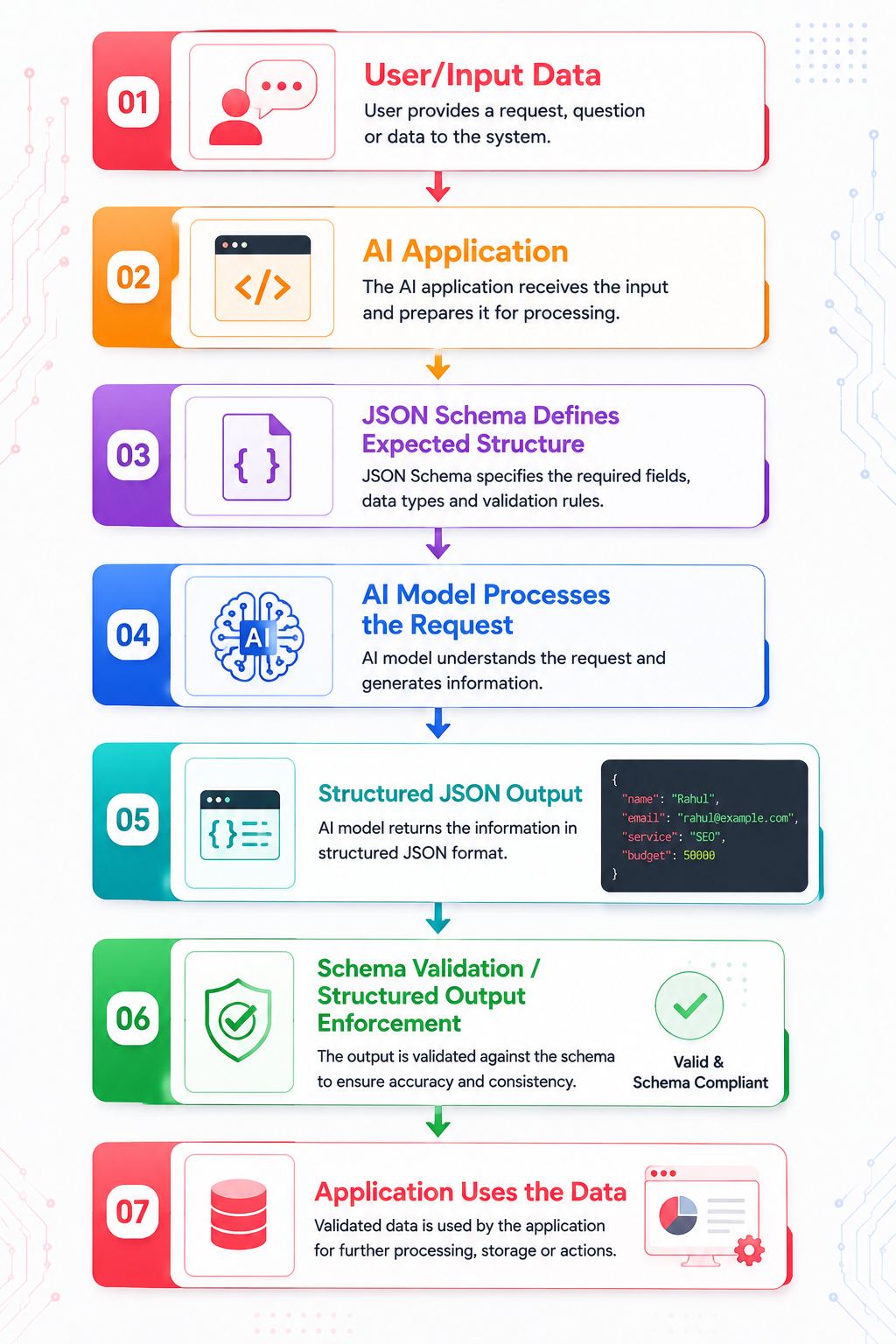
Let us understand this step by step.
1. Define the Task
First, determine exactly what information you need from the AI.
Suppose you are building an invoice-processing system.
You want to extract:
- invoice number
- customer name
- invoice date
- total amount
- currency
2. Create the JSON Schema
You could define the structure as:
{
  "type": "object",
  "properties": {
    "invoice_number": {
      "type": "string"
    },
    "customer_name": {
      "type": "string"
    },
    "invoice_date": {
      "type": "string"
    },
    "total_amount": {
      "type": "number"
    },
    "currency": {
      "type": "string"
    }
  },
  "required": [
    "invoice_number",
    "customer_name",
    "invoice_date",
    "total_amount",
    "currency"
  ]
}
Now the expected structure is clear.
3. Provide Input to the AI
The user may upload an invoice or provide text such as:
Invoice INV-2026-115
Customer: ABC Technologies
Date: 10 August 2026
Total: ₹35,400
The AI analyses the information.
4. Generate Structured Output
Instead of generating paragraphs, the system can return structured information such as:
{
  "invoice_number": "INV-2026-115",
  "customer_name": "ABC Technologies",
  "invoice_date": "2026-08-10",
  "total_amount": 35400,
  "currency": "INR"
}
5. Validate or Enforce the Structure
Depending on the AI platform and implementation, the schema may be used to constrain output generation, validate the result afterward, or both.
A traditional JSON Schema validator checks whether the generated data follows the defined rules.
If the schema requires:
"total_amount": {
  "type": "number"
}
then:
"total_amount": 35400is appropriate.
But:
"total_amount": "Thirty Five Thousand"does not meet that number requirement.
6. Send the Data to Another System
Once structured correctly, the information can be passed to:
- accounting software
- CRM
- database
- spreadsheet
- API
- ERP
- automation platform
This is one of the reasons JSON Schema is valuable in AI automation.
Important JSON Schema Keywords
Understanding a few important keywords makes JSON Schema much easier.
1. type
The type keyword specifies what kind of JSON value is expected.
Common types include:
string
number
integer
boolean
object
array
null
Example:
{
  "type": "string"
}
2. properties
properties describes the fields that may exist inside an object.
{
  "type": "object",
  "properties": {
    "name": {
      "type": "string"
    },
    "age": {
      "type": "integer"
    }
  }
}
3. required
The required keyword specifies fields that must be present.
{
  "required": ["name", "email"]
}
This is especially useful in AI workflows where downstream applications cannot operate without certain information.
4. enum
enum restricts a value to a predefined set.
{
  "type": "string",
  "enum": ["pending", "approved", "rejected"]
}
This is powerful for AI classification.
Instead of allowing an AI model to invent dozens of status labels, you can design your application around a controlled vocabulary.
5. items
items describes elements inside an array.
{
  "type": "array",
  "items": {
    "type": "string"
  }
}
Example valid data:
[
  "SEO",
  "Web Development",
  "Social Media Marketing"
]
6. description
Descriptions explain the intended meaning of properties.
{
  "type": "string",
  "description": "The customer's full name"
}
Descriptions can be particularly useful in AI implementations because they provide semantic context about what information belongs in each field.
7. minimum and maximum
These can define numeric boundaries.
{
  "type": "integer",
  "minimum": 1,
  "maximum": 5
}
This could be useful for a customer rating field.
8. minLength and maxLength
These control string length.
{
  "type": "string",
  "minLength": 2,
  "maxLength": 100
}
9. pattern
A regular expression can describe a required string pattern.
{
  "type": "string",
  "pattern": "^[A-Z]{3}-[0-9]+$"
}
This may help validate structured identifiers.
10. additionalProperties
This keyword can control whether properties beyond those explicitly defined are allowed.
{
  "type": "object",
  "properties": {
    "name": {
      "type": "string"
    }
  },
  "required": ["name"],
  "additionalProperties": false
}
This can be useful when an application requires a tightly controlled response structure.
Key Features of JSON Schema in AI
JSON Schema provides several useful capabilities for AI developers.
- Structured Data Definition: It creates an explicit description of what the output should contain.
- Data Type Control: Developers can define whether values should be strings, numbers, integers, arrays, objects, booleans or null values.
- Required Field Definition: Critical properties can be made mandatory.
- Arrays: AI systems can return structured lists such as products, tasks, recommendations or extracted entities.
- Reusable Definitions: JSON Schema supports mechanisms for reusable schema components and references, helping developers manage larger structures.
- Machine Readability: The schema can be processed by software rather than existing only as documentation for humans.
- Documentation: A well-designed schema also helps developers understand the structure and meaning of the expected data.
Major Benefits of JSON Schema in AI
JSON Schema offers several important benefits for modern AI applications by making model-generated data more structured, predictable, and easier for software systems to process.
1. More Predictable AI Output
One of the biggest advantages is predictability.
Without structured output, developers may have to handle numerous possible response formats.
Schema-driven generation greatly reduces this uncertainty.
2. Easier API Integration
APIs depend on clearly structured information.
JSON Schema allows developers to describe expected fields precisely.
An AI system can therefore participate more reliably in API-driven workflows.
3. Better AI Agents
AI agents often need to select and invoke tools.
For example:
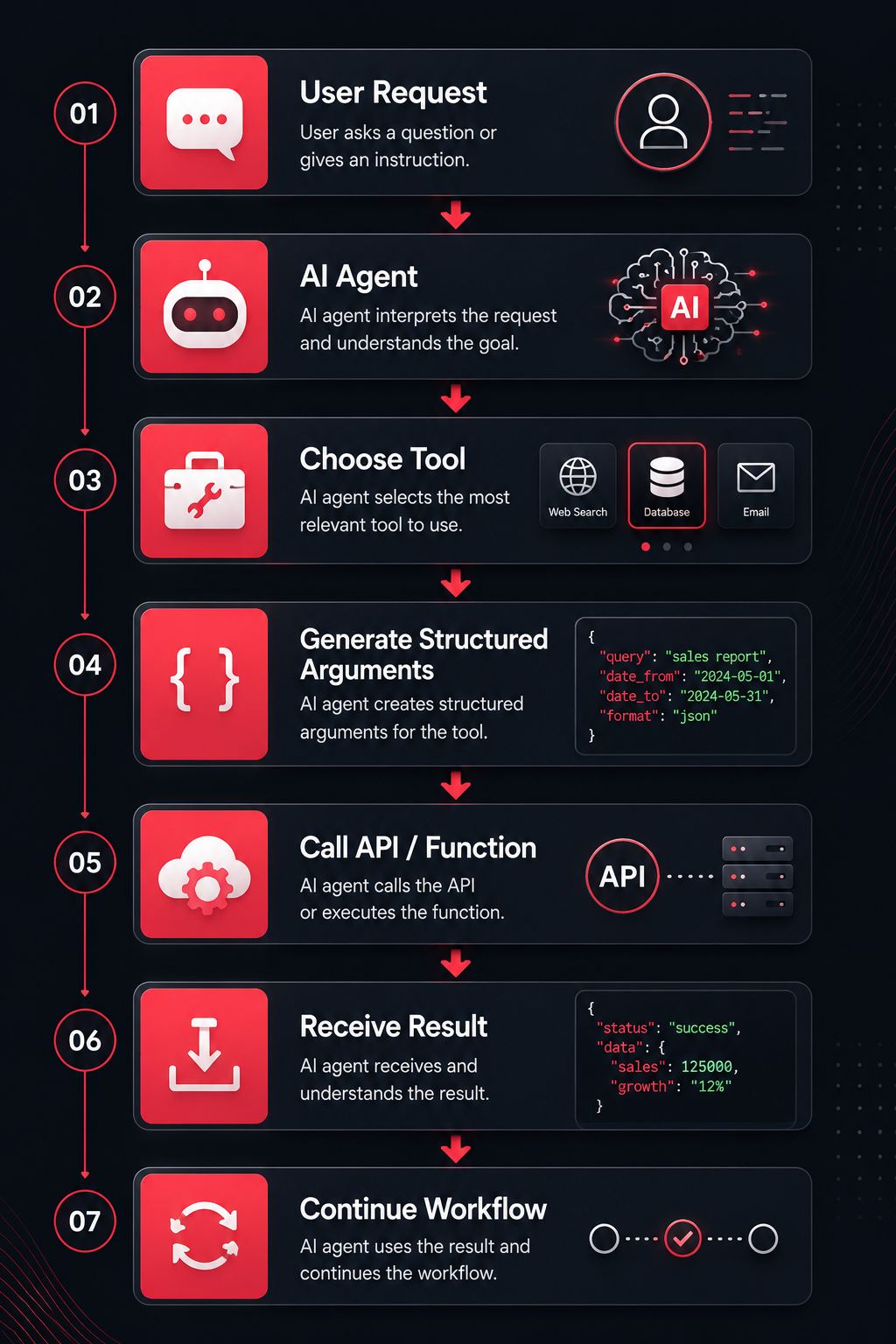
Schema definitions help establish what arguments the tool accepts.
4. Reduced Parsing Complexity
Without structured output, developers often write code to extract information from prose.
For example:
Customer name: Rahul
Budget: ₹50,000
Service: SEO
Parsing such text reliably can become difficult.
Structured output provides:
{
  "customer_name": "Rahul",
  "budget": 50000,
  "service": "SEO"
}
which applications can consume directly.
5. Better Data Validation
Schema rules can identify structurally invalid data before it enters another system.
This is valuable for:
- financial applications
- CRM systems
- databases
- e-commerce
- SaaS applications
- enterprise automation
6. Improved Developer Experience
Developers know exactly what shape of data to expect.
That improves:
- debugging
- testing
- documentation
- maintenance
- team collaboration
7. Safer Automation Boundaries
Structured data can create clearer boundaries between an AI model and the software performing an action.
For example, an agent might produce:
{
  "action": "create_ticket",
  "priority": "high",
  "department": "billing"
}
The application can validate these fields before performing the action.
However, schema validation alone does not guarantee that the action itself is correct or safe. Business rules and authorisation checks are still required.
JSON Schema vs JSON Mode vs Structured Outputs
These concepts should not be treated as identical.
| Feature | Main Purpose |
|---|---|
| JSON | Data representation format |
| JSON Schema | Describes rules and structure for JSON |
| JSON Mode | Encourages/guarantees syntactically valid JSON depending on platform |
| Structured Outputs | Constrains output toward a specified structure/schema |
A critical distinction is that valid JSON does not automatically mean schema-valid JSON.
For example:
{
  "random": "hello"
}
is valid JSON.
But if your application expects:
{
  "name": "Rahul",
  "age": 30
}
the first object is useless for that particular contract.
OpenAI specifically distinguished JSON mode from Structured Outputs when introducing the latter: JSON mode improved the ability to return valid JSON, while Structured Outputs was designed to match a developer-supplied schema.
JSON Schema and AI Function Calling
Function calling is one of the most important applications of structured definitions.
Suppose an AI assistant can call:
get_weather()The function needs:
- city
- country
- unit
A schema could describe its arguments:
{
  "type": "object",
  "properties": {
    "city": {
      "type": "string"
    },
    "country": {
      "type": "string"
    },
    "unit": {
      "type": "string",
      "enum": ["celsius", "fahrenheit"]
    }
  },
  "required": ["city", "country", "unit"]
}
If the user asks:
What is the weather in Dehradun?
the AI application can create structured arguments such as:
{
  "city": "Dehradun",
  "country": "India",
  "unit": "celsius"
}
The software can then call the weather service.
This architecture is fundamental to many modern AI assistants and agentic applications.
JSON Schema in AI Agents
AI agents go beyond answering questions.
They may:
- understand a goal;
- select a tool;
- generate arguments;
- execute an action;
- inspect the result;
- decide what to do next.
JSON-based schemas provide clear contracts between many of these components.
Consider a support agent.
Customer:
“My payment was deducted but my subscription is not active.”The AI could generate:
{
  "intent": "billing_issue",
  "priority": "high",
  "action": "create_support_ticket"
}
A workflow engine could then process these values.
This makes the boundary between language understanding and software execution much clearer.
Real-World Examples of JSON Schema in AI
The practical value of JSON Schema becomes clearer when we look at how it is used in real-world AI applications and automated workflows.
1. Resume Parsing
An AI recruitment application can extract:
{
  "candidate_name": "Aman Kumar",
  "skills": [
    "Python",
    "JavaScript",
    "Machine Learning"
  ],
  "experience_years": 4
}
This information can then be stored in an ATS or recruitment database.
2. Invoice Processing
AI can extract:
{
  "invoice_number": "INV-1052",
  "vendor": "ABC Technologies",
  "amount": 50000,
  "currency": "INR"
}
The schema ensures the application knows which properties to expect.
3. Lead Qualification
A marketing AI could convert an enquiry into:
{
  "name": "Rohit",
  "service": "SEO",
  "budget": 30000,
  "lead_quality": "high"
}
The information can then be automatically sent to a CRM.
4. E-commerce Product Extraction
AI can convert product descriptions into:
{
  "product_name": "Wireless Headphones",
  "category": "Electronics",
  "price": 2999,
  "in_stock": true
}
5. Customer Support Classification
A customer message can become:
{
  "category": "refund",
  "sentiment": "negative",
  "priority": "urgent"
}
The support system can route the ticket accordingly.
6. Content Analysis
A content intelligence system might return:
{
  "topic": "Artificial Intelligence",
  "content_type": "blog",
  "audience": "beginners",
  "keywords": [
    "AI",
    "machine learning",
    "automation"
  ]
}
Popular Tools and Technologies for JSON Schema in AI
JSON Schema is supported across a broad ecosystem.
- JSON Schema Official Ecosystem: The official JSON Schema website provides specifications, documentation and learning resources. Draft 2020-12 remains the current published specification listed by the project.
- OpenAI Structured Outputs: OpenAI provides structured-output functionality designed around developer-supplied schemas. OpenAI has documented uses including structured data extraction, function calling and dynamically generated UI structures.
- Google Gemini: OpenAI provides structuredGoogle Gemini API supports structured outputs using a subset of JSON Schema, including common types such as objects, arrays, strings, integers, numbers, booleans and null. (Google AI for Developers)utput functionality designed around developer-supplied schemas. OpenAI has documented uses including structured data extraction, function calling and dynamically generated UI structures.
- Pydantic: Pydantic is widely used in Python for data validation and typed models and can generate JSON Schema representations from models.
- Zod: Zod is popular in TypeScript development for defining and validating typed schemas.
- AJV: Ajv JSON Schema Validator is a popular JavaScript JSON Schema validator. The exact JSON Schema keywords supported in an AI provider’s structured-output feature may differ from the full JSON Schema specification, so developers should always check provider-specific documentation before implementation.
Challenges and Limitations of JSON Schema in AI
JSON Schema is powerful, but it does not solve every AI reliability problem.
1. Complex Schemas Can Become Difficult
Large enterprise applications may have deeply nested objects and many validation rules.
Such schemas can become difficult to:
- read
- test
- maintain
- version
- debug
Keeping schemas modular can help.
2. Not Every AI Platform Supports the Full Specification
This is extremely important.
A platform may say that it supports JSON Schema while actually supporting only a subset of the specification.
For example, OpenAI has documented that Structured Outputs supports a subset of JSON Schema, and Google’s Gemini documentation similarly states that its structured output mode supports a subset.
Therefore, never assume that every JSON Schema keyword will work identically across AI providers.
3. Correct Structure Does Not Mean Correct Information
Suppose an AI returns:
{
  "capital_of_india": "Mumbai"
}
The JSON may perfectly match the schema.
But the information is factually wrong.
JSON Schema validates structure and constraints, not factual truth.
Developers still need:
- grounding
- data verification
- business rules
- source validation
- human review where necessary
4. Missing Information
Sometimes the input does not contain a required value.
If your schema requires:
name
email
phone
budget
but the source document contains no budget, the system needs a defined strategy.
Possible approaches include:
- allow
null; - make the property optional;
- return a separate missing-fields list;
- ask the user for the missing information.
5. Schema Evolution
Applications change.
Today you may need:
{
  "name": "...",
  "email": "..."
}
Tomorrow you may need:
{
  "name": "...",
  "email": "...",
  "company": "...",
  "lead_source": "..."
}
Production systems therefore need proper schema versioning and backward-compatibility planning.
Expert Tips for Implementing JSON Schema in AI
Implementing JSON Schema effectively requires more than simply defining a few properties. The schema should be designed around the needs of both the AI model and the downstream application.
1. Start With the Smallest Useful Schema
Do not create a 100-field schema if the workflow requires only 10 fields.
Smaller schemas are easier to understand and maintain.
2. Use Clear Property Names
Prefer:
"customer_email"instead of:
"ce"Clear naming reduces ambiguity.
3. Add Useful Descriptions
For example:
{
  "type": "string",
  "description": "The customer's business email address"
}
Descriptions can make the intended semantics clearer.
4. Use Enums for Controlled Categories
Instead of allowing arbitrary priority values:
{
  "type": "string",
  "enum": ["low", "medium", "high", "urgent"]
}
5. Decide How Missing Data Should Be Represented
Do not force the AI to invent information.
Design explicitly for unknown or unavailable values.
6. Validate at Application Boundaries
Even when your AI provider offers schema-constrained generation, validation and business logic remain useful before data triggers important downstream actions.
7. Separate Structure Validation From Business Validation
Schema validation may confirm:
{
  "discount": 90
}
is a valid number.
Your business rules may still prohibit discounts above 50%.
These are separate concerns.
8. Test Edge Cases
Test scenarios involving:
- missing fields
- unexpected values
- empty arrays
- long strings
- null values
- multilingual input
- malformed source data
- ambiguous requests
9. Version Important Schemas
For production APIs and agents, consider clear versions such as:
lead_schema_v1
lead_schema_v2
invoice_schema_v3
10. Check Provider Compatibility
Always compare your schema with the structured-output limitations of the model or platform you are using.
Common JSON Schema Mistakes in AI
While JSON Schema can make AI outputs more structured and reliable, small implementation mistakes can still cause validation errors, integration problems, and unexpected application behaviour.
- Making Every Property Required: Not every piece of information is always available. Making everything mandatory can encourage poor handling of incomplete source data.
- Using Vague Field Names: Names such as: value, data, info, and thing. create ambiguity. Use semantic names instead.
- Confusing Valid JSON With Schema Compliance: A response can be valid JSON but violate your schema. This distinction is fundamental.
- Assuming Schema Validation Prevents Hallucinations: It does not. A model can produce perfectly structured misinformation.
- Ignoring additional Properties: If your workflow requires strict keys, explicitly decide how unexpected properties should be treated.
- Overengineering the First Version: Start with the simplest contract that solves the actual problem.
- Ignoring Schema Versions: Changing a production schema without considering older clients can break applications.
- Skipping Application-Level Validation: AI-generated data should still pass relevant business and security rules before sensitive actions are executed.
Best Practices for Production AI Systems
A robust implementation may use multiple layers:
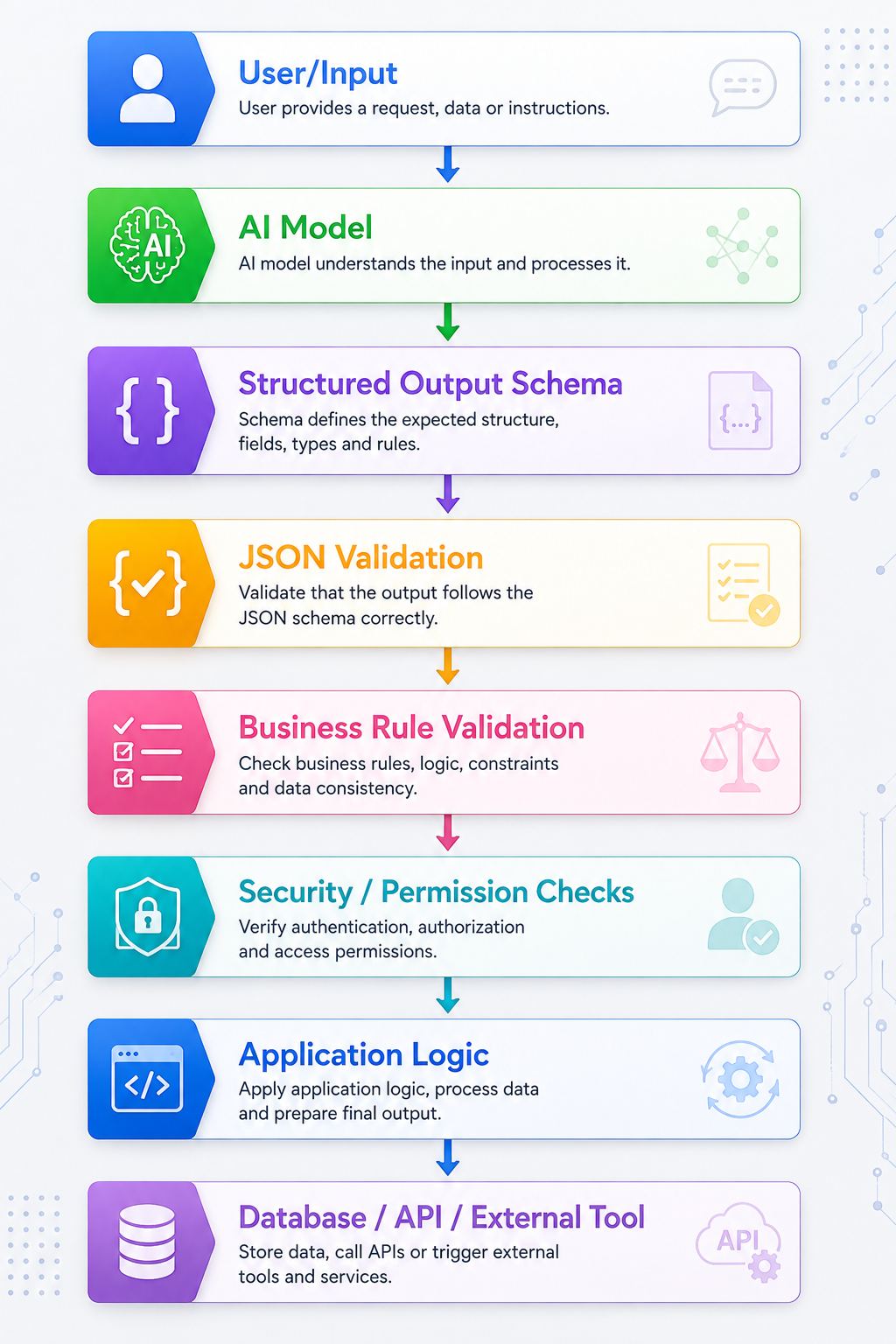
This layered architecture is more reliable than assuming JSON Schema alone can guarantee safe or correct behaviour.
FAQs:)
A. JSON Schema in AI is a structured definition used to describe the expected format, properties, data types and validation rules of JSON data generated or consumed by an AI application.
A. It helps AI applications exchange structured and predictable information with APIs, databases, functions, tools, agents and other software.
A. No. JSON contains actual data, while JSON Schema defines the rules that JSON data should follow.
A. Structured output means an AI model returns information according to a predefined machine-readable structure instead of unrestricted natural-language text.
A. No. JSON Schema can validate structure and certain constraints, but it cannot guarantee that the information inside the fields is factually correct.
A. Yes. Schemas are highly useful for defining tool arguments, structured responses and contracts between components of agentic systems.
A. Yes. The required keyword specifies which properties must exist in an object.
A. No. Some AI platforms support only selected parts of the JSON Schema specification. Developers should check the provider’s current documentation before implementation.
A. The official JSON Schema project currently lists Draft 2020-12 as its current published version.
A. Yes. A JSON Schema validator can check whether generated JSON satisfies the schema’s supported structural and validation rules.
A. Yes. As AI systems become more integrated with software, tools, APIs and autonomous workflows, structured interfaces are becoming increasingly important.
Conclusion:)
JSON Schema is becoming an important part of modern AI development because it provides a structured way for AI models, applications, APIs, databases, tools, and automation systems to exchange information in a predictable format.
Instead of depending on AI-generated text that may change its format from one response to another, developers can use JSON Schema to define required fields, data types, allowed values, arrays, objects, and validation rules. This makes it especially useful for structured outputs, function calling, AI agents, data extraction, API integrations, and business automation.
However, JSON Schema should not be considered a complete solution for AI accuracy. A response can follow the correct structure while still containing incorrect information. For this reason, developers should combine JSON Schema with data validation, business rules, security checks, reliable data sources, and human review wherever necessary.
As AI systems become more capable of interacting with real-world software and performing automated actions, structured communication will become even more important. In 2026 and beyond, JSON Schema is likely to remain a valuable building block for creating reliable, scalable, and production-ready AI applications.
“AI can understand the request, but structure helps software understand the response.” — Mr Rahman
If you are planning to build AI-powered software, agents, APIs, or automated workflows, learning how to design and use JSON Schema can help you move from simple AI-generated responses to structured, reliable, and application-ready AI outputs.
Read also:)
- What Is Local Coding Agent? A-to-Z Guide for Beginners!
- What Is Model Context Protocol? A-to-Z Guide for Beginners!
- What Is Unified Communications? A Complete Guide for Beginners!
I hope you found this article on What Is JSON Schema in AI helpful. If you have any questions, experiences, or suggestions, feel free to share them in the comments below. Thanks for reading!
Good explanation of why JSON Schema improves structure without guaranteeing factual accuracy. I especially liked the point about combining schema validation with business rules, security checks, and application logic. It also made me think about creative AI tools like PicWav (https://picwav.com/), where a clear and predictable workflow around user inputs can be just as important as the generated result itself.